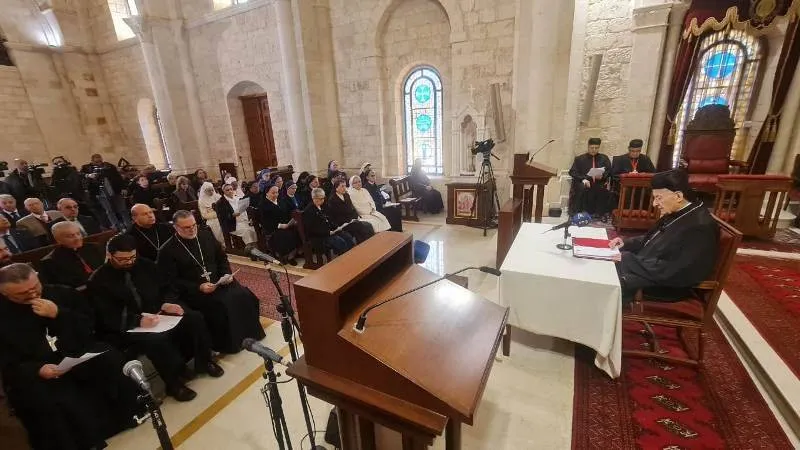
Maronite Patriarch Bechara Al-Rahi has directly held Hezbollah and Iran responsible for the deteriorating conditions in Lebanon, stating that the "violation of Lebanon's sovereignty by Iran through Hezbollah" has led the country into a dangerous path, exacerbating the war and its political and humanitarian repercussions, alongside Israeli attacks on Lebanese territory.
Al-Rahi's remarks came during his Easter message, where he stressed the need to restore sovereignty and free political decision-making. He stated: "The war imposed on Lebanon by Hezbollah and Israel has left victims, destruction, and displacement, leading to an escalation of the internal displacement crisis from bombarded areas; this has placed significant pressure on receiving areas, particularly hospitals that are facing crises in their capacity, operational capabilities, and securing supplies and medications."
Details of the Event
Al-Rahi called for "the protection of civilians and ensuring the unobstructed delivery of humanitarian aid," pointing out that opening humanitarian corridors is not just a humanitarian demand but an international legal obligation that prohibits the siege or isolation of civilians. In the context of his vision for overcoming the crisis, he affirmed that "national resurrection begins from within, from a person who decides to rise, to cling to the truth, and to work for the common good," emphasizing that Lebanon can rise again if there is the will, and that restoring the state requires a genuine commitment to national responsibility.
He also confirmed that "Lebanon is committed to the speech of the presidential oath, the ministerial statement, and the decisions of the Lebanese government, as well as the relevant UN Security Council resolutions 1559, 1680, and 1701," describing them as the entry point for restoring stability and asserting the authority of the state.
Background & Context
Al-Rahi's statements come at a time when Lebanon is suffering from accumulated crises, including economic, political, and social conditions, as citizens live under the pressure of multiple crises. Political tensions in Lebanon have intensified following the escalation of Israeli attacks, leading to a worsening humanitarian situation in the country.
Historically, Lebanon has witnessed multiple conflicts, with Hezbollah playing a prominent role in regional disputes, leading to polarized opinions about its role and influence on Lebanese sovereignty. Additionally, the relations between Lebanon and Iran have significantly impacted the political landscape in the country, with some considering that Iran seeks to enhance its influence by supporting Hezbollah.
Impact & Consequences
Al-Rahi's statements indicate that the situation in Lebanon may deteriorate further if effective steps are not taken to restore sovereignty and political decision-making. The continuation of Israeli attacks could exacerbate humanitarian crises, increasing the suffering of Lebanese citizens.
These statements are expected to affect relations between Lebanon and Iran and may prompt the international community to reconsider its policies towards Lebanon. The situation may also open the door for further external interventions, complicating conditions in the country.
Regional Significance
The situation in Lebanon is part of a broader regional landscape, where crises in Lebanon intersect with those in other countries such as Syria and Palestine. The continuation of tensions in Lebanon could affect the stability of the region as a whole and increase the likelihood of military escalation.
In this context, Arab countries must adopt effective policies to support Lebanon in facing current challenges and work towards enhancing stability in the region. The multiple crises facing Lebanon represent a challenge not only for the Lebanese but for the entire Arab world.
In conclusion, the situation in Lebanon remains under scrutiny, as the current conditions require a concerted effort from both local and international actors to find root solutions to the accumulated crises and ensure the restoration of sovereignty and free political decision-making.