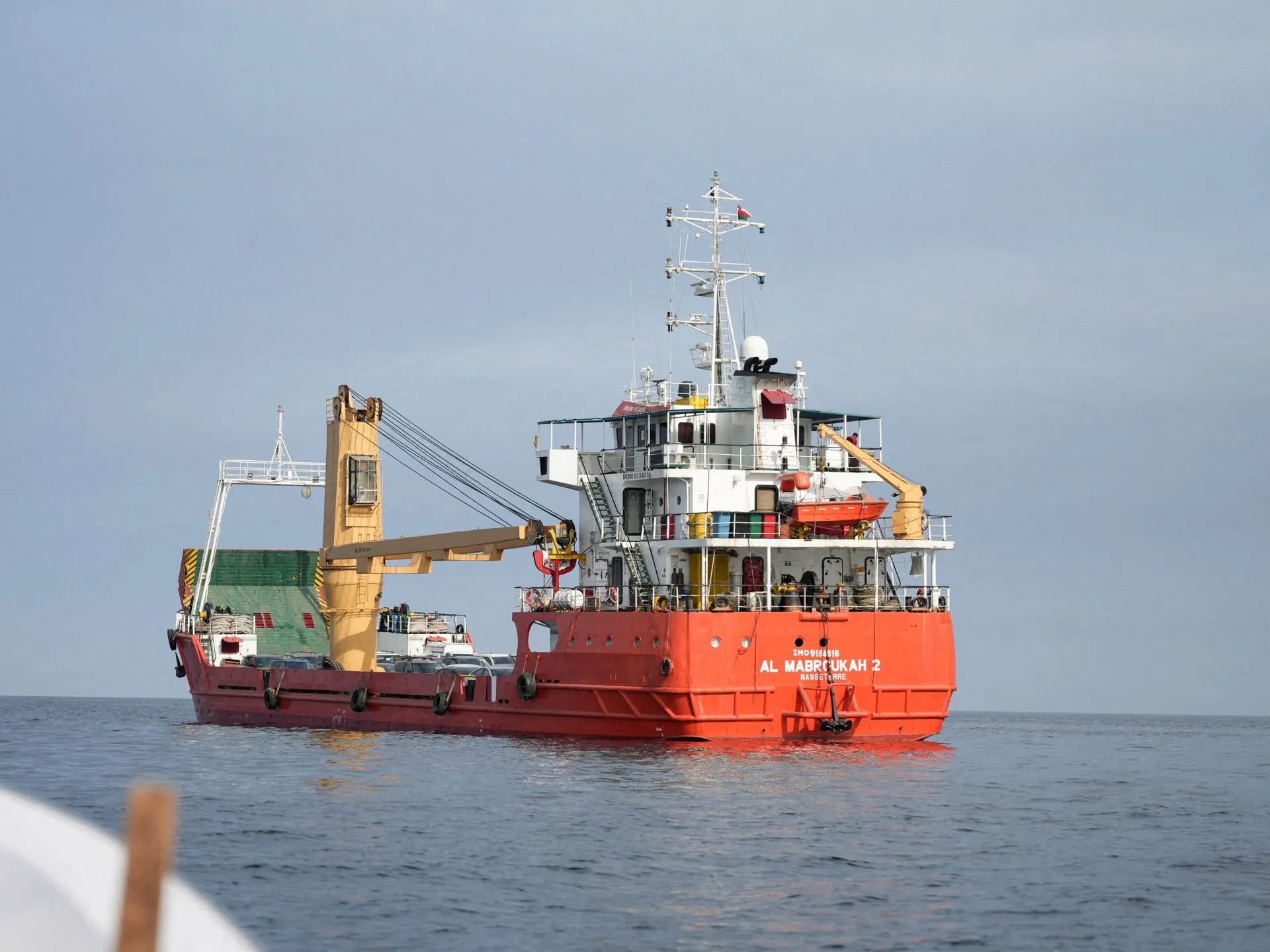
Major General Mohamed Abdel Wahid, a military expert, disclosed that the United States is employing a 'smart blockade' strategy in the Strait of Hormuz, which relies on technology and artificial intelligence to monitor the suspicious behavior of small vessels rather than executing a costly traditional blockade.
Abdel Wahid added during a military analysis segment that the United States is confronted with two main challenges in controlling the strait, which stretches over 167 kilometers and sees thousands of small boats, including fishing vessels and oil tankers, passing through.
Details of the Situation
He pointed out that the U.S. military is identifying the 'radar signature' of each small vessel, tracking their movement and activity through artificial intelligence programs. This technology enables the United States to monitor maritime activities more effectively.
On an interactive map, journalist Mahmoud Al-Kin explained that the U.S. strike force, represented by the aircraft carrier 'Abraham Lincoln,' is stationed 700 kilometers from the Iranian coast in the Arabian Sea, along with destroyers deployed in the area and drone groups.
Drones, such as the 'MQ-4' and 'P-8', conduct continuous surveillance operations in the Gulf and the Strait of Hormuz, transmitting data for analysis through artificial intelligence as part of what is known as 'dynamic targeting.'
Context and Background
In a related context, Al-Kin clarified that Iranian tactics rely on fast boats to implement a 'numerical flooding' strategy aimed at confusing U.S. forces, in addition to mine-laying operations. The U.S. military has vowed to intercept any maritime vessel attempting to lay mines using dynamic targeting by monitoring suspicious activities such as shutting down the Automatic Identification System (AIS) or unusual movements.
Regarding the interpretation of international law, Abdel Wahid noted that both parties interpret the rules according to their interests, with Iran considering the Strait of Hormuz as its territorial waters, while the United States emphasizes the right of ships to transit.
Consequences and Impact
Attacking Iranian boats is seen as an aggression that could provoke Tehran to retaliate, threatening to collapse the agreed-upon rules of engagement between the two sides. On the other hand, the military expert describes the ongoing conflict as being 'below the threshold of total war,' a war of attrition with red lines, but the United States occasionally attempts to breach these rules to test Iran's response capability.
Abdel Wahid anticipated that U.S. forces would detain 'suspicious boats' or push them back using 'the right of visit and search,' by calling them on the radio before employing deadly force.
Impact on the Arab Region
Tactically, Abdel Wahid highlighted the difficulty of fully controlling the strait despite U.S. technological superiority, as vast areas stretching over thousands of kilometers, the pitch-black darkness of night, and the rugged terrain of islands all allow smuggled vessels to hide and maneuver through alternative routes close to the Iranian coast.
He considered the current blockade to be a 'partial blockade' that achieves only relative results, and that absolute control over all vessels seems impossible given the complexity of the maritime environment. It is worth noting that the U.S. maritime blockade against Iran began on April 13, 2026, and since then, U.S. forces have boarded several Iranian vessels and redirected dozens of ships at sea carrying cargo to or from Iran, according to the U.S. Department of Defense.