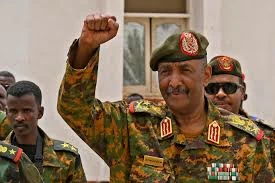
Sudan's Transitional Sovereignty Council President, Abdel Fattah Al-Burhan, asserted that the Sudanese people hold the fundamental right to determine their fate and choose their leaders. This statement was made during his speech marking the anniversaries of the April 6 uprisings in 1985 and 2019, where he highlighted the armed forces' commitment to achieving the desired democratic transformation.
In his address, Al-Burhan noted that the leadership of the armed forces responded to the people's demands in 1985, and this was repeated on April 6, 2019. He stressed the importance of continuing the construction journey that began during these historical moments. He also pointed out the steadfastness of the Sudanese people alongside the armed forces in the battle for dignity against rebellion on April 15, 2023.
Details of the Event
Al-Burhan stated that the people turn to the armed forces when circumstances become dire, reflecting the close relationship between the populace and the military. He considered these moments as bright points in the history of the armed forces, emphasizing that the Sudanese people do not accept humiliation or oppression and will not stand idly by in the face of tyranny.
He reaffirmed that the armed forces are committed to completing the construction journey that began in 1985 and 2019, stressing the commitment to democratic transformation, where the people alone have the right to determine their fate and choose their rulers through means they deem appropriate.
Background & Context
Sudan's history is filled with political and social challenges, having witnessed several popular uprisings against ruling regimes. The April 1985 uprising led to the overthrow of President Jaafar Nimeiri, while the 2019 uprising resulted in the ousting of President Omar al-Bashir after three decades in power. These events marked significant turning points in modern Sudan's history.
The Sudanese armed forces are currently seeking to enhance their role in the political process, with a decision made to form a new Chief of Staff, led by Lieutenant General Yasser Abdel Rahman Hassan Al-Atta, reflecting structural changes within the military.
Impact & Consequences
Al-Burhan's statements serve as a confirmation of the move towards strengthening democracy in Sudan, which may help restore trust between the people and the military. Additionally, the formation of the new Chief of Staff may reflect the military leadership's desire to restructure the armed forces to align more closely with the people's aspirations.
This transformation could positively impact the security and political situation in the country, enhancing Sudan's stability amid current challenges. However, questions remain about how to achieve this democratic transformation under the prevailing circumstances.
Regional Significance
Sudan's experience in democratic transformation is seen as a model for the Arab region, where many countries are facing similar political crises. Sudan's success in achieving political stability could inspire other peoples in the region to seek their rights to self-determination.
In conclusion, all eyes remain on Sudan to monitor the developments in the political situation and the capacity of the people and the armed forces to achieve the desired democratic transformation.