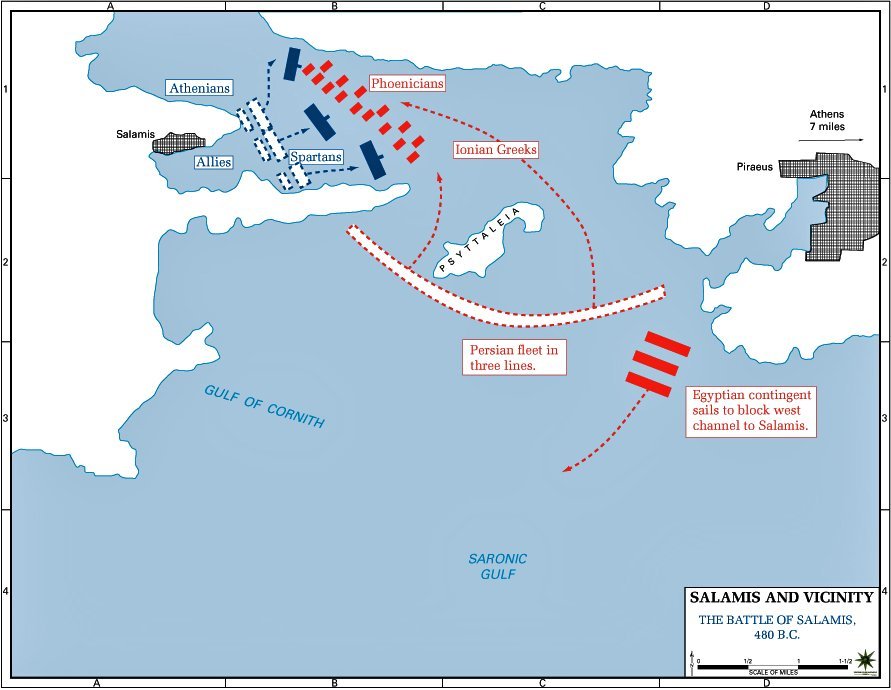
The article explores the Persian defeat at Salamis in 480 BC, attributing it largely to hubris, as highlighted by the playwright Aeschylus. This historical event is depicted in Aeschylus's play 'The Persians', reflecting his personal experience in the war against Persia.
Aeschylus, the renowned Greek poet, participated in the Greek resistance against the Persians as an infantryman at the Battle of Marathon. A decade later, he returned to be part of the Greek victory at Salamis. This personal experience inspired him to write his play, which is considered one of the most significant literary works addressing contemporary historical events.
Details of the Event
In 480 BC, the Strait of Salamis witnessed a decisive battle between the Greek and Persian fleets. The Persian forces were led by King Xerxes, who sought to expand his empire at the expense of Greek cities. However, the Greek forces, led by the Athenians, achieved a significant victory, contributing to a shift in the course of history.
Aeschylus, who was present at that battle, used his personal experience to write his play 'The Persians', which is one of the earliest works to directly address historical events. Through this play, Aeschylus aimed to illustrate how hubris and arrogance can lead to defeat, a lesson that remains relevant today.
Background & Context
The roots of the conflict between Greece and Persia trace back to the Persian attempts to dominate Greek cities. These conflicts began in the 6th century BC, as the Persians sought to expand their influence in the region. Over time, these disputes evolved into a series of wars known as the Persian Wars.
During this period, Greece consisted of a collection of independent city-states, each striving to maintain its independence. This competition among Greek cities, coupled with the Persian threat, contributed to shaping the cultural and political identity of ancient Greece.
Impact & Consequences
The Greek victory at Salamis had a profound impact on the course of history. It not only ended the Persian threat but also fostered unity among the Greek city-states. This victory inspired many philosophers and thinkers, becoming a symbol of resistance against oppression.
Furthermore, this battle contributed to the enhancement of Greek culture, as Greece became a center for thought and art. The plays written by Aeschylus and his contemporaries became part of the cultural heritage that influenced world literature.
Regional Significance
Although the events at Salamis pertain to Greece and Persia, they have far-reaching implications for the Arab region. The ancient conflicts between major powers in the area shaped the political and cultural history of many Arab nations.
Moreover, the lessons learned from this battle, such as the importance of unity and cooperation in facing challenges, remain relevant in the modern Arab context. History often repeats itself, and the lessons learned by the Greeks in the past can be beneficial for Arab nations in addressing current challenges.
In conclusion, the story of the Persian defeat at Salamis serves as a timeless lesson about hubris and its impact on the fate of nations. Understanding these historical events can help shape a more enlightened future vision.