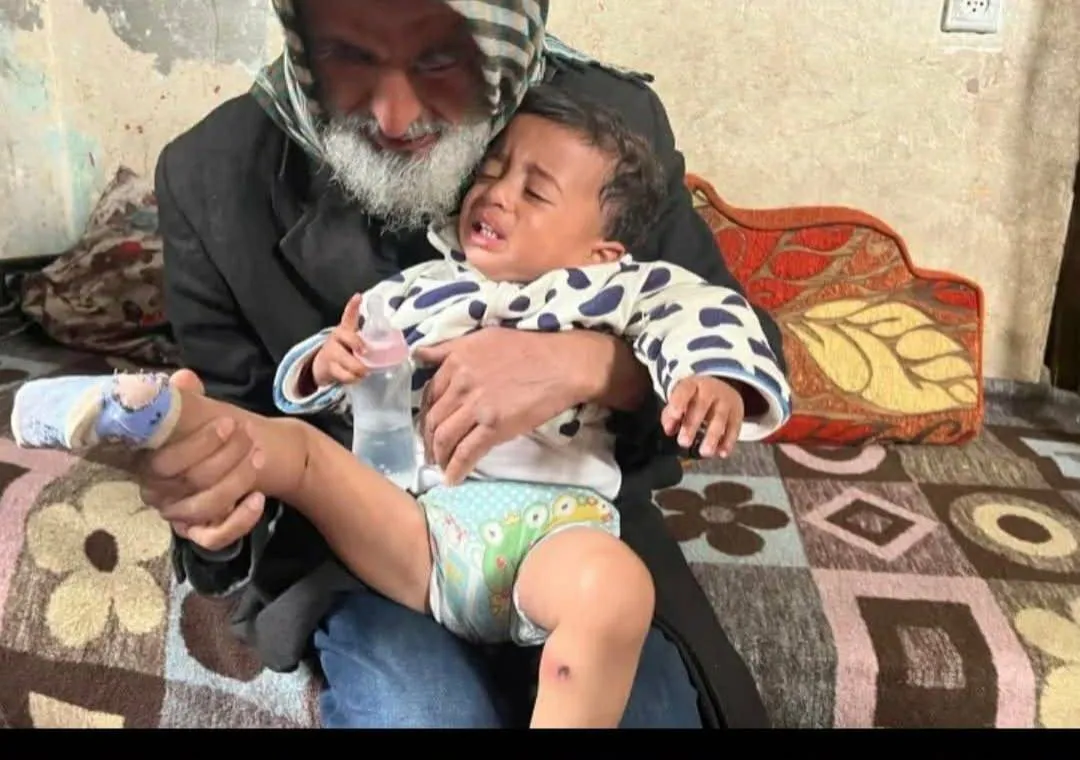
In a heartbreaking incident that has sparked widespread reactions, the Palestinian infant Jwad Osama Abu Nassar, aged 18 months, was arrested and tortured by Israeli occupation forces. The incident took place on March 19, 2026, near the eastern area of the Al-Maghazi camp in the central Gaza Strip, according to his family and local reports.
According to the family's account, the child's father, Osama Abu Nassar, went out with his child to buy some necessities before approaching an area close to Israeli army positions. Soldiers opened fire and ordered the father over loudspeakers to stop and leave the child, leading to the father's arrest and the child's separation. After about 10 hours, the International Committee of the Red Cross contacted the family to return the child and reunite him with his mother.
Details of the Incident
The family reported that the child was in a state of severe shock, with visible signs of injuries on his body. A medical report from the Al-Aqsa Martyrs Hospital indicated that the child arrived suffering from swelling in his right knee, repeated vomiting, and lacerations around his knees. Despite this, his overall condition was stable with no internal injuries, according to the medical report.
For its part, the International Committee of the Red Cross confirmed that it facilitated the child's transfer that day to reunite him with his family, noting that its role was limited to ensuring safe and humane transport, without providing further details to protect privacy, according to media outlets.
Background & Context
This incident highlights the complex humanitarian conditions faced by civilians, particularly children, in the Gaza Strip. The area suffers from escalating military operations and daily threats to civilian life. This incident has sparked angry reactions on social media and human rights demands for an investigation into the circumstances surrounding the arrest.
Furthermore, the child's case has garnered widespread global sympathy, with international influencers such as coach Megan Cooper and British photographer and activist Maysan Hariman speaking out about it. This incident is not an isolated case; rather, it comes amid a continuous context of violations faced by Palestinians in the occupied territories.
Impact & Consequences
The repercussions of this incident extend beyond humanitarian dimensions, impacting international relations. The case has attracted significant attention from human rights organizations, which have called for accountability for those responsible for these violations. Additionally, the incident contributes to the ongoing debate regarding Israeli policies towards Palestinians and underscores the urgent need for a resolution to the Israeli-Palestinian conflict.
At the same time, global reactions to this incident reflect an increasing international awareness of the Palestinian issue, demonstrating that the international community cannot ignore the suffering of Palestinian children. This incident may contribute to pushing more countries to adopt stricter stances against Israeli occupation.
Regional Significance
This incident serves as a wake-up call for the Arab region, highlighting the need for collective Arab and international efforts to protect the rights of children and women in conflict areas. The continuation of such violations could exacerbate the humanitarian situation in Gaza, necessitating urgent action from the international community.
In conclusion, the case of Jwad Abu Nassar remains a symbol of the suffering of the Palestinian people, emphasizing the need for serious and effective handling of humanitarian crises in the region. The global sympathy for this case may contribute to positive changes in policies regarding human rights in Palestine.