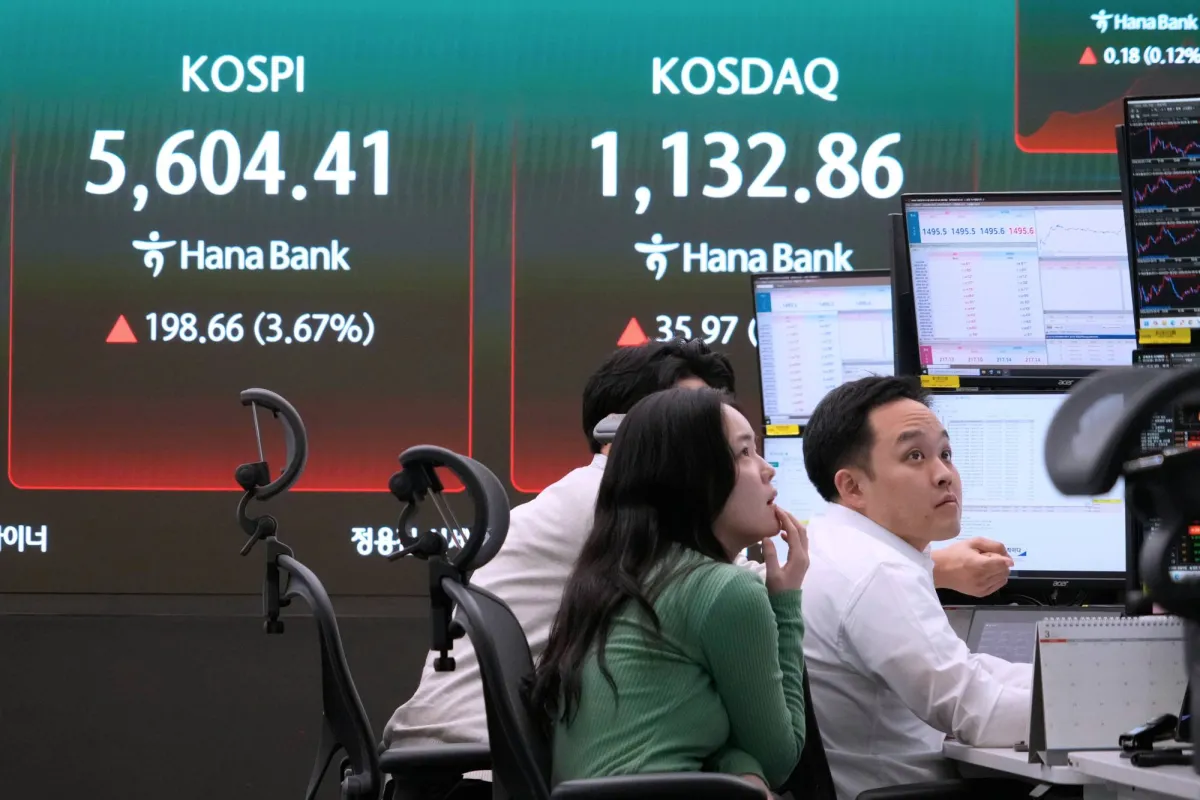
Asian markets have scaled back their early gains due to investor concerns over the economic fallout from the energy shock caused by the conflict in the Middle East.
Despite the MSCI Emerging Markets Index for Asia rising by 2% after a sharp decline of 4% in the previous session, uncertainty remained the primary driver of the market following Tehran's denial of any negotiations with Washington.
Market Movements Across Asia
Asian stock exchanges exhibited mixed movements reflecting a state of anticipation:
- South Korea: The KOSPI index surged by 4% at the session's start, before retreating to close up by 2.4%.
- Thailand: Stocks rose by 1%, while the Thai baht fell to 32.71 against the dollar.
- Singapore and Taiwan: Stocks recorded slight gains (0.13% and 0.29% respectively), surrendering most of their morning profits that had reached 2% earlier in the session.
Background & Context
Analysts confirmed that Asian economies, as net oil importers, remain the most vulnerable to fluctuations; particularly in India, Thailand, and the Philippines.
The rise in oil prices above $100 per barrel again exerts direct pressure on current account balances and raises inflation rates, prompting foreign investors towards traditional safe havens like the US dollar and bonds in developed markets.
Impact & Consequences
The performance of Asian currencies has been generally weak against the strength of the dollar; the South Korean won fell by 0.92% to reach 1503.10, although it remained above its lowest level in 17 years recorded on Monday.
Currencies in the Philippines and Malaysia also experienced varied declines, amid Filipino warnings that inflation could exceed 4% this year if oil prices stabilize at their current high levels.
Regional Significance
An executive at the World Gold Council stated on Tuesday that gold's role as a hedge against a declining dollar and geopolitical risks is expected to prompt absent central banks in the market to purchase the precious metal this year.
Chaukae Fan, the global head of the World Gold Council's banking division, added that central banks in Guatemala, Indonesia, and Malaysia have bought gold in recent months, either after a long absence or for the first time ever.
He noted, "One of the phenomena we have observed in recent months is the entry of new central banks, or central banks that have been absent from the gold market for a long time, into this market." He added, "I believe this trend may continue until 2026."
Fan explained, without going into details, that some central banks are purchasing gold from small local producers to support the local industry and prevent gold sales from reaching illicit entities.
He told Reuters on the sidelines of the Metals Week in Canberra that gold prices dropped this month by more than $1000 per ounce, reaching about $4340, with historical trends indicating that this is partially due to selling related to margin calls.
The peak price of gold was nearly $5600 in late January. During the gold sell-off in October, central banks stockpiled large amounts of the metal, but it is too early to know if the same phenomenon has repeated with the price drop this month, according to Fan.
He added that demand from central banks for gold may decline because rising prices not only deter new purchases but also increase the weight of existing gold holdings compared to total reserves.
The World Gold Council expects that record gold prices will slow central bank purchases to 850 metric tons this year, compared to 863 tons in 2025, although their purchases remain high compared to their levels before 2022, according to the council's January report.
According to figures from the World Gold Council, central bank purchases accounted for about 17% of total demand last year.
Japanese Prime Minister Sanae Takayichi announced on Tuesday that Japan will release another part of its strategic oil reserves starting Thursday, and will benefit from the shared stocks of oil-producing countries by the end of the month.
She stated in a post on the X platform: "To ensure the necessary supply for all of Japan... we will release government oil reserves starting March 26."
Takayichi added, "Moreover, it is expected that the release of part of the shared reserves of oil-producing countries will begin in March."
On March 16, Tokyo began releasing private sector oil reserves for 15 days.
Takayichi had previously announced the release of government stocks sufficient for a month.
Japan relies on the Middle East for 95% of its oil imports.
Its strategic oil reserves are among the largest in the world, exceeding 400 million barrels in December.
Members of the International Energy Agency agreed on March 11 to use oil stocks to mitigate price increases caused by the war in the Middle East, in the largest response of its kind ever.
Oil prices rose in early trading on Tuesday amid supply concerns, as Iran denied conducting any talks with the United States to end the Gulf war, contradicting statements from US President Donald Trump, who said an agreement could be reached soon.
Brent crude futures rose by $1.06, or 1.1%, to reach $101 per barrel at 00:01 GMT, while US West Texas Intermediate crude rose by $1.58, or 1.8%, to reach $89.71.
Oil futures prices had fallen by more than 10% on Monday after Trump stated that he ordered a delay of the attacks he threatened on Iranian power stations for five days, adding that the United States had fruitful talks with unnamed Iranian officials that resulted in "key points of agreement."
Tim Waterer, chief market analyst at KCM Trade, stated: "By postponing the plan to strike Iranian power stations for five days, the US has effectively pulled a significant part of the (war premium) from oil prices."
He added: "The slight rise we witnessed today is merely an attempt by the market to regain its balance. Traders recognize that despite the suspension of missile launches, the Strait of Hormuz is still far from being a safe waterway."
The war has led to a near-total halt of shipments of about one-fifth of the world's oil and liquefied natural gas through the Strait of Hormuz. Nevertheless, two tankers heading to India crossed the strait on Monday.
Tehran rejected claims of communication with Washington, deeming them an attempt to manipulate financial markets, while the Iranian Revolutionary Guard announced new attacks on American targets and condemned Trump's statements as "worn-out psychological operations."
Macquarie stated in a note: "Even with the potential easing of tensions following President Trump's announcement (on Monday), we expect a minimum price range between $85 and $90, with a natural decline towards $110 until the reopening of the Strait of Hormuz."
It added that if the strait remains effectively closed until the end of April, Brent crude prices could reach $150 per barrel.
The clashes have damaged energy infrastructure across the region. In the latest attacks, a gas company office and a pressure reduction station in Isfahan, central Iran, were targeted, and a projectile hit a gas pipeline feeding a power station in Khorramshahr, according to the semi-official Fars news agency.
The United States has temporarily lifted sanctions on Russian and Iranian oil at sea to alleviate shortages. Sector sources indicated that traders offered Iranian crude to Indian refineries at a price higher than Brent crude on the Intercontinental Exchange following Washington's move.
International Energy Agency Executive Director Fatih Birol stated on Monday that the agency is consulting with Asian and European governments regarding the possibility of releasing more strategic reserves "if necessary."
Oil sector executives and energy ministers warned during a conference held in Houston about the long-term impact of the US-Israeli war with Iran on the global economy, although US Energy Secretary Chris Wright downplayed the crisis.