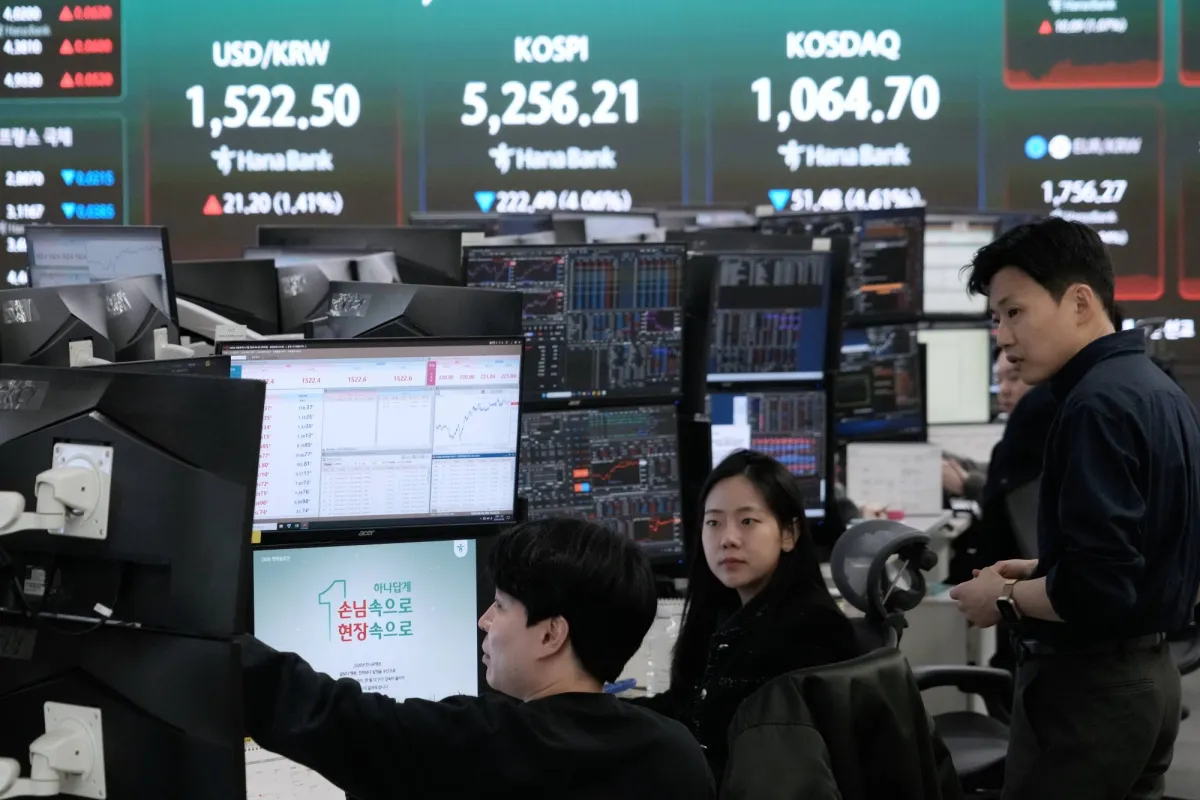
Asian stocks recorded a slight increase in cautious trading on Friday, as oil prices continued to rise amid growing fears of a prolonged Iranian war and its implications for global energy supplies.
In Japan, the Nikkei 225 index rose by 1.3% to reach 53,164.30 points in afternoon trading, while South Korea's KOSPI jumped by 3% to 5,391.78 points. Conversely, the Shanghai Composite index fell by 1% to 3,881.99 points. Several Asian markets, including Hong Kong, Singapore, Australia, New Zealand, the Philippines, Indonesia, and India, experienced a trading halt due to the Good Friday holiday, according to the Associated Press.
Market Details and Energy Prices
In energy markets, oil prices continued their strong ascent, with West Texas Intermediate crude rising by 11.4% to $111.54 per barrel, while Brent crude, the global benchmark, increased by 7.8% to $109.03 per barrel. A report from BMI, a subsidiary of Fitch Solutions, indicated that a prolonged conflict increases risks to energy infrastructure and prolongs disruptions in the Strait of Hormuz, potentially leading to a longer recovery period after the war, with price effects extending beyond this year.
Although the United States relies minimally on oil imports from the Arabian Gulf, oil pricing occurs in a global market, making price effects ripple through various economies. In Asia, the situation appears more sensitive, as countries like Japan heavily depend on oil flows through the Strait of Hormuz, making them vulnerable to any potential disruptions. However, some analysts believe these countries are banking on agreements that ensure the continued passage of supplies through the strait.
Background & Context
On Wall Street, U.S. stocks ended their first week of gains since the outbreak of the Iranian war, despite a volatile start influenced by rising oil prices. This followed a commitment from U.S. President Donald Trump to continue attacks on Iran without specifying a timeline for ending the conflict. The Standard & Poor's 500 index rose by 0.1%, equivalent to 7.37 points, closing at 6,582.69 points, marking a weekly gain of 3.4%.
Conversely, the Dow Jones Industrial Average fell by 0.1% to 46,504.67 points, while the Nasdaq Composite increased by 0.2% to 21,879.18 points, with both indices recording weekly gains. In the bond market, U.S. Treasury yields remained relatively stable, with the yield on 10-year bonds falling to 4.30% from 4.32%.
Impact & Consequences
In currency markets, the U.S. dollar rose slightly to 159.64 Japanese yen from 159.53 yen, while the euro stood at 1.1538 dollars, compared to 1.1537 dollars in the previous session. Data released by the Turkish Statistical Institute on Friday showed a monthly consumer price inflation rate decline to 1.94% in March, while the annual rate dropped to 30.87%, with both figures falling short of market expectations.
The data indicated that transportation and food prices were the main drivers of monthly inflation in March, alongside ongoing price pressures and market disruptions related to the war in Iran. A Reuters survey had predicted monthly inflation at 2.32% and annual inflation at 31.4%, driven by rising fuel prices and climate-related pressures on food prices.
Regional Significance
In a related context, the Turkish central bank raised its inflation rate forecast for the end of the year by two percentage points, placing it within a range of 15% to 21%, while maintaining its interim target at 16% unchanged in February, despite ongoing market doubts regarding the sustainability of the downward inflation trend that prevailed throughout most of 2025.
Consumer prices had risen in February by 2.96% month-on-month and 31.53% year-on-year. The Anadolu Agency reported that central bank governor Fevzi Karakhan confirmed that the bank would continue to pursue a tight monetary policy to ensure the continued decline of inflation, which had already begun to slow before the outbreak of the recent war.
In conclusion, Asian markets continue to monitor developments in the Middle East, where the impact of the Iranian conflict on the global economy, particularly in the energy sector, remains a focal point for investors and decision-makers.