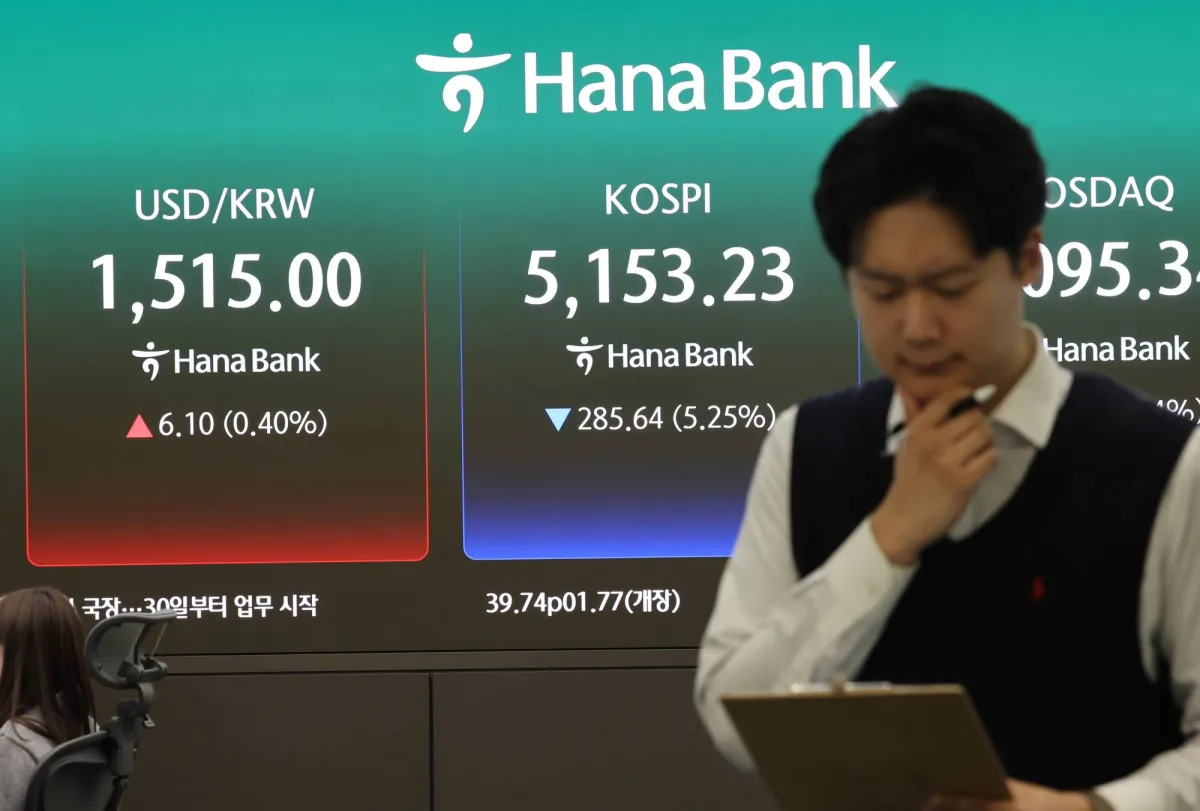
Most Asian markets fell on Monday morning due to rising concerns over oil prices and the potential escalation of the conflict between the United States and Iran. This decline followed sharp losses on Wall Street on Friday, where U.S. markets ended their fifth consecutive week of declines, marking the longest losing streak in nearly four years.
The Japanese Nikkei 225 index dropped by 4.5% to 50,979.54 points, while the Australian Standard & Poor's/ASX 200 index fell by 1.2% to 8,417.00 points. The South Korean KOSPI index also declined by 3.2% to 5,264.32 points, and the Hong Kong Hang Seng index decreased by 1.7% to 24,519.63 points. The Shanghai Composite index fell by 0.7% to 3,884.57 points.
Details of the Event
Concerns are growing in Japan and other Asian countries over the potential disruption of supplies through the Strait of Hormuz, which is considered a vital artery for oil shipments and is heavily relied upon by the region's economies. Investors are preparing for the possibility of prolonged conflict, which could push inflation to higher global levels and undermine economic growth, especially in Asia.
Javier Lee, a senior equity analyst at Morningstar Research, stated, "While we do not expect a long-term conflict, markets are likely to experience sharp volatility in the near term." On Wall Street, the S&P 500 index fell by 1.7%, marking its worst weekly performance since the start of the war, while the Dow Jones Industrial Average lost 793 points, down more than 10% from its record level set last month.
Background & Context
In the context of geopolitical events, the Israeli army announced that Iran launched several waves of missiles at Israel, and there was an attack from Yemen for the second time since the start of the U.S.-Israeli war. In response, Pakistan announced its readiness to host "serious" talks to end the conflict with Iran, despite Tehran accusing Washington of preparing for a ground attack while seeking to negotiate.
South Korean stocks fell by about 3% on Monday, and the won dropped to its lowest level in 17 years, amid fears of escalating war in the Middle East. The benchmark KOSPI index closed down 161.57 points, or 2.97%, at 5,277.30 points, while the won's exchange rate fell by 0.5% to 1,518.7 won per dollar.
Impact & Consequences
Aluminum prices surged by about 6% in global markets after Iran targeted two major production sites in the Middle East, threatening to deepen supply disruptions. Major suppliers in the region, Emirates Global Aluminium and Aluminium Bahrain (Alba), confirmed that their facilities were damaged due to the Iranian strikes.
This disruption comes at a time when global inventories are suffering from historically low levels, leaving little room to absorb shocks. Even before the direct targeting, the closure of the Strait of Hormuz had led to a severe shortage of raw materials needed for the region's giant smelters.
Regional Significance
The Arab region is directly affected by these developments, as rising oil prices may increase inflationary pressures on the economies of Arab countries, which heavily rely on oil imports. Additionally, the ongoing conflict in the Middle East could impact political and economic stability in the region.
In conclusion, experts indicate that global markets will remain under increasing pressure as geopolitical risks persist, requiring investors to make informed decisions to navigate these challenges.