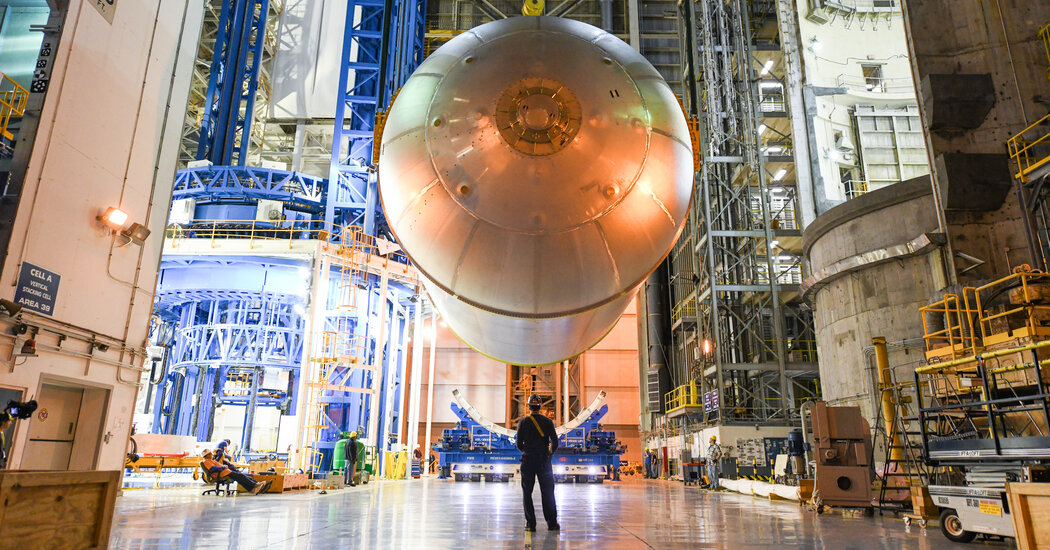
Astronauts on the Artemis II mission are preparing for a historic journey aimed at setting a new record for the distance traveled from Earth, heading towards the far side of the Moon. This mission is part of NASA's efforts to explore outer space and enhance scientific understanding of the Moon.
The mission, which is considered part of the Artemis program, aims to return humans to the Moon after decades, with the journey expected to include a series of scientific and technical experiments that will contribute to the development of new technologies for space exploration. The Orion spacecraft, carrying the astronauts, is scheduled to launch from the Kennedy Space Center in Florida, marking a significant step towards achieving NASA's goals in space exploration.
Event Details
The Artemis II crew consists of four astronauts, who will undertake a journey lasting approximately 10 days, including a flyby around the Moon and a return to Earth. This journey will be the first to carry astronauts to the Moon since the Apollo 17 mission in 1972. During this mission, the astronauts will conduct scientific experiments and observe the far side of the Moon, which has never been seen by humans.
This mission is part of a larger plan aimed at establishing a permanent base on the Moon, which will enable further research and deep space exploration. Success in this mission will also enhance NASA's capability to send astronauts to Mars in the future.
Background & Context
The history of lunar exploration dates back to the 1960s when the United States sent the first human to the Moon during the Apollo 11 mission. Since then, space programs have witnessed significant advancements, but astronauts have not been sent to the Moon for over 50 years. The Artemis program represents a strong return to lunar exploration, aiming to enhance international cooperation in space.
Through the Artemis program, NASA seeks to achieve multiple goals, including advancing space technology, developing new exploration capabilities, and inspiring a new generation of scientists and engineers. There is also increasing interest from other countries in space exploration, which adds to the significance of this mission.
Impact & Consequences
The success of the Artemis II mission could have a significant impact on the future of space exploration. If the astronauts achieve their goals, it could open doors for more missions to the Moon and Mars. This mission may also enhance international cooperation in space, as other countries could participate in future space exploration programs.
Moreover, the success of this mission could encourage further investment in space programs, potentially leading to the development of new technologies that benefit humanity in various fields, such as communications, energy, and the environment.
Regional Significance
Although the Arab region is not at the forefront of current space programs, the success of the Artemis II mission could have a positive impact on Arab countries. This success could encourage Arab nations to invest in their own space programs, leading to the development of new scientific and technological capabilities.
International cooperation in space could also open new horizons for Arab countries to collaborate with global space agencies, enhancing their standing in the international community and increasing opportunities for education and training in science and technology.