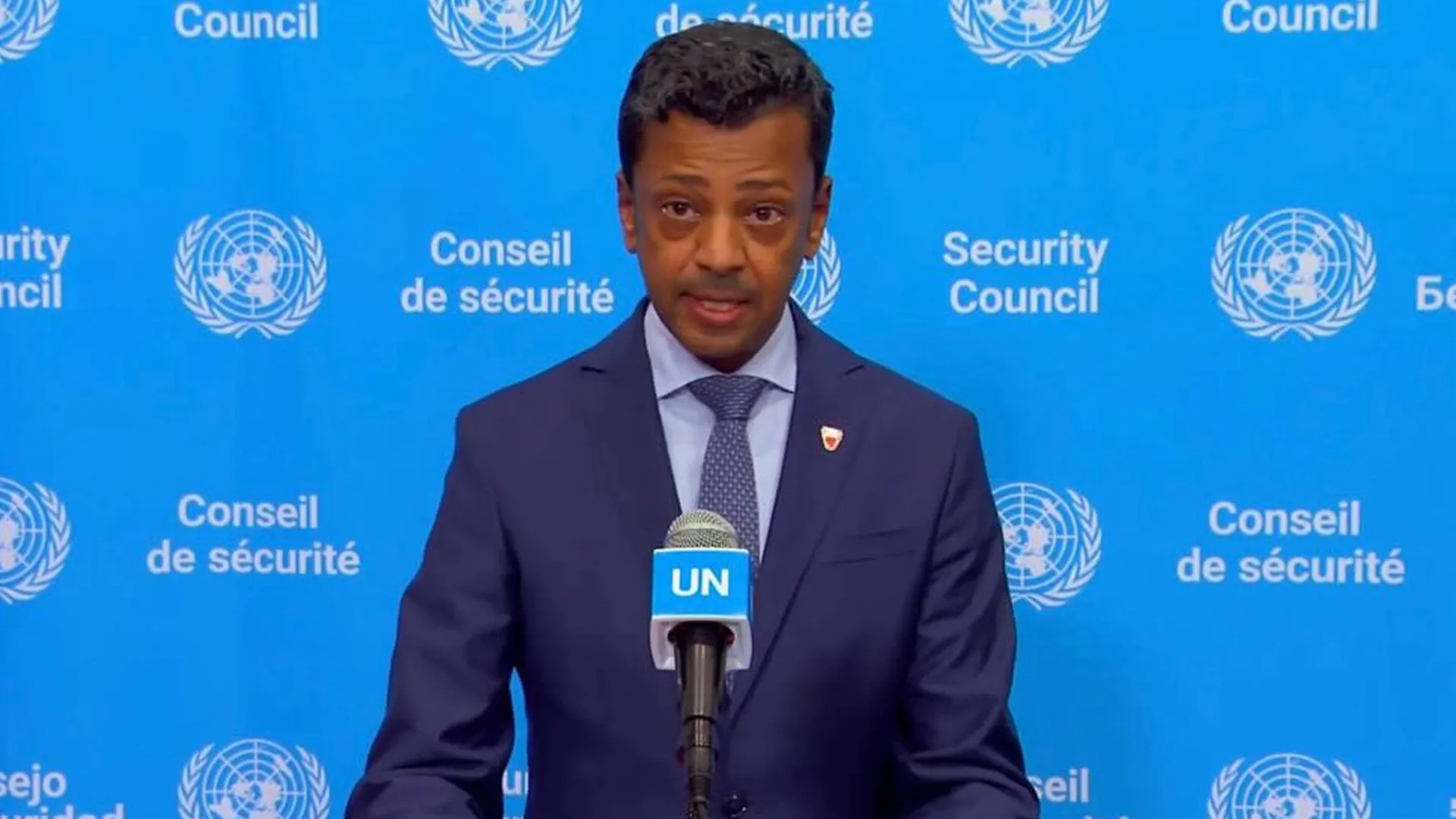
Bahrain's representative to the United Nations, Jamal Al-Ruwaie, announced on Wednesday that his country is seeking to adopt a UN resolution aimed at putting an end to what he termed 'economic strangulation and terrorism' in the Strait of Hormuz. This announcement coincides with Bahrain's presidency of the UN Security Council for the month of April.
During a press conference in New York, Al-Ruwaie explained that the resolution concerning the Strait of Hormuz aims to find a 'sustainable solution' to maritime threats that have persisted for over four decades. He emphasized that protecting waterways is a fundamental principle of international law and should not be used as a tool for political or military pressure.
Details of the Initiative
Al-Ruwaie indicated that the council will hold a special session on maritime security on the 27th of this month to discuss recent developments in the Strait of Hormuz. He noted that the ongoing threats pose a danger that extends beyond regional borders, affecting global energy security and the international economy as a whole.
The Bahraini representative also provided updated statistics on the damages inflicted on his country due to Iranian attacks, revealing that Bahrain has been subjected to 186 missiles and 419 drones within a single month of the war that began on February 28. He confirmed that these attacks targeted vital civilian infrastructure, including water desalination plants, oil storage tanks, residential buildings, and hotels.
Context and Background
These developments coincide with rising tensions in the region, as Bahrain seeks to strengthen its position in the UN Security Council. Bahrain is considered one of the countries facing ongoing threats from Iran, which increases the significance of the resolution it is attempting to present.
Bahrain's presidency of the UN Security Council in April includes an intensive agenda led by Foreign Minister Abdul Latif Al-Zayani, focusing on four main priorities: establishing peace in the region, addressing security threats, promoting international multilateralism, and ensuring inclusive participation.
Impact and Consequences
Through this resolution, Bahrain aims to gain international support to confront Iranian threats, potentially contributing to enhanced regional security. This initiative could also pave the way for broader discussions on maritime security in the region and reflects Bahrain's commitment to protecting its national interests.
These steps are expected to increase pressure on Iran and may contribute to the formation of new alliances in the region to address security challenges. Furthermore, Bahrain's success in passing this resolution could bolster its position on the international stage and enhance its role as a supporter of security and stability in the Gulf.
Significance for the Arab Region
The Bahraini resolution represents an important step in the context of Gulf-Iranian relations, reflecting growing concerns over Iranian activities in the region. This resolution may impact relations between the Gulf Cooperation Council countries and Iran, strengthening cooperation among Arab states to confront common threats.
In conclusion, Bahrain's presidency of the UN Security Council holds particular significance amid current tensions, as Manama seeks to activate resolution 2817, which calls on Iran to cease its attacks on Gulf countries and Jordan, a resolution that has garnered support from 136 UN member states. These steps could help put an end to irresponsible behaviors that threaten international peace and security.