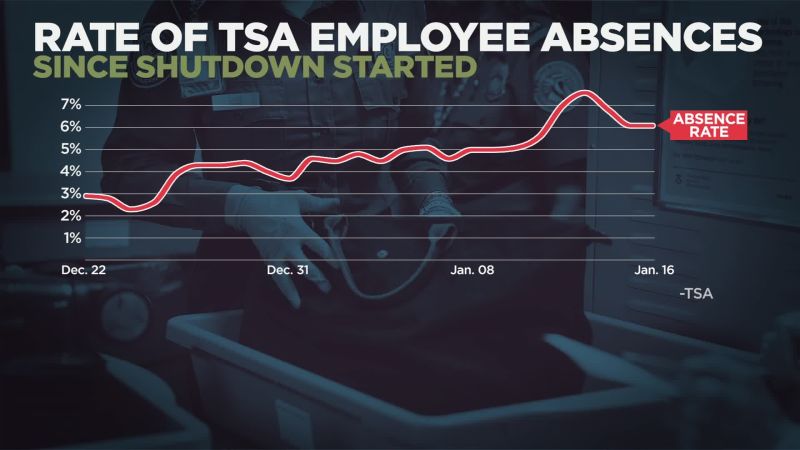
Bills aimed at ensuring salary payments for Federal Aviation Administration (FAA) and Transportation Security Administration (TSA) employees during government shutdowns are facing ongoing hurdles in the U.S. Congress. This situation is critical as many employees rely on these salaries for their basic needs.
Despite the introduction of these bills, discussions in Congress have not yielded any tangible progress, raising concerns among employees and their families. This impasse in passing the legislation poses a significant challenge for many workers in both sectors, who are experiencing increasing financial pressures.
Details of the Legislation
The proposed bills seek to ensure salary payments for employees during government shutdowns, a situation that has become more frequent in recent years. FAA and TSA employees suffer from financial instability due to these shutdowns, as salary payments are halted if the federal budget is not approved.
The proposed measures include mechanisms to guarantee continued salary payments even during shutdowns; however, they face opposition from some members of Congress who argue that this step could lead to increased government spending without addressing underlying issues.
Background & Context
The United States has witnessed several government shutdowns in recent years, the most notable being the shutdown that lasted for 35 days from 2018 to 2019, which significantly impacted many federal employees. During that period, FAA and TSA employees faced severe financial difficulties, prompting some to seek additional jobs to meet their daily needs.
Historically, the United States has relied on a federal budget system that requires Congressional approval, making government shutdowns a potential outcome if no agreement is reached. This system reflects the political tensions between the two major parties in the country, as their views on budget management diverge.
Impact & Consequences
If the impasse in passing the bills continues, it could exacerbate the financial situations of employees, affecting their ability to meet basic needs. This situation may also impact the performance of services provided by the FAA and TSA, potentially leading to a decline in safety levels at airports and in air transport.
Moreover, the continuation of government shutdowns could negatively affect the U.S. economy as a whole, since delayed salary payments may reduce consumer spending, impacting economic growth. These conditions may also increase pressure on the government to seek permanent solutions to this issue.
Regional Significance
Although this event pertains to the United States, it has global implications, including for the Arab region. Political and economic tensions in the U.S. may affect trade and investment relations with Arab countries, especially given the increasing reliance on economic cooperation between both sides.
Furthermore, any downturn in the U.S. economy could impact oil prices and financial markets, which would reflect on the economies of Arab countries that heavily depend on oil exports. Therefore, monitoring developments in the U.S. Congress is crucial for Arab nations seeking to maintain their economic stability.