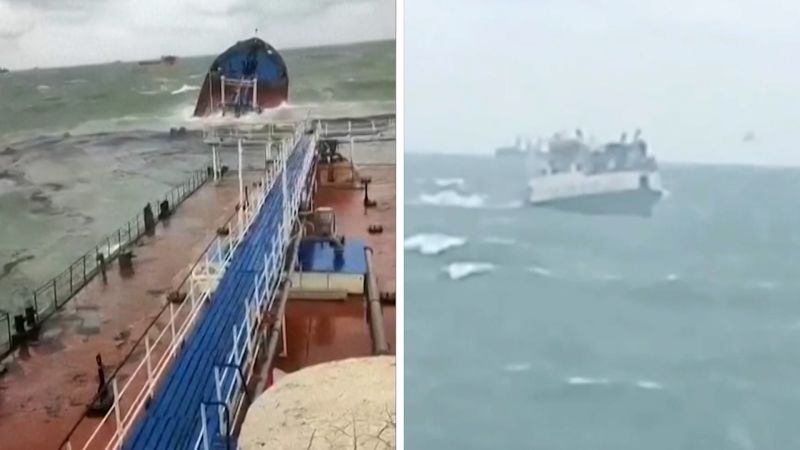
A cargo ship carrying wheat sank in the Black Sea after being attacked by Ukrainian drones, as announced by a Russian official. The incident took place on Friday, but details were only revealed on Sunday when survivors managed to reach the shore. The official, Vladimir Saldo, appointed by the Kremlin, accused Ukraine of carrying out a "terrorist attack" on the vessel, although no official comment has been made by Kyiv.
The ship, known as Volgo-Balt, sank following the attack, forcing its crew to abandon it. Nine crew members, all Russian citizens, were found alive near the village of Strilkovo in the Kherson region. Meanwhile, the assistant captain was killed, and two others are still missing, while the captain is receiving treatment in a hospital.
Details of the Incident
Saldo stated that an investigation into the incident is underway, noting that this is not the first time commercial vessels have been targeted by Ukrainian attacks in neutral waters. He threatened to respond to what he described as a crime against commercial ships. This incident comes at a sensitive time as mutual attacks between Russia and Ukraine are increasing, particularly in the energy and infrastructure sectors.
In a related context, reports indicate that the Russian port of Ust-Luga, a major port in the Baltic Sea, has resumed oil loading after days of disruption caused by Ukrainian drone attacks. An Aframax tanker named Jewel began loading shipments on Saturday, although news agencies were unable to immediately verify this information.
Background & Context
The war between Russia and Ukraine has been ongoing since 2022, witnessing an escalation in attacks on the critical infrastructure of both countries. Attacks have particularly focused on oil facilities, with reports suggesting that up to 40% of Russia's oil export capacity has been affected due to these assaults. These developments come at a time when the Russian economy is under increasing pressure from Western sanctions.
Historically, the Black Sea region has been the theater of numerous maritime conflicts, with commercial ships playing a vital role in global trade. Attacks on commercial vessels are not new, but they reflect a serious escalation in the ongoing conflict.
Impact & Consequences
Attacks on commercial ships could exacerbate the economic situation in Russia, which heavily relies on oil and gas exports. Any disruption in this sector may lead to an increase in global energy prices, thereby impacting the global economy as a whole.
Moreover, these events could escalate tensions between Russia and Western countries, as they may be used as a pretext for increased military support for Ukraine. At the same time, they could lead to heightened investments in naval defense by affected nations.
Regional Significance
Arab countries are directly affected by rising oil prices due to conflicts in production areas. Any escalation in the Russian-Ukrainian conflict could lead to price increases, impacting Arab economies that depend on oil imports. Additionally, the stability of the region relies on the balance of power in the Black Sea, where Russia and Ukraine play a pivotal role in the global energy market.
In conclusion, events in the Black Sea remain a focal point of global interest, reflecting geopolitical conflicts and economic tensions that affect all nations, including Arab countries.