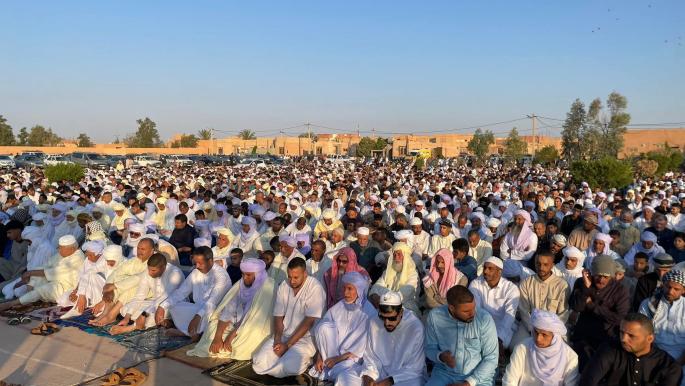
Algeria celebrates the blessed Eid al-Adha in ways that reflect the depth of its cultural and religious traditions. Many regions maintain inherited customs that embody the spirit of the holiday. This is evident in the processions of remembrance and gunpowder that fill the atmosphere, adding a special character to this occasion.
The celebrations include spiritual rituals that enhance the noble values associated with the holiday, such as generosity and solidarity. Families gather in mosques and public squares to perform the Eid prayer, exchanging greetings and well-wishes, reflecting the spirit of unity and brotherhood among community members.
Event Details
The celebrations begin on the morning of Eid, as worshippers head to mosques to perform the Eid prayer. After the prayer, people exchange congratulations and begin the ritual of slaughtering the sacrificial animals, which is one of the most prominent rites of the holiday. In many areas, processions of remembrance take place, where people gather in circles to recite the Quran and engage in dhikr, creating a unique spiritual atmosphere.
Gunpowder processions are an integral part of the celebrations in some regions, where gunpowder is fired into the sky as a form of expressing joy and celebration. This custom showcases pride in cultural heritage and strengthens social bonds among individuals.
Background & Context
Eid al-Adha is one of the most important Islamic holidays, celebrated on the tenth day of the month of Dhu al-Hijjah. The origins of these celebrations date back to the time of the Prophet Ibrahim (Abraham), who was commanded to sacrifice his son Ismail as a test of his faith. Thus, this holiday symbolizes sacrifice and altruism.
Algeria is characterized by its cultural diversity and customs, with celebration methods varying from one region to another. In mountainous areas, celebrations may include traditional dances and local songs, while in major cities, the focus is on the spiritual and social aspects of the holiday.
Impact & Consequences
These celebrations contribute to strengthening Algerian cultural identity, serving as an opportunity to renew family and social ties. They also promote values of cooperation and sharing among individuals, contributing to building a cohesive community.
These customs are also a means of preserving cultural heritage, passed down from generation to generation. Amid globalization and social changes, these celebrations gain greater significance as a way to maintain cultural identity.
Regional Significance
The Eid al-Adha celebrations in Algeria serve as a model for many Arab countries, demonstrating how traditions can adapt to modern times without losing their essence. These celebrations strengthen ties between Arab nations, as everyone shares in the values of the holiday.
Additionally, these celebrations provide an opportunity to enhance cultural tourism, as many tourists visit Algeria during this period to enjoy the festive atmosphere and learn about local customs and traditions.
In conclusion, the Eid al-Adha celebrations in Algeria embody the collective spirit and ancient traditions that enhance cultural identity, making it an unforgettable occasion in the hearts of Algerians.