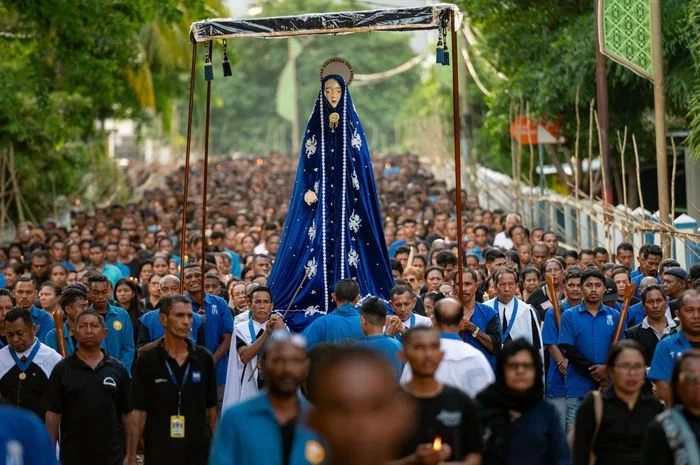
The Indonesian city of Larantika is preparing to celebrate the traditions of Semana Santa, where its special rituals begin on White Thursday, the day before Good Friday. The celebration includes a series of religious and social rituals that reflect the local culture.
Semana Santa in Larantika is distinguished as one of the oldest and most important religious traditions in Indonesia, where local residents and visitors from various regions come together to participate in these events. The celebrations typically begin with special rituals that include prayers and hymns, creating a unique spiritual atmosphere.
Event Details
On White Thursday, distinctive rituals are organized, including the offering of sacrifices and communal prayers. Residents participate in these rituals wearing traditional clothing, adding a cultural touch to the celebrations. Streets are decorated with flags and flowers, enhancing the aesthetic appeal of the atmosphere.
The celebrations continue until Good Friday, commemorating the crucifixion of Christ. This day is considered one of the most important days in Semana Santa, where a number of religious rituals attract many visitors. People participate in processions carrying crosses, and the call to prayer is raised in nearby mosques, reflecting the peaceful coexistence of religions in the area.
Background & Context
The roots of Semana Santa traditions in Larantika date back to the colonial era, where local culture was influenced by Christian traditions. Over the years, these rituals have evolved to become an integral part of the city’s cultural identity. Semana Santa is an opportunity to strengthen social ties among residents, as individuals of various ages and backgrounds come together to celebrate.
Larantika is characterized by its cultural and religious diversity, where Muslims and Christians live side by side. Semana Santa serves as an example of how peaceful coexistence between different religions is possible, reflecting the spirit of unity and tolerance in the community.
Impact & Consequences
Semana Santa in Larantika is considered an important event not only on a religious level but also economically. The celebration attracts many tourists, contributing to the enhancement of the local economy. This event provides an opportunity for shops and restaurants to offer their products and services to visitors, improving the living standards of local residents.
Moreover, Semana Santa contributes to raising cultural and religious awareness among new generations. By participating in these rituals, young people learn the value of traditions and the importance of preserving them, which aids in the continuity of this rich culture.
Regional Significance
Although Semana Santa is considered a Christian tradition, the values of tolerance and coexistence reflected in these celebrations can inspire many Arab communities. In light of the challenges facing the region, these traditions can be seen as a model to be emulated to promote unity and understanding among different cultures and religions.
In conclusion, Semana Santa in Larantika demonstrates how ancient traditions can enhance social and economic ties among individuals, contributing to the building of more cohesive and tolerant communities.