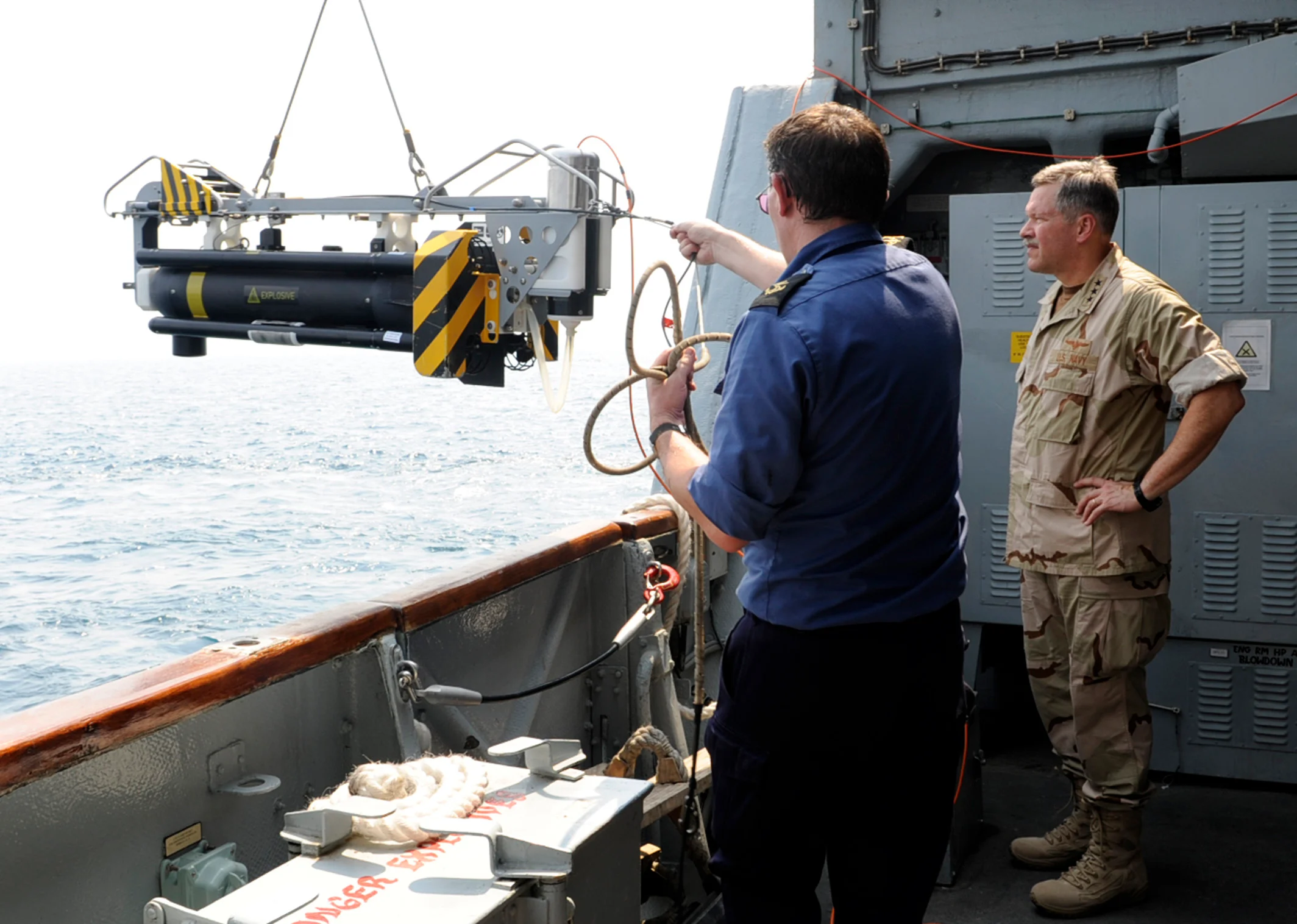
The United States faces significant challenges in opening the Strait of Hormuz, where Iran can plant sea mines faster than they can be removed. In this narrow passage, a single mine is enough to close the route to global shipping.
Geography intertwines with military means in the Strait of Hormuz, where the narrow passages limit maneuverability, and shallow waters are ideal for mine planting. These conditions make it difficult for U.S. naval forces to effectively carry out mine-clearing operations.
Details of the Situation
The Strait of Hormuz is one of the most prominent waterways in the world, with its narrowest point measuring about 34 kilometers. Despite the strength of the U.S. military, the use of sea mines as a means to disrupt navigation demonstrates how simple tools can constrain a greater power. This equation was exemplified in the 1988 incident when the U.S. frigate Samuel B. Roberts struck an Iranian mine, resulting in significant damage with repair costs exceeding $90 million.
U.S. intelligence estimates that Iran possesses over 5,000 sea mines, and has already begun deploying them within the Strait of Hormuz. These mines provide Iran with an asymmetric capability to disrupt shipping and increase the costs of any military intervention without engaging in direct confrontation.
Background & Context
The roots of sea mines date back to the 14th century, when the Chinese used rudimentary explosive devices. These mines have evolved throughout history, with their use accompanying nearly every major war. In both World War I and II, Allies and Germans planted hundreds of thousands of mines, showcasing their effectiveness as a means to restrict ship movement.
Modern sea mines fall into four main categories: moored, drifting, bottom, and adhesive mines. Each type features a different triggering mechanism, complicating mine-clearing efforts. Iran possesses a mix of these mines, including both conventional and more advanced types.
Impact & Consequences
Iran's ability to replant mines faster than they can be cleared poses a real threat to navigation in the Strait of Hormuz. This reality places the United States in a difficult position, as it needs to develop new strategies to counter this threat. While Washington has a comprehensive suite of mine countermeasure capabilities, clearing mines in a threat-filled environment can be a slow and interrupted process.
The threats faced by U.S. forces include coastal missiles and fast boats, further complicating mine-clearing operations. These conditions make it challenging for the United States to maintain a safe and stable corridor within the strait.
Regional Significance
These developments in the Strait of Hormuz have significant implications for the Arab region, through which about 20% of the world's total oil passes. Any escalation in tensions could affect oil prices and increase instability in global markets.
Moreover, Iran's ability to disrupt navigation in the strait could escalate regional conflicts, heightening tensions between Tehran and Washington and its allies in the region.