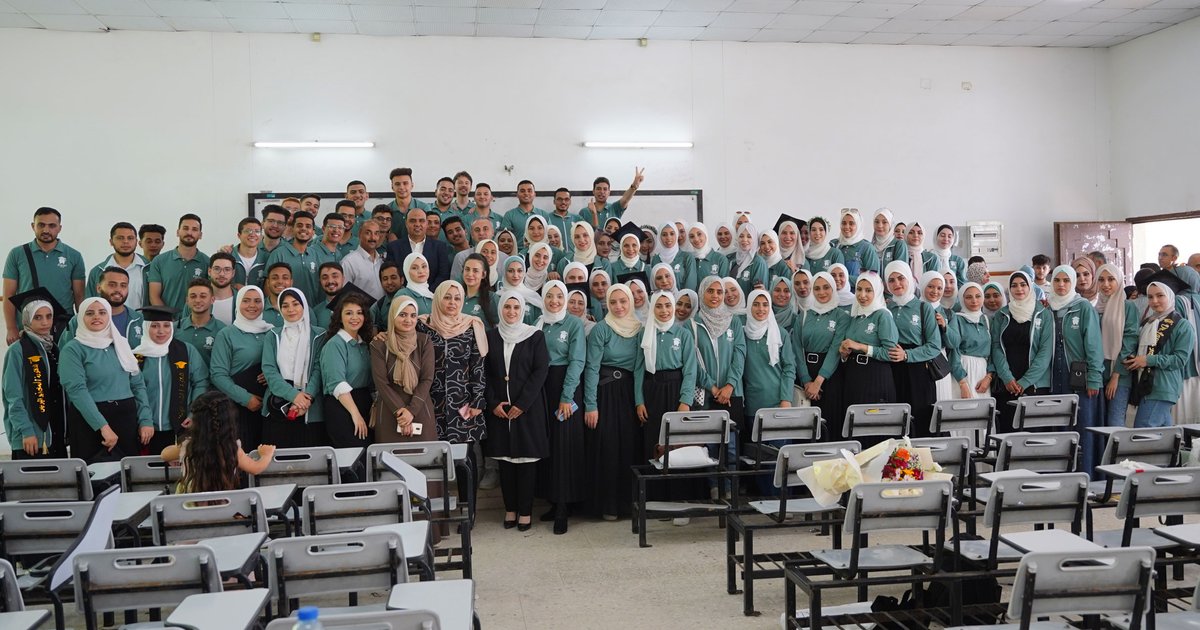
In the Gaza Strip, academic success is not measured by the hours a student spends reviewing their books, but rather by the kilometers they travel in search of an "internet signal" or the minutes before the power goes out. Here, a medical student sits behind the cracked screen of his phone, trying to imagine the feel of a pulse in a patient's veins, while the blockade and fragile digital reality stand between him and his laboratory and university.
Amid shattered test tubes and remnants of electronic microscopes that were once a source of pride in Gaza's universities, medical student Ali Yassin reflects on what has become of his "fortress of knowledge." The smell here is not chemical as he used to know, but rather the scent of gunpowder mixed with cement dust, and the silence is not the quiet of studying, but the silence of structures targeted at their core.
Event Details
"We study with great psychological fatigue," summarizes the student, filled with sorrow, the scene of his "remote learning" from within displacement tents and the rubble of his college. In his shocked voice, dental student Abdul Rahman Al-Rais states that the difficulty lies not only in internet outages or charging phones, but in the destruction of laboratories and the chairs we train on, which the genocide war has turned into rubble.
Al-Rais points out that studying in specialized fields such as dentistry, pharmacy, and engineering is no longer what it used to be, as theoretical knowledge presented through screens has turned into a form of "forced disability" in the absence of the necessary practical environment. He adds that the academic staff has suffered a severe blow, with some professors leaving the country and others martyred during the war, deepening the educational gap and weakening the ability for practical training.
Background & Context
In the same context, engineering student Basma Sabra states that students are supposed to receive their training in equipped laboratories, but the reality is entirely different, explaining: "Imagine studying engineering drawing through a cracked phone screen." She points out that the digital blockade imposed by the occupation, which prevents devices and equipment, even phones, from entering Gaza, exacerbates the students' suffering, especially in fields that rely on practical application.
Basma confirms that she feels she will graduate lacking an important aspect of training, yet she continues to learn despite all circumstances. For his part, Dr. Mohamed Shbeir, president of Al-Azhar University in Gaza, stated that university laboratories have turned into rubble, and the chemicals and sensitive devices that cost millions of dollars are now worthless after being destroyed by the war.
Impact & Consequences
Shbeir explained that these laboratories, which represented an environment for scientific research, have turned into what resembles empty "battlefields," placing the future of scientific research in the sector before an unprecedented existential challenge. He added that the university administration is trying to salvage what can be saved from the rubble and work on repairing salvageable devices for reuse in student training.
He noted that they managed to extract some dental chairs and repair about 10 of them, but he admitted that there is a severe shortage of practical training and practice. He stated that despite the loss of laboratories and the destruction of classrooms, students continue their educational journey through alternative means, explaining that a student in Gaza may open his book on a stone from the rubble of his university, in a battle of awareness that is no less important than academic achievement.
Regional Significance
In discussing the extent of the destruction, he pointed out that what some see as an end, students view as a new beginning. They do not wait for the reconstruction of universities to continue their education, but strive to learn to be part of their reconstruction. He described this as a manifestation of exceptional resilience, led by a student holding his pen in one hand and clearing the dust of rubble with the other.
According to the Ministry of Education and the United Nations Educational, Scientific and Cultural Organization (UNESCO), approximately 95% of higher education institutions in the Gaza Strip were damaged during the war. Out of 38 university campuses, 22 were completely destroyed, and 14 sustained varying degrees of damage, indicating the magnitude of the disaster that has struck the education sector.