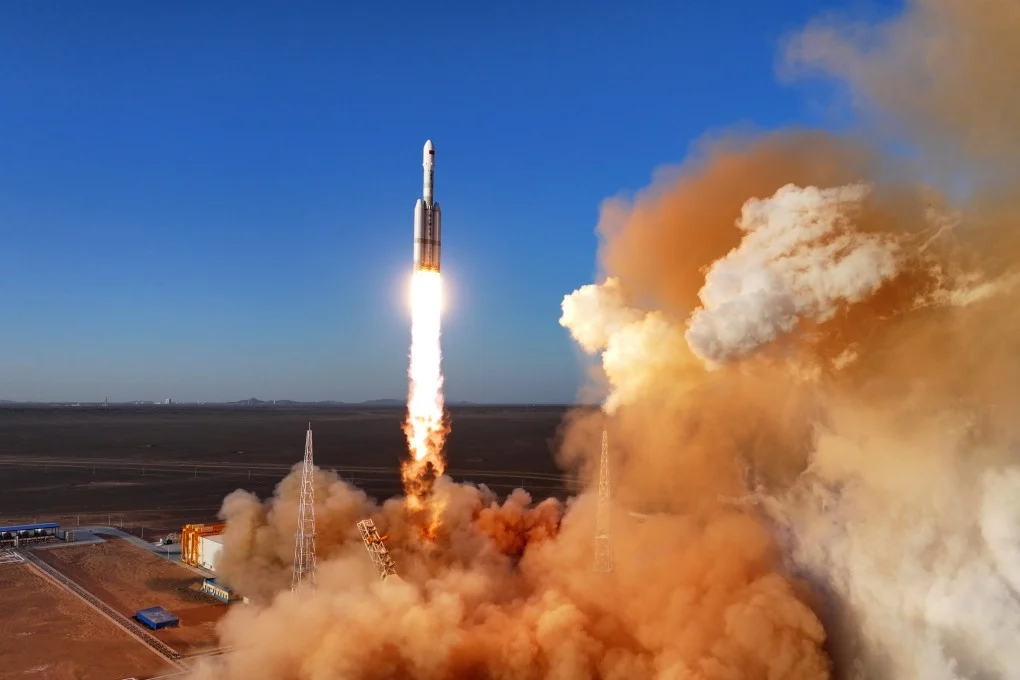
China has announced a new achievement in the commercial space sector with the launch of its new rocket, Kinetica-2 Y1, which is now considered cheaper than the reusable SpaceX Falcon 9. The launch, which took place last Monday, successfully placed three satellites into orbit, including a prototype for a commercial cargo vehicle and a satellite functioning as a small space laboratory.
The rocket, developed by the Chinese company CAS Space, represents an important step towards reducing the costs of access to space, enhancing China's ability to compete in the global space market.
Details of the Launch Event
The launch of the Kinetica-2 Y1 rocket comes at a critical time as China seeks to expand its activities in space. The new rocket is part of China's efforts to enhance its capabilities in the space sector, showcasing the technological advancements the country has made in recent years. The launch was successful, with the rocket managing to place three satellites into orbit, thereby strengthening China's ability to carry out multiple space missions.
This step is a milestone in the history of Chinese space exploration, as the new rocket demonstrates China's capability to provide space services at competitive prices, which could alter the dynamics of the global market.
Background & Context
In recent years, the global space sector has witnessed increasing competition between private and government entities. The American company SpaceX, founded by Elon Musk, has been a pioneer in this field, offering low-cost space launch services thanks to its reusable technology. However, China's entry into this sector with lower prices may pose a significant challenge to SpaceX and other companies.
China has invested heavily in developing space technologies, launching numerous satellites and spacecraft in recent years. These investments reflect China's commitment to enhancing its presence in space and developing its technological capabilities.
Impact & Consequences
Recent developments in the Chinese space sector could lead to significant changes in the global market. If China continues to offer low-cost space launch services, other companies may find themselves compelled to lower their prices or improve their technologies to remain competitive. This could accelerate innovation in the sector, benefiting all parties involved.
Moreover, China's success in this field could bolster its position as a technological and innovation superpower, granting it greater influence on the international stage.
Regional Significance
For Arab countries, China's entry into the space sector at competitive prices represents a significant opportunity for collaboration in space and technology fields. Many Arab nations are seeking to develop their own space programs and could benefit from partnerships with Chinese companies to reduce costs and enhance their capabilities in this area.
Additionally, cooperation in the space sector could enhance scientific research and technology in the region, contributing to sustainable development.