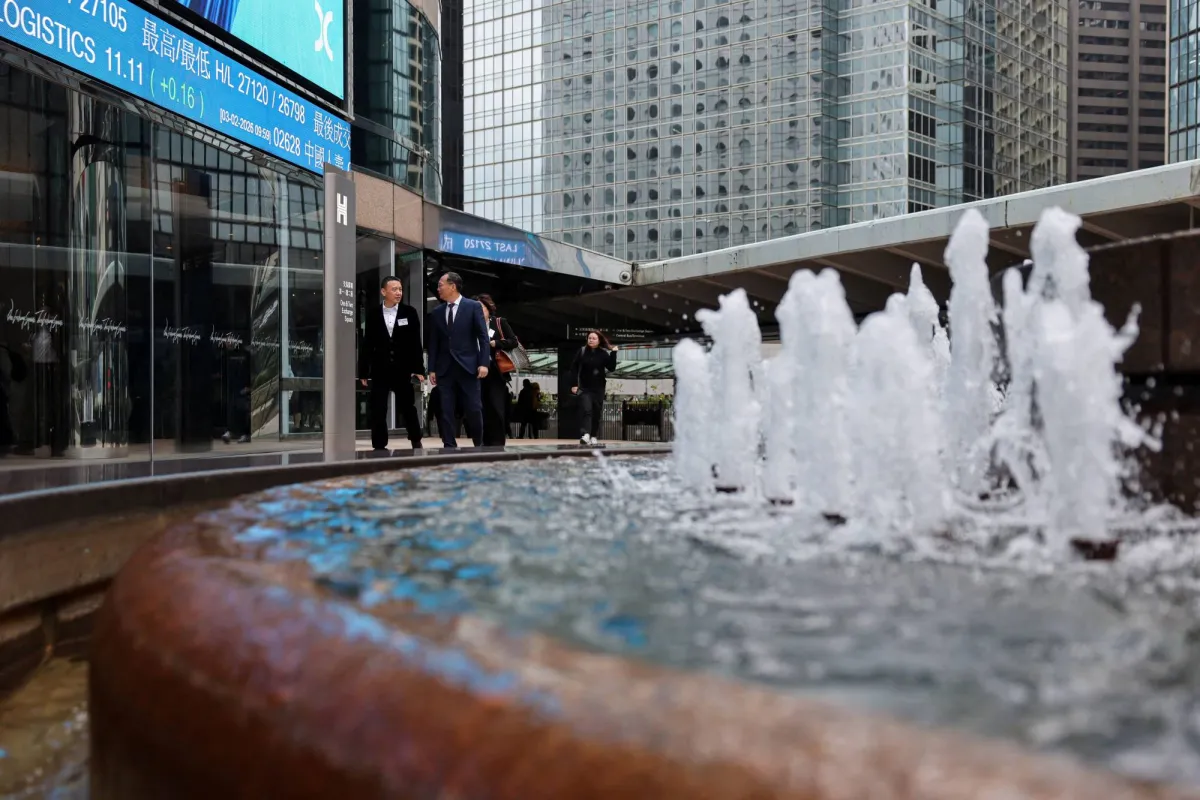
Chinese stocks fell on Friday, marking a decline for the third consecutive week, as uncertainty in the Middle East heightened risk aversion ahead of a local holiday. The CSI 300 index, which reflects the performance of leading stocks in China, closed down by 0.9%, while the Shanghai Composite Index dropped by 1%. Consequently, the CSI 300 ended the week down 1.4%, continuing its decline for the third week in a row. The local market is expected to remain closed on Monday in observance of the Chinese Qingming Festival.
Analysts at China International Bank reported that the markets have yet to clarify the details of controlling the Strait of Hormuz or the efforts to resolve the oil supply chain crisis, keeping concerns about crude oil supplies elevated. They added that external volatility in local company stocks significantly affects market sentiment, while the declining inflation rate in China and expectations of rising nominal prices this year may support domestic demand.
Details of the Event
A private sector survey published on Friday indicated that growth in China's services activity slowed in March after reaching a 33-month high in February, as weak demand and a decline in external orders negatively impacted momentum. Shares of WuXi AppTec fell by nearly 4%, and the CSI 300 healthcare index dropped by 1.9% after U.S. President Donald Trump ordered a 100% tariff on certain branded drug imports and reconsidered tariffs on steel, aluminum, and copper.
While shares in artificial intelligence companies were among the few bright spots, rising by 0.7%. Semiconductor stocks remained almost stable, and the CSI energy index fell by 1.5%, while the CSI new energy index decreased by 2.4% despite rising oil prices.
Background & Context
In a related context, the Chinese yuan appreciated against the dollar on Friday as the U.S. dollar stabilized, with attention turning to upcoming U.S. employment data. The spot yuan opened at 6.8930 against the dollar and was last traded 37 basis points higher than the previous session's close. Before the market opened, the People's Bank of China set the average exchange rate at 6.8929 yuan to the dollar, which was 45 points lower than Reuters' estimates.
The spot yuan is allowed to trade 2% above or below the daily fixed average exchange rate. The dollar stabilized on Friday after rising on Thursday, as Trump's threat to bomb Iran exacerbated risks in a war that has entered its fifth week, diminishing hopes for a quick resolution to the conflict that pressures oil supplies and increases inflation.
Impact & Consequences
Analysts at Zijin Tianfeng Futures noted that the outbreak of war in the Middle East has bolstered demand for the dollar as a safe haven, and the yuan has entered a consolidation phase after a sharp rise in the first quarter of 2026, supported by trade surpluses and foreign currency settlements. Analysts at MUFG Bank predicted that the yuan would remain strong during the second quarter, supported by China's high self-sufficiency rate in energy, large strategic reserves, and increasing demand for renewable energy sources.
At the same time, liquidity remains abundant in local financial markets, with the average interest rate for seven-day repurchase agreements in China falling to 1.3119%, its lowest level since August 8, 2022.
Regional Significance
Arab markets are directly affected by geopolitical tensions in the Middle East, as any escalation in conflict could lead to rising oil prices, impacting the economies of oil-importing countries. Additionally, uncertainty in Chinese markets may affect Arab investments in China, particularly in technology and energy sectors.
In conclusion, global markets remain under pressure from geopolitical tensions, requiring investors and analysts to closely monitor developments, especially regarding potential changes in oil prices and their impact on the global economy.