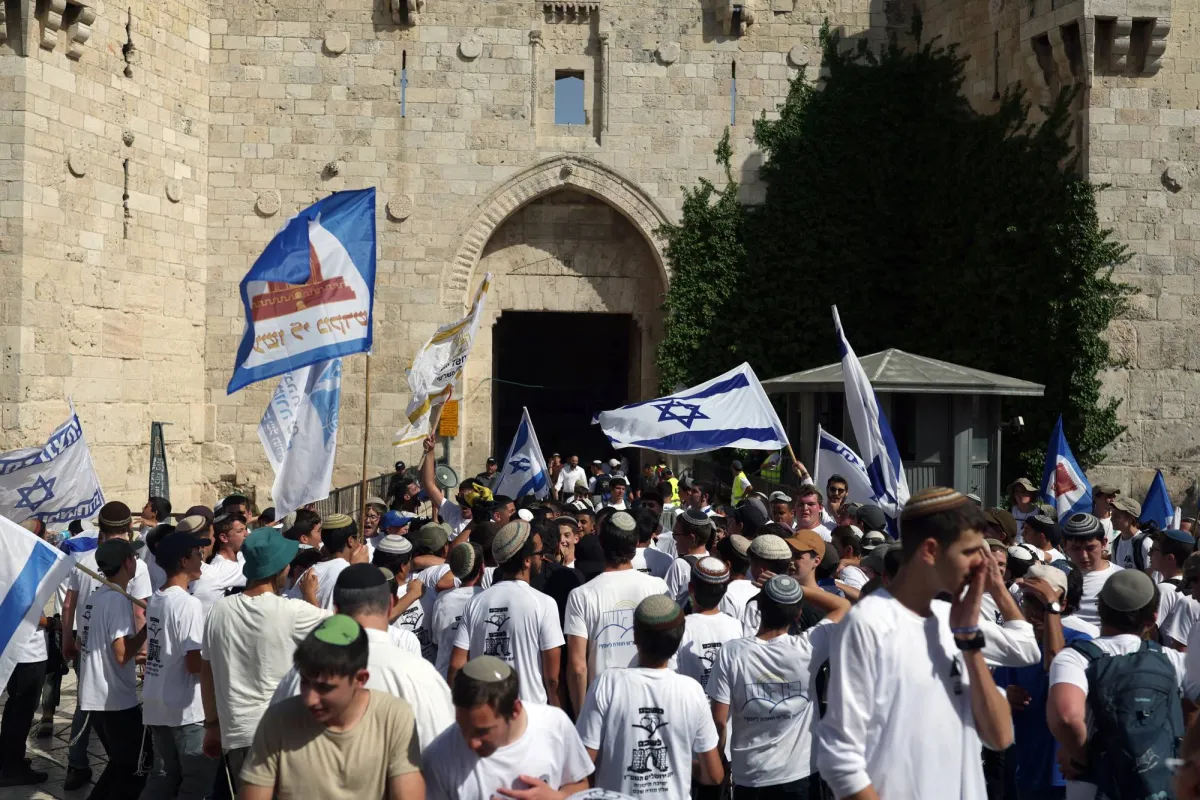
Today, Thursday, Jerusalem experienced a significant escalation in settler attacks, leading Christian institutions to close their doors due to the tense atmosphere. This escalation coincides with what is known as the "Flag Dance March" organized by Israeli settlers to commemorate the occupation of East Jerusalem.
In detail, settlers stormed the blessed Al-Aqsa Mosque and assaulted Palestinians in the Islamic Quarter of the Old City. Occupation forces imposed strict restrictions on Muslim access to the mosque, significantly reducing the number of worshippers.
Details of the Incident
Approximately 1,000 settlers flocked to Al-Aqsa Mosque from the Mughrabi Gate, performing their religious rituals under heavy protection from occupation forces. The Islamic Waqf Department reported that the settlers conducted rituals and ceremonies, including what was described as "epic prostration" near the Gate of Mercy.
In contrast, Israeli police enforced strict restrictions on Palestinian access, preventing men under the age of 60 and women under the age of 50 from entering the mosque since dawn prayers. Several worshippers were assaulted at the mosque gates, escalating tensions in the area.
Background & Context
These attacks are part of a systematic settlement policy aimed at altering the demographic reality in Jerusalem. According to statistics, approximately 400,000 Palestinians live in Jerusalem, with 60% of them suffering from poverty. Additionally, there are 14 Jewish settlement neighborhoods established in the city, exacerbating tensions between Palestinians and settlers.
Historically, Jerusalem has witnessed many similar events, where assaults on Islamic and Christian holy sites escalate during religious occasions. These incidents reflect the ongoing tensions between Palestinians and settlers, manifested in daily assaults.
Impact & Consequences
These assaults significantly affect the lives of Palestinians in Jerusalem, contributing to feelings of frustration and despair. The closure of Christian institutions reflects a state of concern within the Christian community in the city, which is facing increasing pressures.
Moreover, these events could lead to greater escalation in the conflict, as Palestinian factions are expected to respond to these attacks in various ways, potentially increasing violence in the region.
Regional Significance
The events in Jerusalem are part of the broader Israeli-Palestinian conflict, which impacts relations between Arab countries and Israel. These attacks provoke strong reactions from Arab nations, which call for the protection of Islamic and Christian holy sites in Jerusalem.
In conclusion, Jerusalem remains a center for numerous political and religious tensions, as settler attacks continue to shape the reality of the city and affect the lives of its inhabitants.