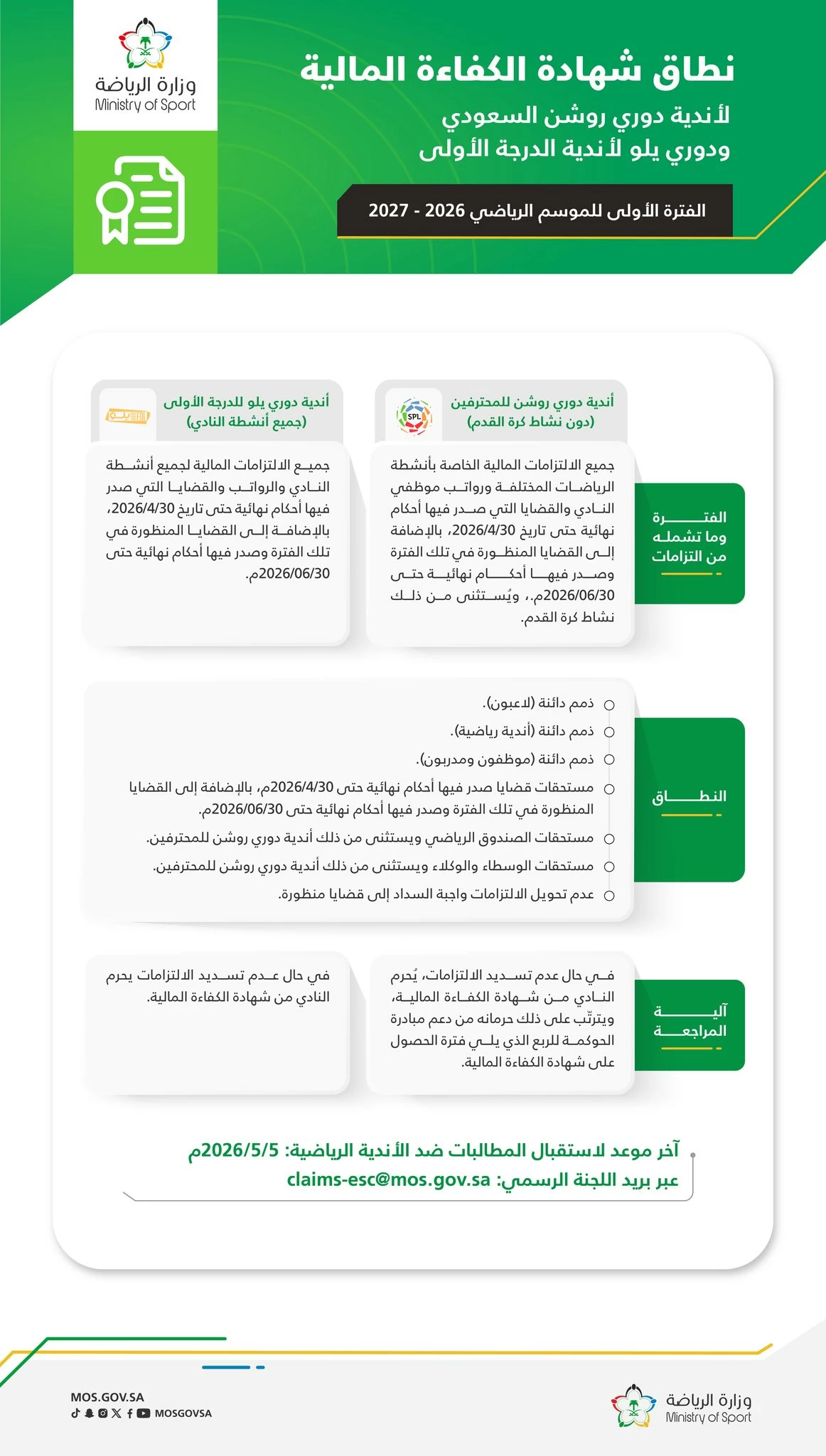
The four clubs are racing against time to fulfill the requirements for obtaining the Financial Efficiency Certificate for the first period of the 2027-2026 sports season. These efforts are underway amid growing pressures to close all financial cases that have been ruled upon by the Dispute Resolution Chamber.
In this context, the Ministry of Sports has set Tuesday, May 5, 2026, as the final deadline for receiving claims against sports clubs. This includes the necessity to provide all financial obligations related to various sports activities, including salaries of club employees and cases that have received final rulings by April 30, 2026.
Details of the Event
The Ministry of Sports requires that financial obligations be settled before the deadline, with clubs needing to close pending cases that have received final rulings by June 30, 2026. Football activities are exempt from this requirement, adding an additional challenge for clubs in their pursuit of the certificate.
If financial obligations are not met, clubs will be deprived of the Financial Efficiency Certificate, negatively impacting support for the governance initiative for the quarter following the certificate acquisition period. This situation could hinder clubs' ability to compete in the league and affect their financial stability.
Background & Context
The Financial Efficiency Certificate is a fundamental requirement for sports clubs in Saudi Arabia, aimed at enhancing financial transparency and ensuring the sustainability of clubs. This certificate was introduced as part of the Ministry of Sports' efforts to improve the financial and administrative performance of clubs.
Clubs face multiple challenges in this context, including accumulated financial issues that may affect their competitiveness. Adhering to financial conditions is a vital step to ensure the continuity of clubs in the Roshan League and Yelo League.
Impact & Consequences
If clubs fail to meet the required conditions, it could lead to serious consequences for both their athletic and financial performance. Clubs may be barred from participating in sports competitions, impacting their fan base and financial returns.
Moreover, failure to obtain the Financial Efficiency Certificate may weaken clubs' ability to attract sponsors and investors, increasing financial pressures on them. This situation could lead to a decline in the level of competition in the league and affect the reputation of Saudi sports as a whole.
Regional Significance
The experience of Saudi clubs in obtaining the Financial Efficiency Certificate serves as a model in the Arab region. Many countries are striving to improve the financial performance of sports clubs, reflecting the importance of transparency and accountability in the sports sector.
The success of clubs in meeting these standards may encourage other countries to implement similar systems, enhancing the level of sports in the region and increasing investment opportunities.
In conclusion, the challenge faced by the clubs in obtaining the Financial Efficiency Certificate represents a critical step towards enhancing financial sustainability and transparency in the sports sector, positively reflecting on the future of sports in Saudi Arabia and the region.