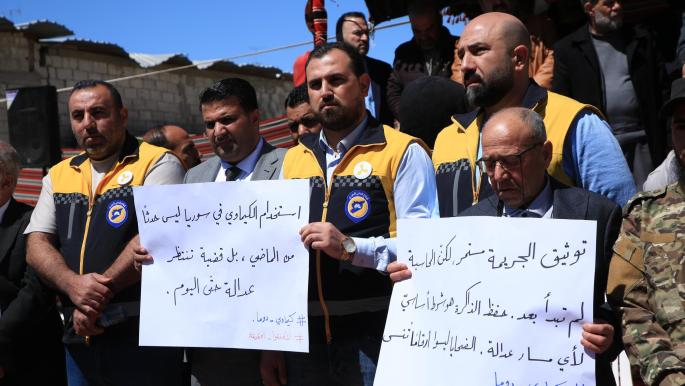
Today, the city of Douma in rural Damascus marked the anniversary of the chemical massacre committed by the Assad regime in April 2018. The event saw widespread participation from residents and activists, who gathered to memorialize the victims and stress the importance of holding the perpetrators accountable.
The Douma massacre is considered one of the bloodiest incidents in the Syrian conflict, where the regime used chemical weapons against civilians, resulting in the deaths of dozens and injuries to hundreds. This crime sparked widespread international outrage, with many countries and humanitarian organizations condemning the use of chemical weapons in conflicts.
Event Details
The event included several activities, such as speeches from human rights activists, displays of photographs of the victims, and solidarity vigils. Participants emphasized the importance of not forgetting these crimes and that justice must be achieved for the victims and their families.
Leaflets detailing the massacre and the number of victims were distributed in an effort to document these tragic events that continue to affect the Syrian community. Participants expressed their determination to continue demanding justice and to prevent the recurrence of such crimes.
Background & Context
Since the onset of the Syrian conflict in 2011, the country has witnessed numerous grave human rights violations, including the use of chemical weapons. Human rights organizations have documented many of these incidents, leading to international calls for investigations and accountability for those responsible.
The Douma massacre is part of a series of chemical attacks targeting civilians, where sarin gas and chlorine gas were used on several occasions. These attacks escalated tensions between the Syrian regime and Western countries, which threatened to impose military sanctions on the regime.
Impact & Consequences
The repercussions of the Douma massacre continue to affect the Syrian community, with many survivors living in a state of psychological trauma. These incidents contribute to worsening humanitarian conditions in the country, as residents suffer from a lack of medical and psychological assistance.
On the international stage, the issue of chemical weapons use in Syria remains a sensitive topic, with varying positions among countries. While some nations call for strict actions against the regime, others prefer dialogue and negotiation, complicating efforts to achieve justice.
Regional Significance
The Douma massacre reflects the significant challenges facing the Arab region in terms of human rights. There is an urgent need to strengthen accountability and justice mechanisms, not only in Syria but in all countries suffering from similar violations.
The continuation of these crimes without accountability contributes to destabilizing the region and negatively impacts relations between countries. Commemorating this massacre serves as a call for the international community to work towards preventing the recurrence of such incidents in the future.
In conclusion, the memory of the Douma massacre remains alive in the minds of Syrians, serving as a constant reminder that crimes do not fade over time and that justice must be achieved regardless of how long it takes.