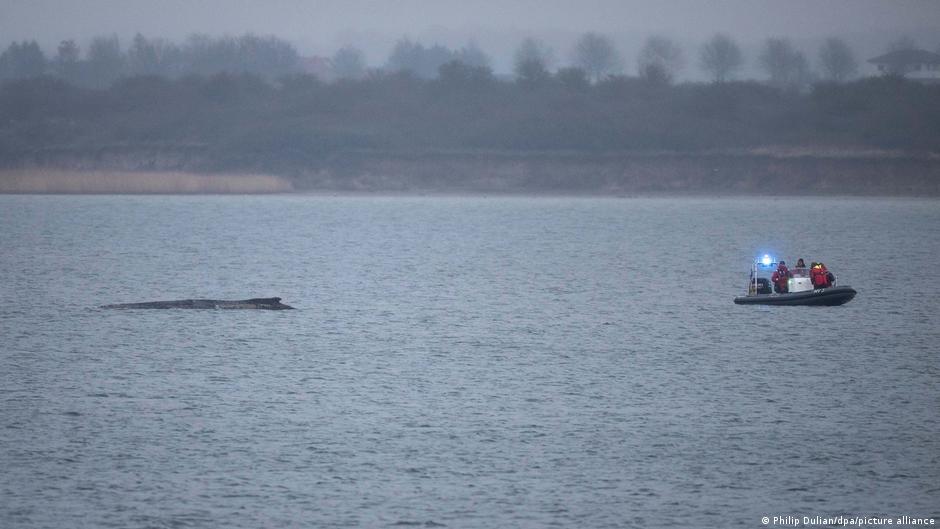
Reports indicate that the humpback whale stranded in the Baltic Sea, which has not moved much in recent hours, is suffering from a noticeable decline in its health. The whale, which has been stranded for over a week, has shown no improvement despite rising water levels that could provide it with an opportunity to escape.
During a press conference, the Minister of Environment in Mecklenburg-Vorpommern, Till Backhaus, confirmed that the whale remains in the same location, having only moved a short distance. He noted that its breathing frequency has significantly decreased, indicating a deterioration in its health condition.
Details of the Incident
Water levels in Vismar Bay are expected to rise by 30 centimeters, which may offer a new chance for the whale to free itself. However, rescue efforts are facing great difficulties, as Professor Burkhard Bäschick from the German Oceanographic Museum stated that today could be critical for the whale's fate. He explained that the whale has only moved about 1 to 1.5 meters in the past 24 hours, despite favorable conditions.
Franziska Salmin from the organization Greenpeace added that the whale has become less responsive to stimuli, showing no reaction during attempts to revive it. This decrease in activity and responsiveness suggests severe weakness in its health.
Background & Context
The story of this whale began when it became stranded on the sands of Timmendorfer beach earlier last week. After several days of rescue efforts, the whale managed to free itself and swim north. However, while attempting to navigate through shallow waters, it became stranded again in Vismar Bay.
This incident is part of a larger phenomenon concerning marine mammals in European waters, where cases of whales deviating from their natural paths have increased, raising questions about the impact of environmental changes and pollution on these creatures.
Impact & Consequences
The condition of the stranded humpback whale exemplifies the challenges faced by marine mammals amid climate change and pollution. If the whale cannot free itself, difficult options such as euthanasia may need to be considered to end its suffering, a decision experts have not yet reached.
Highlighting this issue can raise awareness about the importance of protecting the marine environment and encourage more effective actions to safeguard marine life from increasing threats.
Regional Significance
Although the incident is occurring in the Baltic Sea, it raises important environmental issues that concern all nations, including Arab countries. As environmental challenges increase, Arab nations should draw lessons from this incident to enhance their efforts in protecting marine and coastal environments.
In conclusion, the condition of the humpback whale stranded in the Baltic Sea serves as a powerful reminder of the importance of protecting marine life and the environment, and the necessity for international cooperation to address environmental challenges.