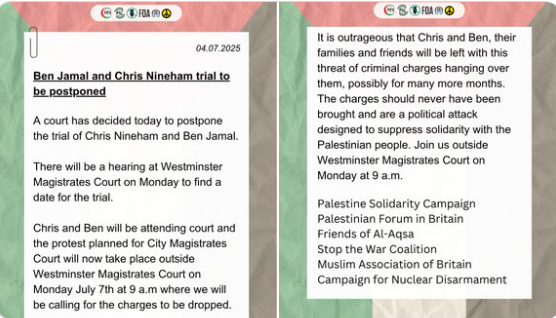
A Westminster court in London has found Ben Jamal, the director of the Palestine Solidarity Campaign, and Chris Nineham, the vice-chair of the Stop the War Coalition, guilty of breaching protest conditions. This decision has sparked widespread concern among civil liberties advocates in Britain, who view it as a threat to the right to free expression and peaceful assembly.
This conviction comes at a sensitive time, as the country witnesses a surge in protests related to Palestinian issues, highlighting the tensions between the British government and human rights advocacy groups. Jamal and Nineham were accused of public disorder and failing to comply with imposed protest conditions, which many see as targeting activists seeking to express their political views.
Details of the Case
The details of the case stem from a protest organized by the Palestine Solidarity Campaign, where specific conditions were imposed by local authorities. According to the court, Jamal and Nineham did not adhere to these conditions, leading to legal action against them. Both were convicted following lengthy hearings, with the court deeming their actions a threat to public order.
In the aftermath of the ruling, many activists expressed concerns that this conviction could undermine the ability of human rights groups to organize peaceful protests in the future. They pointed out that this ruling could have negative implications for freedom of expression in the country.
Background & Context
Historically, Britain has been a center for social and political movements, witnessing numerous protests that have contributed to changes in public policy. However, recent years have seen an increase in restrictions on protests, raising alarms among civil liberties defenders. Some human rights organizations have deemed these restrictions a regression in human rights within the country.
This case coincides with rising global tensions surrounding the Palestinian issue, as protests in support of Palestine have increased in many countries. In this context, activists argue that any attempt to suppress these movements is tantamount to stifling their right to express their views.
Impact & Consequences
The repercussions of this conviction extend beyond the individuals involved, potentially affecting the Palestine Solidarity Movement as a whole. Other activists may feel deterred from participating in protests, which could lead to a decline in civic engagement in this area. Furthermore, this conviction may pave the way for more legal actions against activists, escalating tensions between the government and civil society.
Moreover, this case could impact Britain's image in the international community, where it is viewed as a supporter of human rights. This conviction may lead to criticism from international organizations advocating for human rights, placing the British government in a difficult position.
Regional Significance
For Arabs, this case reflects the challenges faced by movements advocating for Palestinian rights worldwide. It demonstrates that there are increasing efforts to suppress voices calling for justice for Palestine, which may affect international support for the Palestinian cause.
Additionally, these events may encourage more activists in the Arab world to bolster their efforts in supporting Palestine, despite the challenges they may face. International solidarity with Palestine is a crucial element in promoting Palestinian rights, and this case could stimulate further discussion on human rights in the region.
In conclusion, the issue of civil liberties in Britain remains a significant concern, with growing fears regarding the decline of rights to expression and assembly. The conviction faced by the leaders of the Palestine Solidarity Movement may serve as a wake-up call for civil society in the country, necessitating enhanced efforts to protect these fundamental rights.