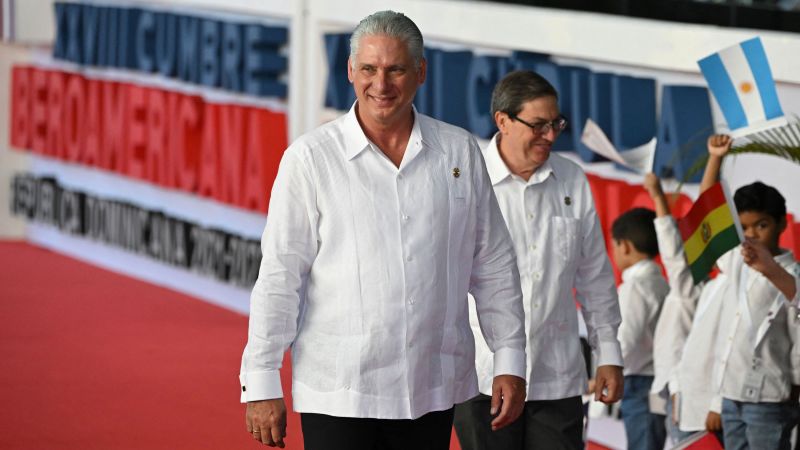
Cuban President Miguel Díaz-Canel warned that his country would respond with a guerrilla campaign if the United States launched a military attack, stating that any such operation would lead to "heavy losses" for both nations.
Díaz-Canel's remarks came during an exclusive interview with Newsweek in Havana, marking his first with an American media outlet since 2023. These comments arise amid increasing threats from former US President Donald Trump to annex the Cuban island, located about 145 kilometers from Florida.
Details of the Threats
Trump's threats come at a time when Cuba is grappling with a severe economic crisis, as 10 million citizens face daily power outages amidst an energy crisis exacerbated by the US blockade on oil shipments to the island since the beginning of the year. The White House has justified these measures by claiming that Cuba poses an "extraordinary threat" to US national security, citing Havana's communist policies and its relationships with countries like Russia and China.
In response, Cuban officials deny any connections to organizations classified as terrorist by the United States, asserting that the American blockade has led to soaring food prices and a shortage of medicines, resulting in rare protests against the government. The Trump administration has hinted at the possibility of military intervention in Cuba.
Context and Background
Following military operations conducted by the United States in Venezuela and Iran, Trump has repeatedly stated that Cuba would be the "next target," expressing a desire to "control Cuba in one way or another." Díaz-Canel responded to these threats by stating that while his country prefers dialogue, it will defend itself vigorously with the involvement of all its citizens if attacked.
Díaz-Canel added that "to die for the homeland is to live," invoking the slogan of the late leader Fidel Castro. He emphasized that any US military attack would result in heavy losses for both peoples, warning that "the loss of life and material destruction would be incalculable."
Impact and Consequences
Díaz-Canel's statements serve as a clear warning to the United States, indicating that any military aggression would be extremely costly in all respects. He affirmed that Cuba does not pose a threat to the United States and that there is no justification for military aggression.
He also pointed to the "maximum pressure" exerted by US officials, clarifying that Cuba is always seeking dialogue. He noted that the American blockade has led countries like Mexico to stop sending oil shipments to Havana, further increasing the suffering of the Cuban people.
Impact on the Arab Region
These events indicate a rise in tensions between major powers and their impact on smaller nations. They also highlight the importance of Arab solidarity in facing external challenges, as many Arab countries are experiencing similar pressures from great powers.
In conclusion, Cuba remains an example of people's resistance against external pressures, and Díaz-Canel's stance reflects his country's commitment to defending its sovereignty and independence.