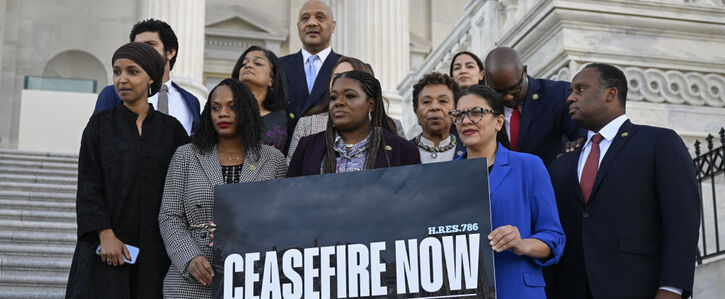
In a move that could put Democratic leaders in a difficult position, Alison Minerly, a member of the Democratic National Committee, has introduced a resolution aimed at rejecting the substantial spending of the American Israel Public Affairs Committee (AIPAC) on congressional election races. This resolution is expected to be discussed at the committee meeting next month.
The resolution, sponsored by Minerly from Florida, proposes that Democrats adopt a clear stance regarding AIPAC's increasing influence on the party's primary elections, according to the American news site Intercept.
Details of the Resolution
AIPAC is considered the largest pro-Israel lobbying group in the United States and has maintained relationships with lawmakers from various party affiliations for decades. However, this committee has become a source of controversy within the Democratic Party, as it is believed to have an increasing influence in the primaries, raising concerns among many Democratic leaders who see AIPAC promoting pro-Israel candidates at the expense of U.S. interests.
Last August, Minerly called for a ban on arms to Israel due to the war on Gaza, and although the resolution failed, it sparked a lively discussion about the party's relationship with Israel. Recent polls have shown that Democrats have become more critical of Israel and more sympathetic to Palestinians, opening the door for further discussion regarding AIPAC's funding directed towards primary elections.
Background & Context
AIPAC, through another committee known as the United Democracy Project, has funded Democratic candidates in the primaries, spending at least $22 million in Illinois during recent races. This spending comes at a sensitive time, as concerns grow regarding the influence of political money in shaping the Democratic Party's positions.
The new resolution could spark renewed debate about AIPAC's role in the primaries, something many party leaders wish to avoid. In response, AIPAC has sought to counter these criticisms, having recently appointed a new director for political projects in an attempt to defend itself.
Impact & Consequences
One of AIPAC's supporters, Michael Sacks, who is considered a major donor to the Democratic Party, defended the group, stating that critics are attempting to push Jews out of the party. Recently, AIPAC responded to the growing wave of disavowal from within the Democratic Party, as several figures running for the 2028 U.S. presidential election announced their rejection of any support from the group.
This reflects the widening political embarrassment associated with public alignment with Israel within party circles. AIPAC claimed it has "never provided support for a presidential campaign," arguing that excluding millions of pro-Israel Democrats is "wrong and undemocratic."
Regional Significance
Concerns are rising about the impact of this debate within the Democratic Party on U.S.-Israeli relations, which have a direct effect on Arab issues, especially amid the rising voices against the Israeli occupation. This debate could contribute to a reassessment of U.S. positions regarding the Israeli-Palestinian conflict, potentially opening the door for further discussions about Palestinian rights.
In conclusion, it appears that the resolution introduced by Minerly reflects a significant shift in the Democratic Party's positions towards Israel, which could impact U.S. policy in the region and reshape relations between the United States and Arab countries.