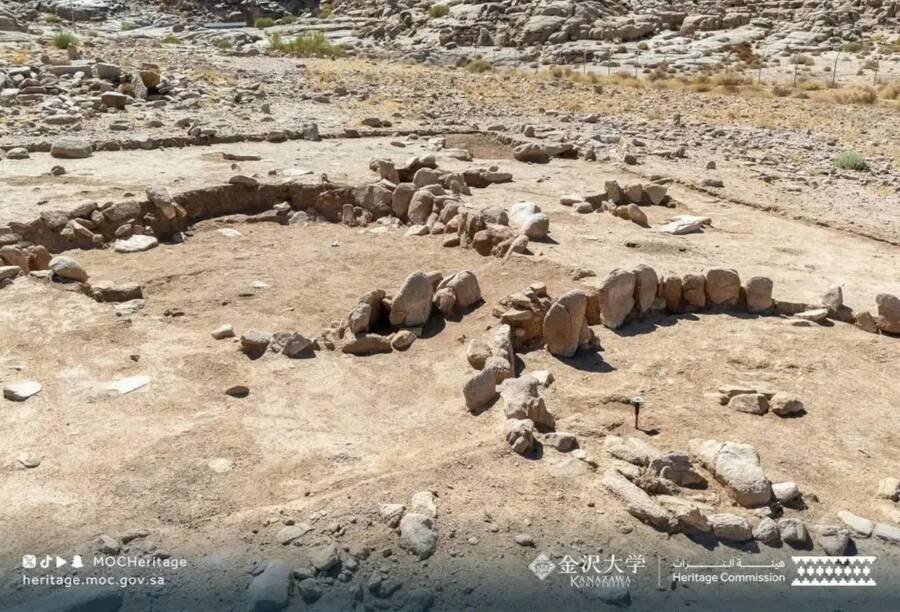
A recent study has uncovered evidence of human settlement in the Arabian Peninsula dating back over 210,000 years, challenging the prevailing belief that the region was uninhabited during the late Ice Age. The results were published in Nature Communications on March 23.
The study was based on archaeological and environmental evidence from the "Bhais Rock Shelter" site in the Emirate of Sharjah, United Arab Emirates. This site is considered one of the most important archaeological locations providing a detailed timeline of human presence in the area, extending from about 60,000 years to 16,000 years ago, in addition to even earlier periods.
Details of the Discovery
The Bhais site is located approximately 60 kilometers from the coast of the Arabian Gulf, in a desert region today. Although the site was known for its artifacts from more recent periods such as the Iron Age, recent excavations revealed much older layers dating back to the Paleolithic era, a time when early humans lived before the advent of agriculture.
Knut Breitsky, an archaeologist at Friedrich Schiller University in Jena, Germany, states that these layers represent an accumulated historical record, with each layer reflecting a different time period. By studying these layers, the team was able to trace human presence in the area over tens of thousands of years.
Context and Background
The study indicates that humans lived at the site during four major periods, dating back approximately 125,000 years, then 60,000 years, followed by 35,000 years, and finally around 16,000 years ago. The results expand the scope of known records and confirm repeated settlement in the region that began at least 210,000 years ago.
Breitsky adds that this recurrence of human presence suggests that humans were not merely passing through the area but were returning repeatedly, indicating that conditions allowed for life at certain times.
Implications and Impact
The evidence did not only indicate human presence but also included hundreds of stone tools left by ancient inhabitants, which were used for hunting or food preparation. These tools show a clear evolution over time, with early humans using simple tools based on stone flaking, while more recent periods saw the emergence of more precise and complex tools.
This change in tool forms not only reflects technological advancement but also indicates a shift in human behavior and their ability to adapt to the surrounding environment. Environmental analyses showed that periods of human presence at the site coincided with times when the region was wetter than it is today, providing a suitable environment for life.
Significance for the Arab Region
The findings suggest that the Arabian Peninsula was not a permanently arid desert but underwent periods when it became habitable. Additionally, humans were not merely influenced by the environment but were capable of adapting to it, reflecting a concept of resilient settlement.
These results hold particular importance for understanding how modern humans spread out of Africa, as the study indicates that southern Arabia may have been one of the main corridors through which humans migrated towards Asia and Europe.