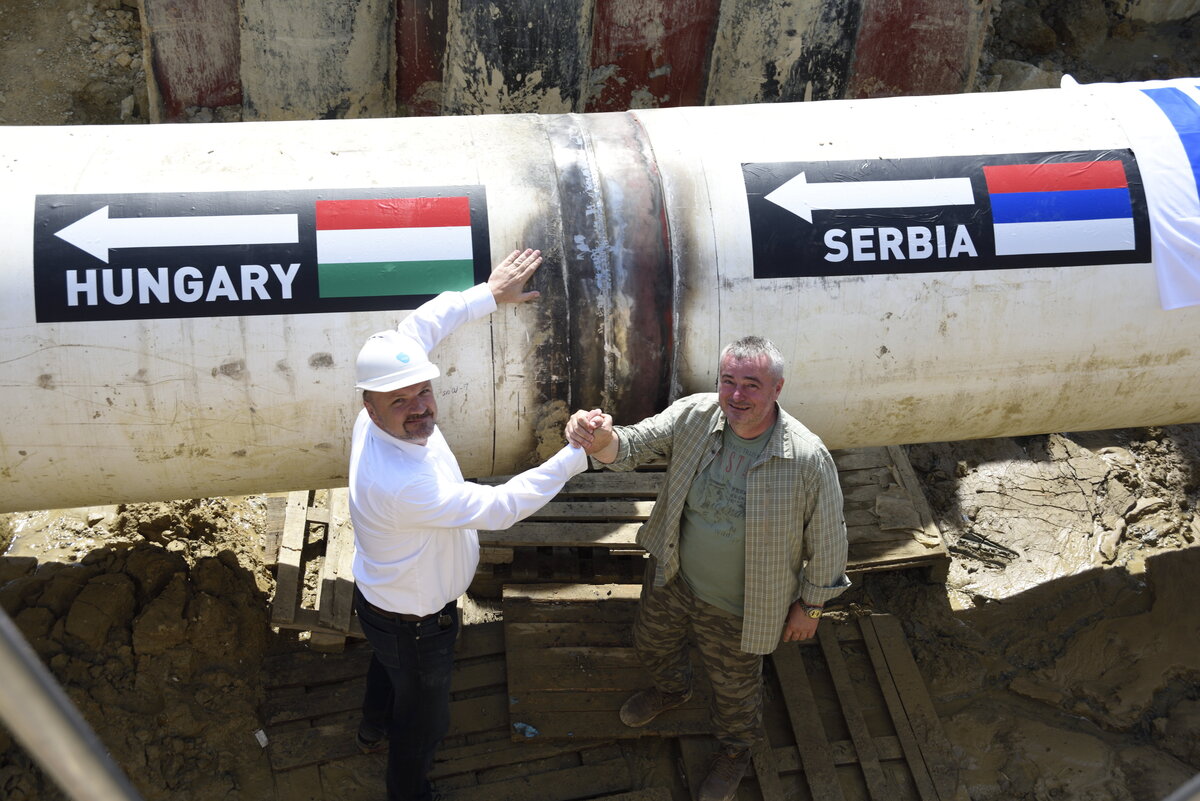
Hungarian Prime Minister Viktor Orbán convened an emergency meeting with the National Defense Council following the discovery of explosives near the gas pipeline transporting Russian gas to Hungary. This finding occurred in a border area with Serbia, just one week before elections deemed critical for his party, Fidesz.
This incident coincides with a significant decline for Orbán's party in opinion polls, raising questions about the government's motives. Opposition leader Péter Márki-Zay accused Orbán of "spreading panic" in collaboration with Russian advisors, following warnings from security experts about a potential "false flag" operation that could be attributed to Ukraine.
Details of the Incident
Two bags filled with explosives were discovered near the village of Tricsehvák in the Kanjiza region, approximately 20 km from the point where the TurkStream pipeline crosses into Hungary. Serbian President Aleksandar Vučić confirmed this discovery to Orbán on Sunday morning.
Vučić stated in an Instagram post: "We found explosives with destructive power," indicating that authorities would keep Orbán informed about the investigations. Hungary relies on Russian gas transported through this pipeline, with imported quantities ranging from five to eight billion cubic meters annually.
Background & Context
Since the onset of the war in Ukraine, Orbán has faced pressure from the European Union to abandon Russian energy imports. Nevertheless, he has remained adamant that cheap energy from Russia is the only way to maintain low fuel and heating prices in Hungary. This issue has made anti-Ukrainian sentiment a central part of his electoral campaign.
During campaign rallies, Orbán assured his supporters that low energy prices in Hungary depend on Russian oil and gas, reflecting his strong pro-Russian stance. He also accused Kiev, Brussels, and Berlin of conspiring to prevent Hungary from accessing cheap fuel, threatening the stability of his government.
Impact & Consequences
This incident raises questions about potential political ramifications, as it is believed to have the potential to influence the upcoming elections. Some security experts in Hungary suggested the possibility of a staged operation aimed at generating sympathy for Orbán, which could assist his party in winning the elections.
At the same time, this event serves as a test of the government's ability to handle security crises, and it may affect voter confidence in Orbán and his party. The mutual accusations between the government and the opposition could escalate political tensions in the country.
Regional Significance
This incident is particularly significant for the Arab region, where many Arab countries rely on Russian energy. The situation in Hungary may also impact global energy markets, reflecting on oil and gas prices in Arab nations.
In conclusion, the situation in Hungary remains under scrutiny, as political developments could lead to widespread implications for the European and global landscape.