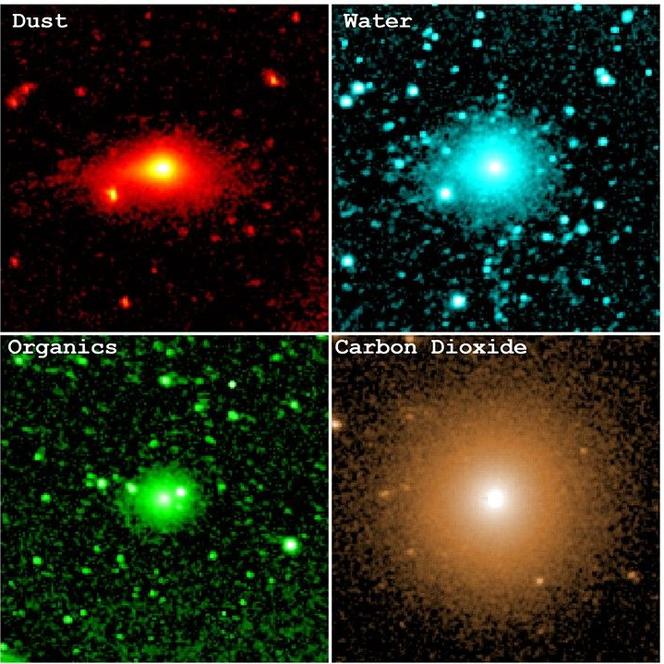
In an exciting development in the field of astronomy, scientists have obtained new information about the interstellar comet 3I/Atlas, which was discovered on July 1, 2025. This comet is considered a rare visitor to our solar system and has exhibited intriguing chemical properties during the second wave of observations that began in December 2025.
Initial research has shown that 3I/Atlas consists of a nucleus rich in volatile elements, with the release of these elements leading to the formation of a tail extending in the opposite direction of the sun. As the comet approached the sun, its visibility became more challenging, prompting scientists to wait until early December to observe it again after it passed its closest point to the sun on October 29.
Details of the Observations
During the first campaign of observations conducted between July and September, scientists confirmed that 3I/Atlas is indeed a comet and not merely an asteroid. These observations helped to better define its chemical properties, allowing scientists to understand how it formed in an extremely cold environment billions of years ago.
Following its approach to the sun, the second set of observations aimed at analyzing the comet's atmosphere with greater precision began. These observations come at a critical time as scientists seek to learn more about the formation of interstellar comets and how they may reflect the conditions that prevailed in the early universe.
Background & Context
3I/Atlas is the second of its kind to be discovered after the first interstellar comet, 1I/‘Oumuamua, which was observed in 2017. While 1I/‘Oumuamua disappeared quickly after its discovery, 3I/Atlas represents a unique opportunity to study an interstellar comet for a longer duration. Historically, interstellar comets are extremely rare, representing fascinating astronomical phenomena.
The rarity of such comets makes their study crucial for understanding the broader dynamics of our galaxy and the materials that may have contributed to the formation of our solar system.
Impact & Consequences
These discoveries open new horizons in astronomy, potentially aiding in the understanding of how planets and stars form in different environments. Additionally, studying interstellar comets may reveal information about the materials present in the early universe, which could lead to improved observational and imaging techniques in astronomy.
Furthermore, the insights gained from 3I/Atlas could enhance our understanding of the chemical processes that govern the formation of celestial bodies, thereby enriching our knowledge of cosmic evolution.
Regional Significance
The implications of studying 3I/Atlas extend beyond academic interest; they touch on the very foundations of our understanding of the universe. As scientists continue to explore the mysteries of interstellar comets, they may uncover clues that help explain the origins of our solar system and the conditions that led to the emergence of life.
In conclusion, the ongoing research into 3I/Atlas not only sheds light on the comet itself but also enhances our comprehension of the universe's history and the processes that shape it.