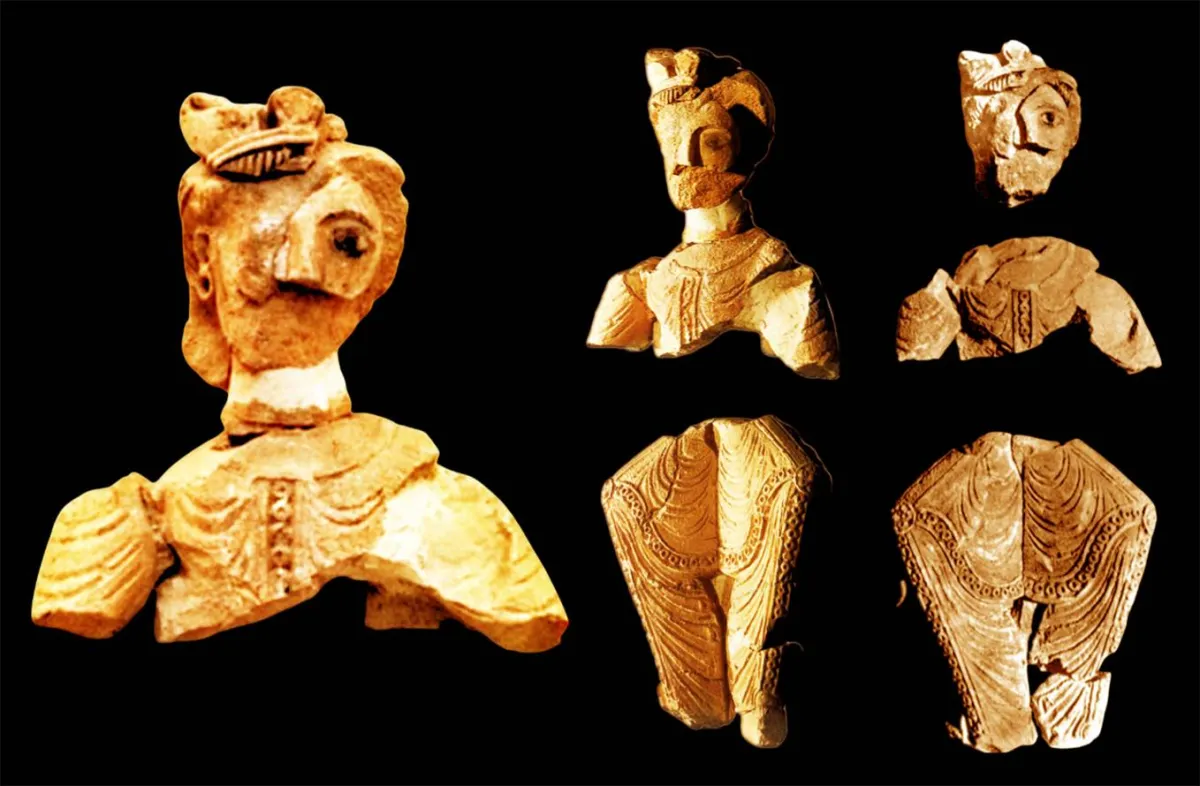
A royal monument representing Caliph Hisham ibn Abd al-Malik has been unveiled at Al-Hayr Al-Gharbi Palace, situated southwest of Palmyra. This monument is considered one of the most prominent components of Umayyad civil art, reflecting the richness and diversity of art during that era.
The significance of this monument lies in its representation of an idealized image of the Umayyad caliph, showcasing intricate details that reflect the greatness of Umayyad civilization. This monument was discovered among a collection of artifacts representing the architectural art of that period, highlighting the artistic and cultural advancements witnessed by the Umayyad state.
Details of the Discovery
The royal monument, found in Al-Hayr Al-Gharbi Palace, consists of three separate pieces, including the head, the upper part of the chest, and the legs. The head is connected to the upper part of the chest using an added neck, forming a bust that represents the upper part of the stature. Meanwhile, the leg block remains intact, reflecting the wear and tear the monument has endured over time.
This monument, currently displayed at the National Museum in Damascus, is one of the most important artifacts representing Umayyad art. The monument appears three-dimensional, yet its back is smooth and flat, indicating that it was affixed to a wall. It is believed that this sculpture was part of the palace facade, mounted on the surface of the arched alcove above the entrance door.
Background & Context
Historically, Al-Hayr Al-Gharbi Palace is one of the most significant Umayyad landmarks, built in the 8th century CE. This palace is known as part of a group of palaces referred to as the "Desert Palaces," which were used as places for rest and recreation. Umayyad art, characterized by ornamentation and architectural details, reflects multiple cultural influences, including Byzantine and Persian arts.
The royal monument also represents a traditional model of kings during that period, depicting Caliph Hisham ibn Abd al-Malik wearing the attire of the Persian Khosrow. This style of sculpture was popular in the Mediterranean world, adopted by the Umayyad caliphate, which inherited the glory of the Sasanian kings. The monument illustrates how Umayyad art was inspired by previous cultures and reshaped to fit the Islamic identity.
Impact & Consequences
This discovery serves as evidence of the evolution of Umayyad art and its influence on subsequent arts. The monument demonstrates that Umayyad civilization was not merely a temporal period but a turning point in the history of art and culture in the region. This discovery also underscores the importance of preserving cultural heritage and historical artifacts that represent Arab and Islamic identity.
This royal monument is also a symbol of power and prestige, showcasing how the arts were used as a means to enhance the status of rulers. It highlights the significance of the arts in expressing the cultural and religious values that prevailed during that time.
Regional Significance
This discovery holds great importance for the Arab region, reflecting the rich cultural heritage it possesses. Umayyad art is an essential part of Arab identity, illustrating how previous civilizations contributed to shaping contemporary culture. It also emphasizes the importance of cultural tourism in the region, as this discovery could attract visitors and researchers interested in the history of Islamic civilization.
In conclusion, this royal monument stands as a testament to the greatness of Umayyad civilization and highlights the importance of the arts in expressing cultural identity. Arab countries should invest in preserving and enhancing this heritage, ensuring it remains a part of the collective memory of the nation.