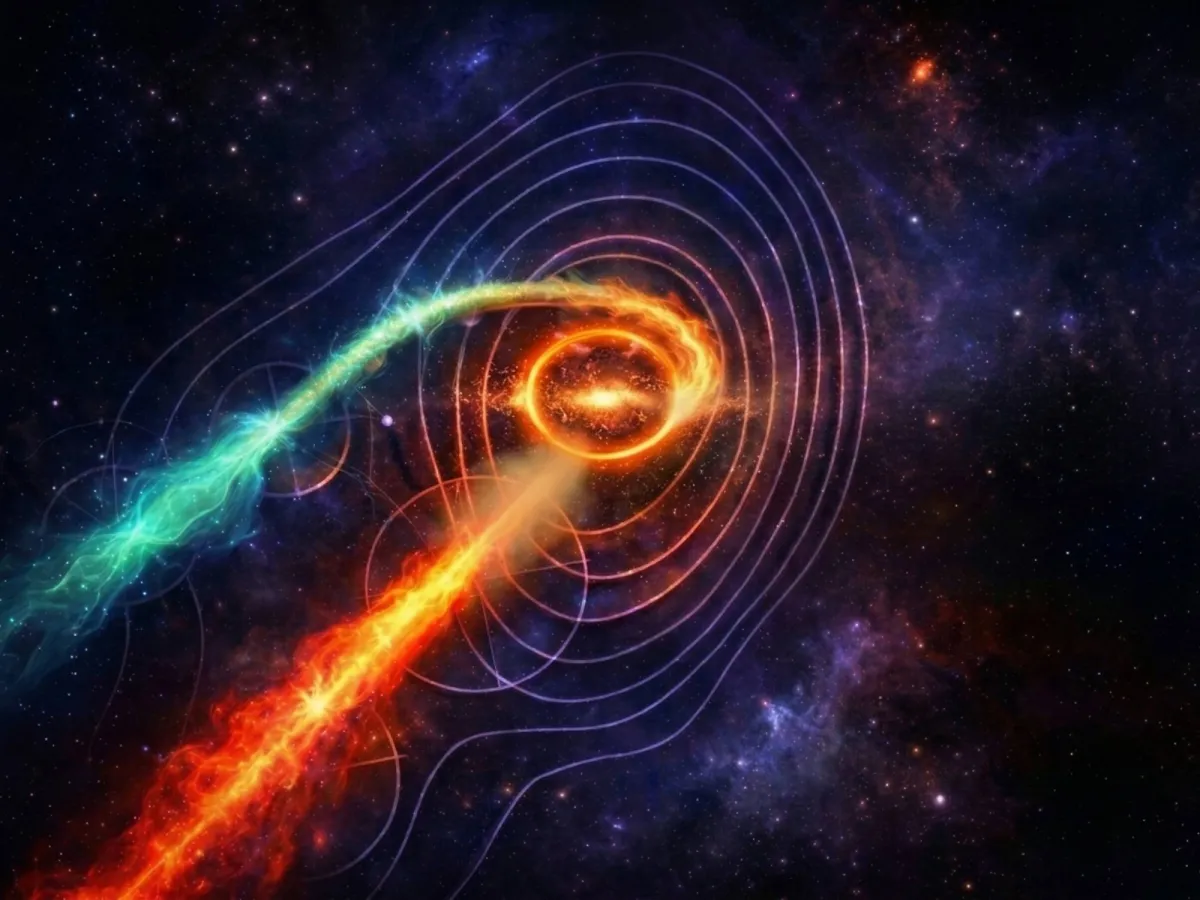
A research team from the Max Planck Institute for Radio Astronomy in Germany has uncovered direct evidence of two supermassive black holes in Markarian 501, orbiting each other in very close orbits. These discoveries may be the first of their kind to record a pair of black holes on the verge of merging, providing a unique opportunity to understand a pivotal process in galaxy evolution.
The results published in the Monthly Notices of the Royal Astronomical Society, led by astronomer Silke Britzen, indicate that nearly every large galaxy contains a supermassive black hole at its center, with masses exceeding that of the sun by millions or even billions of times. However, it remains unclear how these black holes can reach such massive sizes. Therefore, it is likely that supermassive black holes in the centers of colliding galaxies will merge, as they orbit each other increasingly closely, ultimately merging to form a single galaxy.
Details of the Event
Supermassive black holes at the centers of galaxies are among the most active areas of research in astronomy. So far, theoretical models have struggled to accurately describe this final stage. However, the new study of Markarian 501 has changed this reality, as the black hole at the center of the galaxy has been observed ejecting powerful jets of particles moving at speeds close to that of light into space.
To conduct this study, the team analyzed high-precision observations, revealing the first direct image of such a system at the center of a galaxy, providing conclusive evidence of the existence of a second adjacent supermassive black hole. Britzen states, "We have been searching for this system for a long time, and now we can also track its motion."
Background & Context
The first black hole's jet is directed toward Earth, making it appear particularly bright, and has been known for a long time. The second jet, however, is oriented differently, making it more challenging to observe. Britzen explains, "The entire jet system has been in constant motion, which explains the existence of a binary black hole system, where the orbital plane oscillates."
On one observation day in June 2022, radiation emitted from the system reached us via a highly convoluted path, appearing as a ring — known as an Einstein ring. By analyzing the brightness evolution of the jets over time, the researchers concluded that the two black holes are orbiting each other, with a distance between them ranging from 250 to 540 times the distance between the Earth and the sun.
Impact & Consequences
This distance is extremely small for such massive objects, with masses ranging from 100 million to 1 billion times the mass of the sun. Based on their actual masses, the distance between them could shrink rapidly, meaning they could merge within just 100 years. Co-author of the study Hector Olivares notes, "When gravitational waves are detected, we may witness a steady increase in their frequency as these giants approach collision, providing a rare opportunity to observe the merger of two supermassive black holes."
This discovery opens new avenues in understanding black holes and galaxy evolution, reflecting the importance of astronomical research in exploring the universe's mysteries. Additionally, studying black holes may contribute to developing more accurate theoretical models to understand these cosmic phenomena.
Regional Significance
These discoveries hold particular significance for the Arab region, as they can inspire astronomical research in Arab countries and contribute to enhancing scientific collaboration among nations. Understanding black holes and galaxy evolution can open new horizons for scientific research in space and astronomy in the Arab world.
In conclusion, this discovery represents a significant step toward a deeper understanding of the universe, reflecting the ongoing efforts of scientists in exploring the secrets of space.