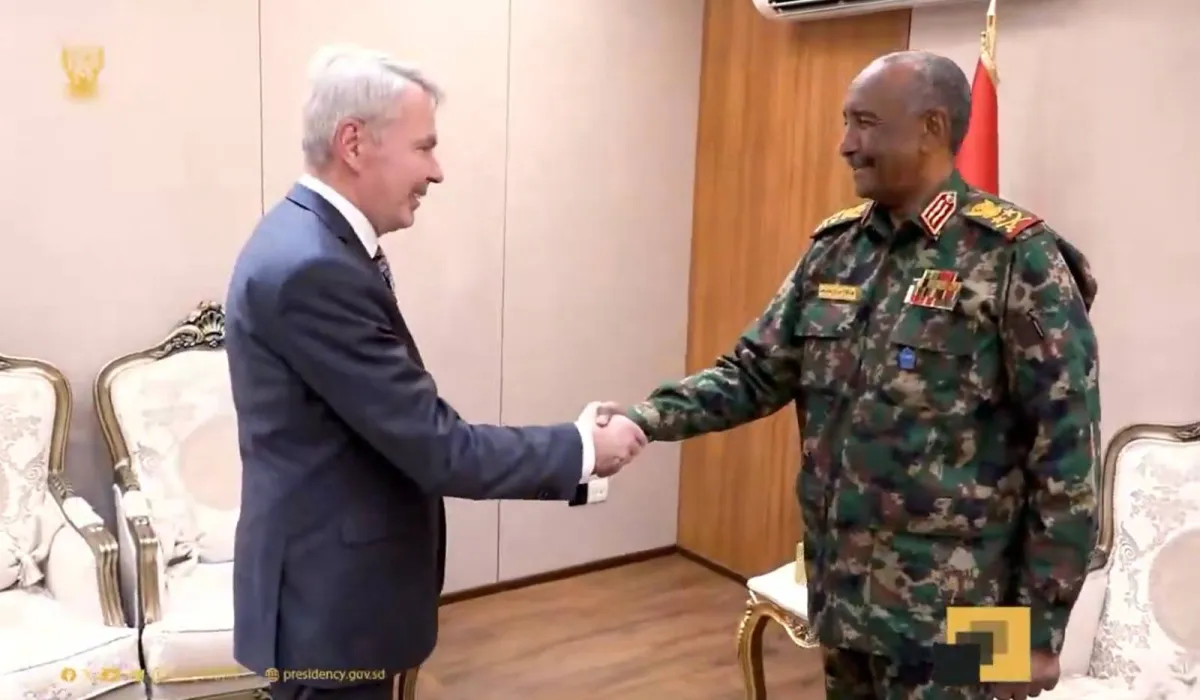
Sudan's transitional Sovereign Council President and Commander-in-Chief of the Sudanese Armed Forces, Abdel Fattah al-Burhan, met on Wednesday in the capital Khartoum with the UN Secretary-General's personal envoy to Sudan, Pekka Haavisto, to discuss international efforts aimed at ending the war in the country. These meetings occur at a time when Sudan is witnessing an escalation in field developments across several regions, complicating the security and humanitarian situation.
Haavisto, who is on his first official visit to Sudan since his appointment, reiterated the UN's commitment to supporting efforts aimed at achieving a ceasefire and working towards a lasting peaceful resolution to the conflict. He emphasized that his visit represents an important opportunity to hear directly from various key political and civil actors in the country.
Details of the Meeting
During the meeting, the UN envoy stressed the importance of adopting dialogue and de-escalation as a fundamental approach towards a comprehensive cessation of hostilities. He also highlighted the necessity of prioritizing civilian protection and taking confidence-building measures to create conditions for tangible progress in the political process. Haavisto clarified that the UN remains fully engaged with all stakeholders to promote peace and stability and provide humanitarian assistance throughout Sudan.
Haavisto also met with Sudan's Minister of Finance, Gabriel Ibrahim, who provided a detailed explanation of the economic and humanitarian conditions in the country amid the ongoing conflict. Ibrahim affirmed the Sudanese government's rejection of any ready-made solutions that may be proposed by the international community, emphasizing that the participation of all actors is a crucial step towards building a clear vision for the peace process.
Background & Context
This UN initiative comes at a time when Sudan is experiencing an escalation in armed conflict, with military operations continuing in many regions, threatening the country's stability. For instance, the Blue Nile region has witnessed rapid field developments, with the region's governor, Ahmed Al-Omda, confirming the security situation's stability despite the fall of the strategic city of Kurmuk.
These events coincide with increasing reports of field advances by the