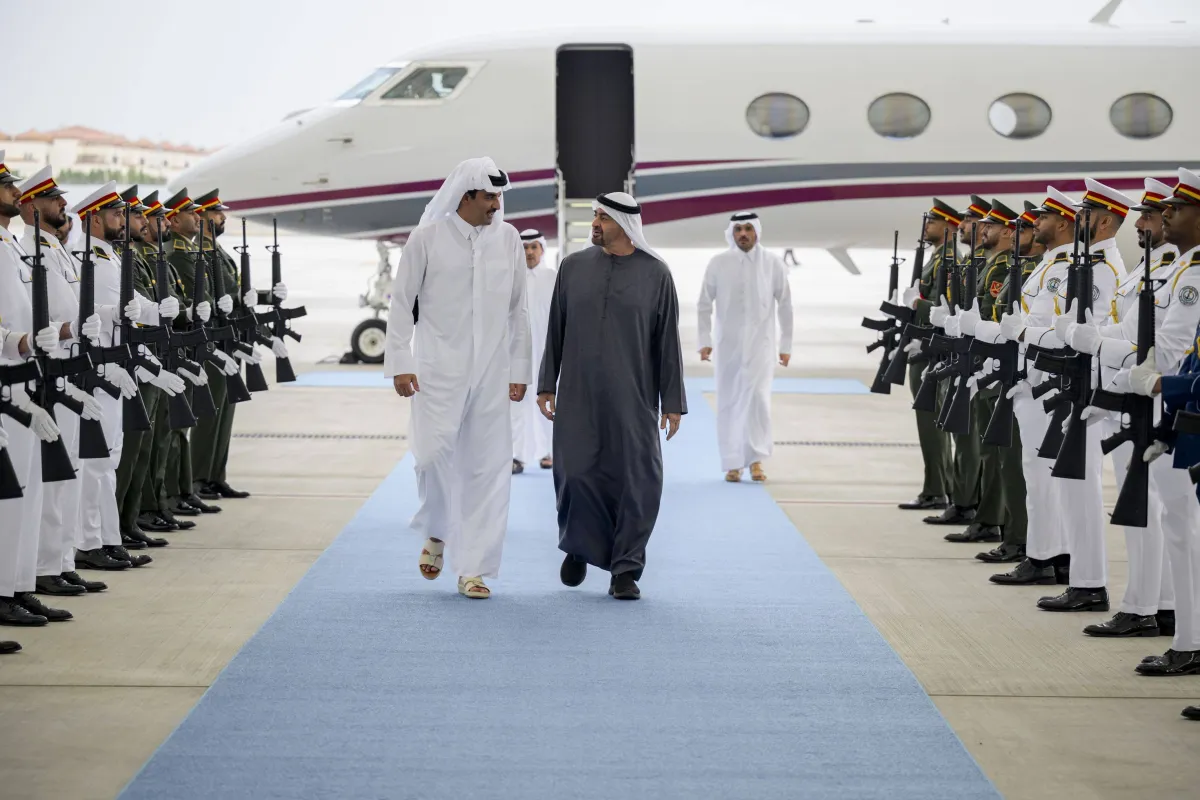
The UAE President Sheikh Mohammed bin Zayed Al Nahyan met with Qatari Emir Sheikh Tamim bin Hamad Al Thani on Tuesday in Abu Dhabi to discuss developments in the region amid military escalation and its implications for regional and international security and stability. The meeting also addressed the impact of these aggressions on the security of international navigation and the global economy.
The discussions highlighted the ongoing Iranian aggressions targeting the UAE and Qatar, which pose a direct threat to civilians and vital installations. Both sides emphasized the importance of cooperation in defending their security, sovereignty, and the safety of their territories and citizens.
Details of the Meeting
The Qatari Ministry of Foreign Affairs confirmed that recent Iranian attacks have crossed red lines, warning of the repercussions of continued escalation on regional security. Qatari Foreign Ministry spokesman Majid Al Ansari called for de-escalation in the region, noting that ongoing tensions would not benefit any party and would lead to further losses. He welcomed diplomatic initiatives aimed at calming the situation, stressing the importance of dialogue and negotiation.
Regarding Lebanon, Al Ansari emphasized the need to respect the country's sovereignty, pointing out that Israeli attacks represent a clear violation of international law. He also revealed coordination with international parties to contain the escalation in Lebanon.
Background & Context
These meetings come at a time when the Middle East is witnessing increasing military escalation, with countries in the region facing ongoing threats from Iran. These aggressions have impacted regional security, prompting Gulf states to enhance security and defense cooperation among themselves.
Historically, relations between Gulf countries and Iran have been marked by ongoing tensions, with Gulf states accusing Iran of supporting armed groups and destabilizing the region. These tensions place the region in a state of uncertainty, affecting regional security and stability.
Impact & Consequences
The Iranian aggressions directly affect regional security, raising concerns about a larger military escalation that could lead to armed conflicts. These tensions also impact the global economy, particularly in energy and navigation sectors, as the Strait of Hormuz is a vital point for oil transportation.
The swift response from UAE and Saudi air defenses reflects these countries' readiness to confront any threats. The Qatari armed forces have also demonstrated their capability to counter attacks, highlighting the importance of military cooperation among Gulf states.
Regional Significance
These events serve as a wake-up call for Arab countries, underscoring the need to strengthen security and defense cooperation to address common threats. The military escalation may also affect peace and stability efforts in the region, requiring Arab states to take effective steps for collaboration and coordination.
In conclusion, dialogue and negotiation remain the optimal means for resolving conflicts and achieving stability in the region. Arab countries must work together to face the security and economic challenges they encounter and enhance cooperation in defense and security fields.