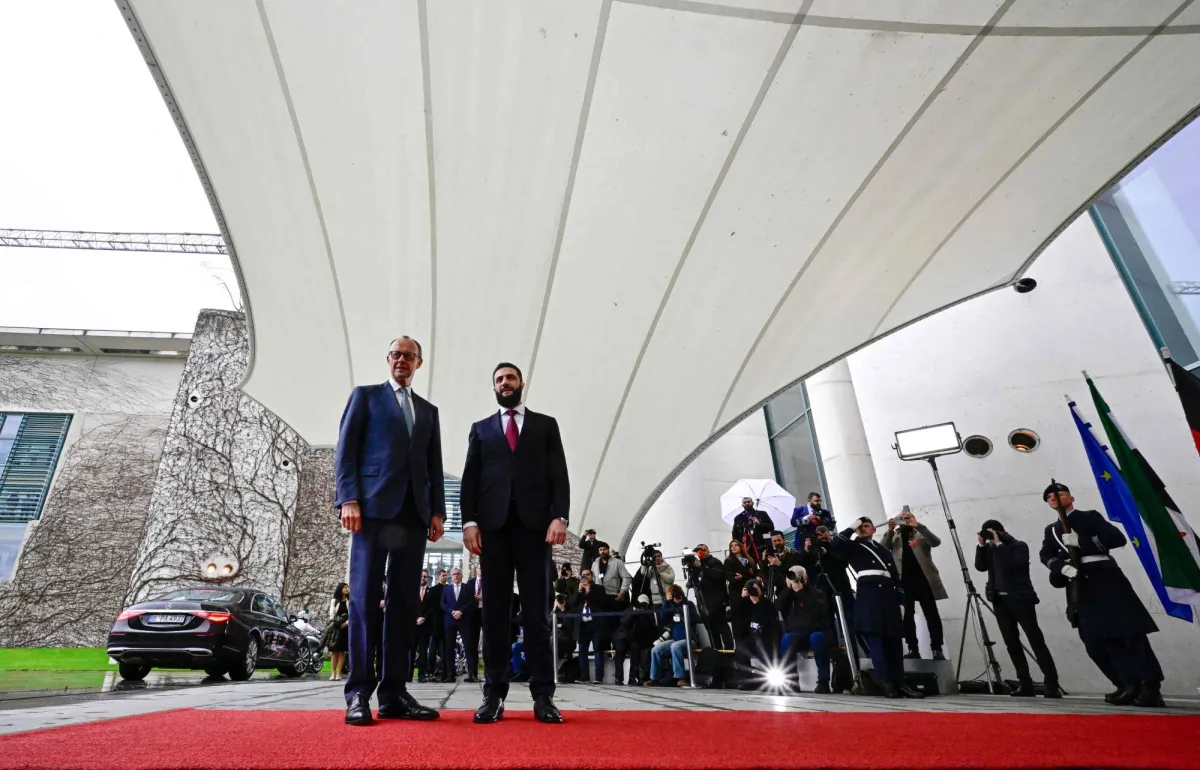
The issue of refugee return dominated Syrian President Ahmad al-Shara's visit to Berlin, where German Chancellor Friedrich Merz announced during a joint press conference that "approximately 80% of Syrians currently residing in Germany are expected to return to their homeland within the next three years."
In response to this announcement, President al-Shara confirmed that the Syrian government is working with its partners in the German government to establish a circular migration program, which allows Syrian professionals to contribute to the reconstruction of their homeland without abandoning the lives they have built in Germany.
Details of the Event
During the press conference, Merz indicated that Germany intends to support reconstruction efforts in Syria post-war, revealing plans for a delegation from the German government to visit Damascus in the coming days. He clarified that these joint projects will remain contingent on developments related to strengthening the rule of law in Syria.
This visit comes at a time when the situation in Syria is undergoing significant changes, as the Syrian government seeks to regain control over internal conditions and enhance relations with Western countries, especially after years of ongoing conflict.
Background & Context
Since the onset of the conflict in Syria in 2011, the country has witnessed massive waves of displacement and asylum, with millions fleeing to neighboring countries and Europe in search of safety. These conditions have affected host communities, leading to economic and social challenges.
Germany is considered one of the countries that has welcomed a large number of Syrian refugees, as the German government seeks to find sustainable solutions to this issue, including programs for the return of refugees to their homeland.
Impact & Consequences
If the refugee return plan is successfully implemented, it could lead to improvements in the economic and social situation in Syria, as returning professionals may contribute to the country's reconstruction. However, questions remain regarding the security and economic conditions in Syria, and the government's capacity to accommodate returnees.
Moreover, these steps could affect relations between Syria and Western countries, potentially opening doors for further cooperation in various fields, including economics and security.
Regional Significance
The issue of Syrian refugees is one of the most complex issues in the region, affecting relations between Arab countries and Western nations. Efforts to return refugees may help alleviate pressures on host countries, but they also require international coordination to ensure the success of these plans.
Ultimately, the matter of returning refugees to Syria remains a sensitive topic that requires careful consideration, as all parties involved must take into account the internal conditions in Syria and the challenges that returnees may face.