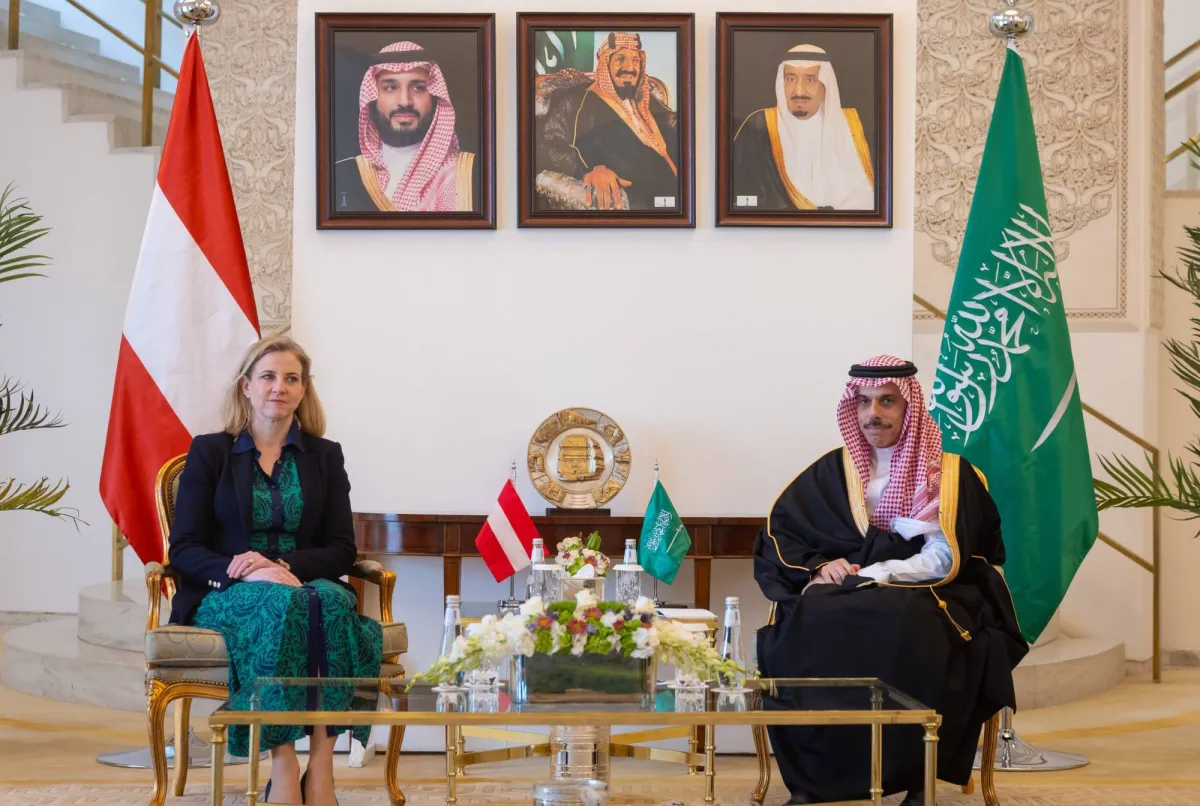
Saudi Foreign Minister Prince Faisal bin Farhan met with his Austrian counterpart, Beate Meinl-Reisinger, on Tuesday to discuss the current conditions in the region and their security implications. The meeting took place at the Saudi Ministry of Foreign Affairs in Riyadh, where the two officials reviewed the bilateral relations between their countries.
Present at the meeting from the Saudi side was Dr. Saud Al-Sati, the Deputy Minister for Political Affairs, where various regional and international issues of concern to both countries were addressed. This meeting occurs at a sensitive time, as the deadline set by U.S. President Donald Trump for the Iranian regime is nearing its end, increasing tensions in the region.
Event Details
As part of preparations to face potential challenges, a strategic report issued by the Gulf Research Center presented five scenarios for potential air operations that could be carried out by the United States and Israel within Iranian territory. The scenarios range from limited incursions targeting sensitive sites, such as Kharg Island, to more complex scenarios involving the opening of multiple ground fronts.
The report indicated that the scenarios also include a decisive strike targeting the Iranian capital, Tehran, focusing on potential challenges such as Iranian missile capabilities and the leadership crisis following the death of Supreme Leader Ali Khamenei.
Background & Context
These developments coincide with escalating tensions in the region, where the United Arab Emirates has witnessed missile and drone attacks originating from Iran. The UAE Ministry of Defense confirmed that it has intercepted 520 ballistic missiles and 2,221 drones since the onset of Iranian aggressions, reflecting the rising security threats.
In this context, Sultan Haitham bin Tariq of Oman emphasized the importance of intensifying efforts towards achieving de-escalation in the Gulf region, stressing the need for fundamental solutions to current crises. This came during his meeting with the Kuwaiti Foreign Minister, where the implications of the ongoing war on regional countries and the global economy were discussed.
Impact & Consequences
The current tensions in the region could lead to military escalation, threatening regional security and stability. The scenarios outlined in the report suggest that any military operation may face significant challenges, including potential Iranian responses, which could involve missile and drone attacks on deployed forces.
Furthermore, any military intervention could exacerbate humanitarian conditions and impact the global economy, especially given the heavy reliance on energy supplies from the region. Gulf countries are focusing on protecting their national security and avoiding direct military conflicts.
Regional Significance
Arab countries are directly affected by developments in the Gulf, as any escalation could lead to negative repercussions on security and stability in the region. The current tensions may result in increased migration and displacement, as well as affecting local economies.
In light of these circumstances, there remains an urgent need to enhance dialogue and cooperation among Arab countries to achieve security and stability, and to avoid military escalation that could plunge the region into new crises.