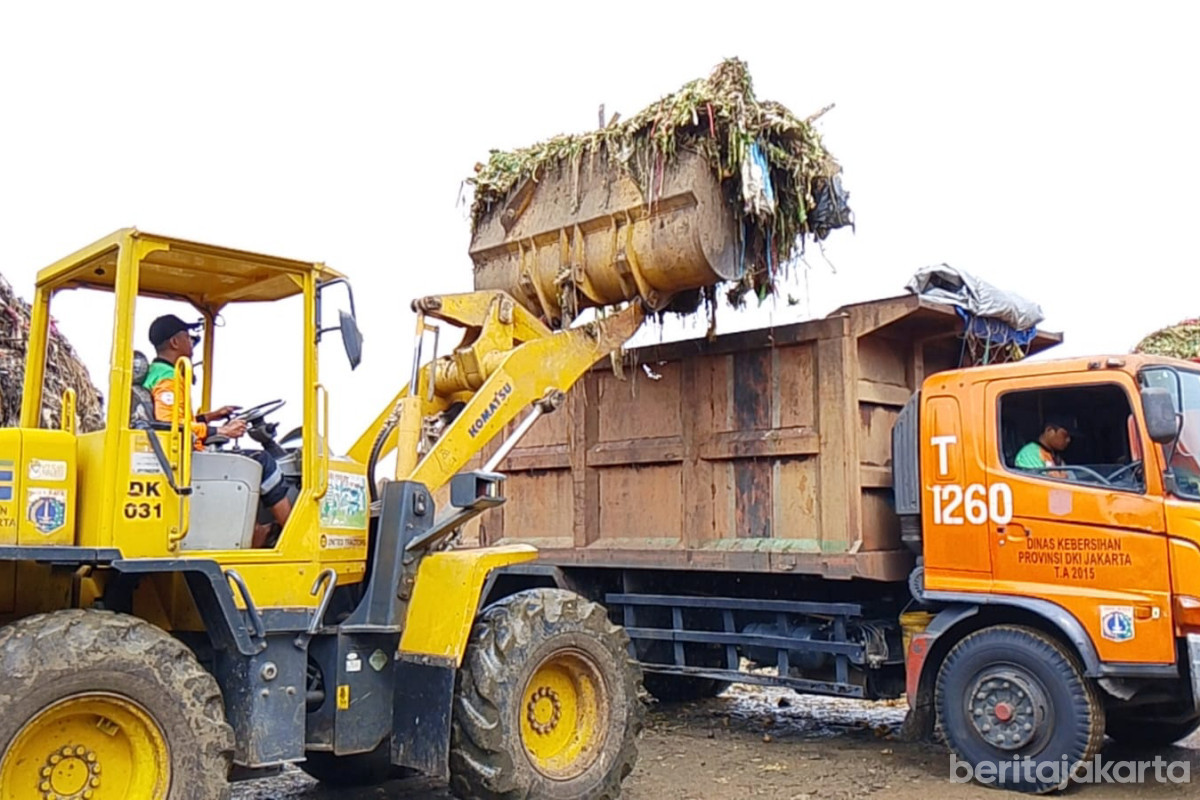
Efforts to remove the accumulated waste at Kramat Jati Market in East Jakarta continue, but these efforts, which began four days ago, have yet to show any tangible results. According to a sanitation worker, Sugiyat (55 years old), the number of trucks used for the removal operations has been significantly lower than before, leading to the ongoing issue.
Approximately twenty trucks were utilized on the first day, but this number dropped to thirteen trucks on the second day, and by the third day, the trucks that left the site were fewer than the fingers on a hand. Consequently, the six-meter-high waste piles continue to dominate the landscape in the area.
Details of the Situation
Images captured from the waste site show that the garbage piles remain high, raising concerns among traders and citizens. Sugiyat pointed out that the current situation is vastly different from what it was last January, when removal operations were carried out more swiftly due to the use of a larger number of trucks. At that time, as many as fifty trucks were used daily, which significantly helped in reducing the volume of waste.
The current removal operations face additional challenges, as only one heavy machine has been used for waste removal, whereas two heavy machines were previously employed. These equipment limitations contribute to exacerbating the problem, as current efforts cannot cope with the large quantity of accumulated waste.
Background & Context
The waste problem in Jakarta is an ongoing issue that affects the quality of life in the city. Residents of the Indonesian capital suffer from environmental and health problems due to the accumulation of waste, necessitating a swift and effective response from local authorities. Previously, there were increased efforts to improve waste management, but it seems these efforts have not been sufficient to tackle the current challenges.
Complaints from traders at Kramat Jati Market are on the rise, as they express concern over the impact of waste accumulation on their businesses. The atmosphere surrounding the market has become uncomfortable, with waste causing foul odors that negatively affect customers.
Impact & Consequences
The repercussions of waste accumulation at Kramat Jati Market extend beyond environmental dimensions, also affecting the local economy. With a decline in customers due to unpleasant odors and unhealthy conditions, traders may face significant financial losses. Moreover, the continuation of this problem could lead to the outbreak of diseases, posing a threat to public health.
Local authorities, represented by Julius Monak, head of the environment department in East Jakarta, are striving to address this issue by providing more trucks and human resources. He has assured that support will continue until the problem is fully resolved.
Regional Significance
The waste management issue is one of the challenges faced by many Arab countries as well. With increasing population and rapid urban growth, Arab cities encounter similar challenges in waste management. Jakarta's experience can be seen as an important lesson for Arab countries on how to deal with these environmental issues.
In conclusion, authorities in Jakarta need to take urgent and effective steps to address the waste problem at Kramat Jati Market to ensure the health and safety of citizens and to protect the environment. Improving waste management is essential not only in Indonesia but worldwide, including in Arab countries.