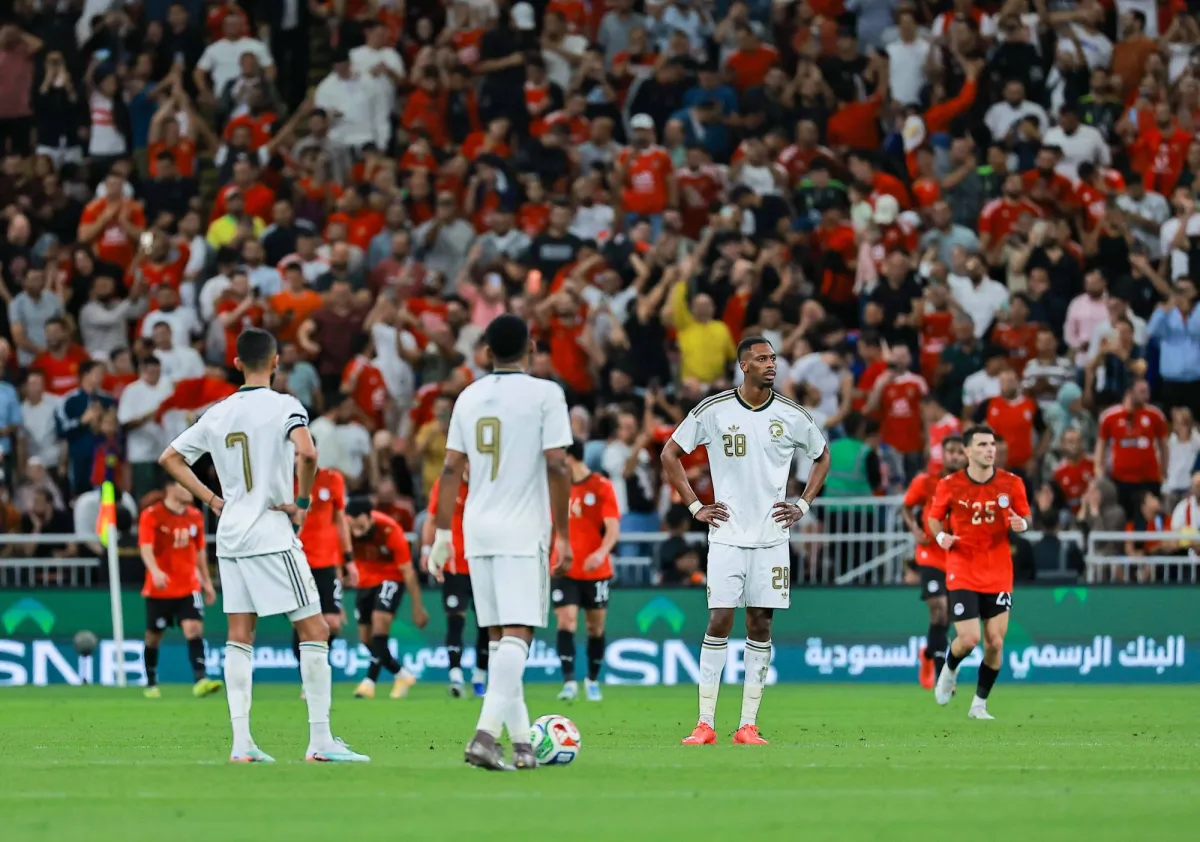
The Egyptian national team achieved a resounding victory over Saudi Arabia with a score of 4-0 in a friendly match, raising questions about the Green Falcons' preparations for the World Cup. The Saudi performance was disappointing, prompting criticism from analysts.
In the match held at the King Abdullah Sports City in Jeddah, Islam Issa opened the scoring for Egypt in the fourth minute, followed by Mohamed Hassan 'Trezeguet' in the 16th minute, then Ahmed Sayed 'Zizo' in the 44th minute, and finally Omar Marmoush capped off the scoring with a fourth goal in the 56th minute. Despite the absence of Liverpool star Mohamed Salah due to injury, the Egyptian team delivered a strong and cohesive performance.
Match Details and Performance Analysis
The Egyptian team had a significant opportunity to showcase its strength before the World Cup, capitalizing on the absence of several key players from the Saudi squad, such as Salem Al-Dawsari, Hassan Tambakti, and Zakaria Hawsawi. Saudi coach Hervé Renard used the match to experiment with a range of players, which affected the overall performance of the team.
After the match, Prince Abdul Rahman bin Musaad, former president of Al-Hilal Club, criticized the performance of the Saudi team, expressing sarcasm about the current state of the team, stating: "Our national team is excused, and we should not be harsh on them, a team playing without players, without a coach, without an administrative staff, and without a federation overseeing it!"
Background & Context
This match comes as part of both teams' preparations for the 2026 World Cup, as each seeks to improve its performance ahead of the tournament. The Egyptian team is placed in Group G alongside Belgium, Iran, and New Zealand, while the Saudi team is in Group H with Spain, Cape Verde, and Uruguay.
Historically, friendly matches between the two teams have seen significant competition, but this time the result was unexpected, reflecting the current performance gap between the two teams. The Egyptian team showed remarkable development, while the Saudi team still requires fundamental improvements.
Impact & Consequences
This loss serves as a harsh lesson for the Saudi team, as the coaching staff and players must reevaluate their strategies and tactics before the World Cup. The weak performance in both defense and attack raises concerns about the team's ability to compete in the upcoming tournament.
On the other hand, this result may boost the morale of the Egyptian team, which aims to deliver a strong performance in the World Cup, potentially affecting fans' and media's expectations regarding its chances in the tournament.
Regional Significance
This match exemplifies the challenges faced by Arab teams in international arenas, as effective strategies are required to develop the level of local players. Additionally, the good performance of the Egyptian team may encourage other teams in the region to improve their performance and better prepare for international competitions.
In conclusion, the Saudi team must learn from this experience and work on correcting mistakes before the World Cup, while the Egyptian team continues to build its confidence as one of the teams capable of competing strongly.