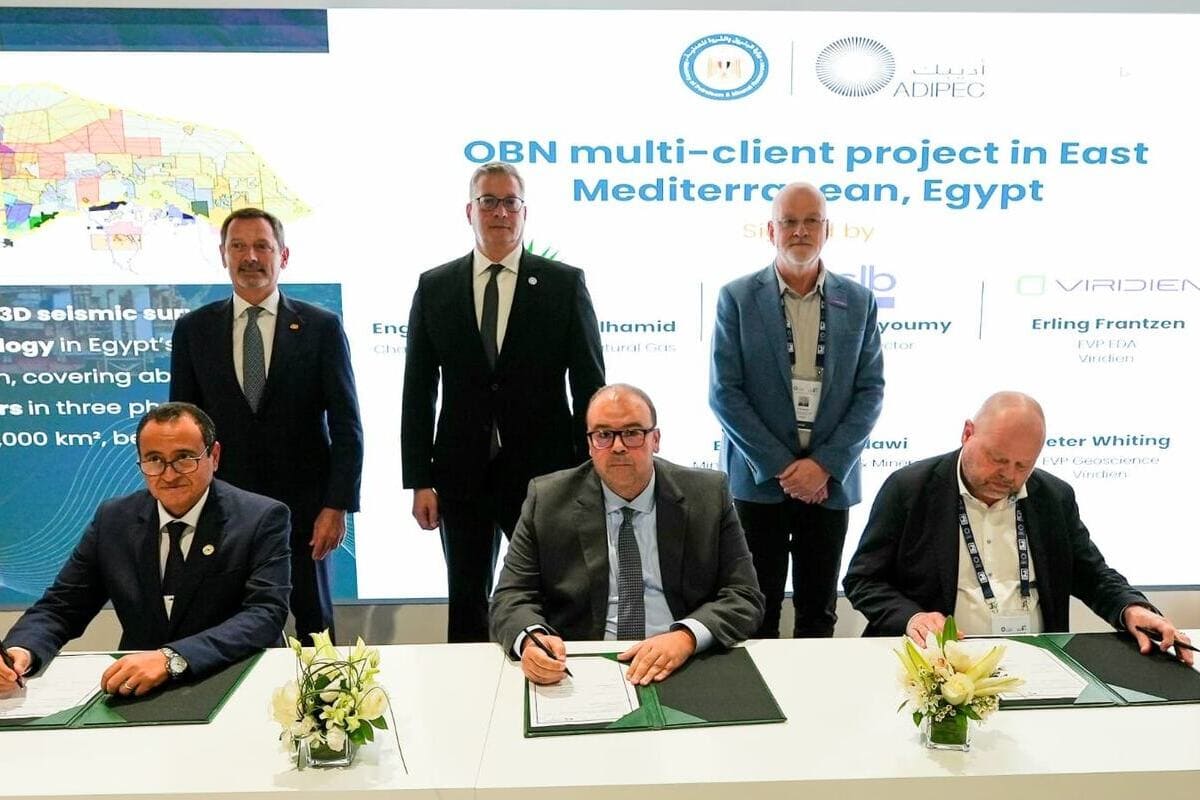
Egyptian authorities announced today, Thursday, the signing of a $500 million agreement with Arcus to develop the Harmatan gas field in the Mediterranean. The project aims to produce around 150 million cubic feet of gas and 3,300 barrels of condensate daily, with the potential to increase production to 200 million cubic feet of gas and 4,400 barrels of condensate daily, with completion expected by 2028.
According to a statement from the Egyptian Ministry of Petroleum, the project will begin its first phase by drilling two wells as part of an investment plan for the Pharaonic Petroleum Company. This agreement follows the ministry's announcement in November 2025 regarding Arcus acquiring all production and exploitation rights in the offshore Al-Burj area agreement in the Mediterranean, including the development contract for the Harmatan field, after the transfer of rights and obligations from Shell and BP to Arcus.
Details of the Agreement
Within the framework of this agreement, the Egyptian Ministry of Petroleum confirmed that the company will inject new investments to bring the field into production, as part of a broader expansion plan in the Mediterranean. Last February, Arcus presented a five-year work program in Egypt, aiming to expand research, exploration, and production, double the company's production rates, and increase its business portfolio while acquiring new exploration areas.
The statement also highlighted the company's success in finalizing the investment agreement for the development of the Harmatan field, alongside other expansion plans in the natural gas sector. This direction reflects the Egyptian government's commitment to increasing local gas production, as Egyptian Petroleum Minister Kareem Badawy confirmed in January that the current priority is to raise crude oil and gas production to reduce import bills and secure needs for the summer of 2026.
Background & Context
This step comes at a time when Egypt is seeking to enhance its position as a major gas supplier in the region, especially following significant gas discoveries in recent years. The Egyptian government has launched an ambitious plan to drill more than 100 exploratory wells for oil and gas during 2026, including 14 gas wells in the Mediterranean, as part of a broader program targeting around 500 wells by 2030.
These efforts reflect the government's desire to better utilize natural resources and achieve self-sufficiency in gas, contributing to reducing reliance on imports. Additionally, these projects align with Egypt's strategy to become a regional energy hub.
Impact & Consequences
The development of the Harmatan field is expected to enhance gas production in Egypt, leading to increased economic returns and the creation of new job opportunities. This project may also strengthen Egypt's ability to export gas to European markets, especially in light of the global trend to reduce dependence on Russian energy.
This agreement is a significant step in the context of Egypt's efforts to achieve sustainable development, as the government seeks to balance optimal resource exploitation with environmental preservation. Increasing gas production could also improve the overall economic situation in the country.
Regional Significance
This agreement serves as an indicator of the positive trend in the energy sector in the region, as many Arab countries seek to better exploit their natural resources. Egypt's success in developing the Harmatan field may encourage other countries in the region to invest in similar projects, thereby enhancing regional cooperation in the energy sector.
In conclusion, this agreement represents a strategic step for Egypt towards achieving gas self-sufficiency and enhancing its position as a major energy supplier in the region, opening new avenues for economic cooperation with neighboring countries.