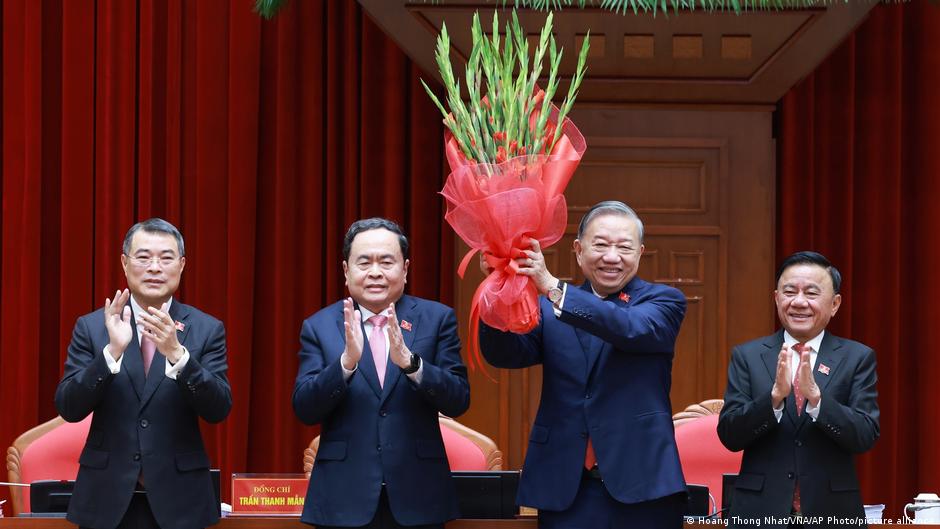
The Vietnamese parliament has unanimously elected To Lam, the General Secretary of the Communist Party, as the country's president for a five-year term, making him the most powerful Vietnamese leader in decades. This election took place during a parliamentary session held on Tuesday, where To Lam received support from all 495 attending deputies, while five deputies were absent from the session.
After the oath-taking ceremony, To Lam confirmed in his speech to the National Assembly that his priorities would focus on maintaining peace and stability, noting that these elements are the foundation for rapid and sustainable growth. He also added that he aims to improve the living standards of citizens to ensure they benefit from the fruits of development.
Details of the Event
The election of To Lam represents a significant transformation in the power structure in Vietnam, where the leadership of the party and the state has traditionally been under two different leaders. Now, To Lam combines both positions, indicating a trend towards centralizing power in one hand, which may reflect governance patterns in countries like China under Xi Jinping's leadership.
This concentration of power is expected to lead to faster decision-making, but it may also raise concerns about increased authoritarianism in the one-party state. In his speech, To Lam described his new role as a "great honor" and a "sacred and noble duty," reflecting his commitment to enhancing national stability and development.
Background & Context
Historically, Vietnam has undergone significant political and economic transformations since the beginning of economic reforms in the late 1980s. These reforms, known as "Doi Moi," have contributed to transforming Vietnam into one of the fastest-growing economies in the world. However, the Communist Party remains the dominant force in the country, limiting political freedoms.
To Lam, who assumed the position of General Secretary of the Communist Party in 2021, has implemented rapid reforms during his leadership, abolishing eight ministries and pushing for massive infrastructure projects. These reforms have demonstrated his ability to outmaneuver competitors and achieve radical changes in the structure of government.
Impact & Consequences
Analysts believe that the concentration of power in To Lam's hands may lead to the strengthening of the authoritarian regime, but at the same time, it could facilitate the quick decision-making necessary to accelerate economic growth. A new growth model has been proposed, aiming for double-digit annual growth over the next five years.
To Lam also highlighted the importance of self-reliance in defense, reflecting the government's direction towards enhancing military capabilities amid rising regional tensions. These steps could affect relations with neighboring countries, especially in light of increasing regional competition.
Regional Significance
Vietnam's experience in economic and political reforms is significant for Arab countries seeking sustainable development. This experience can provide lessons on how to balance political stability with economic growth.
Moreover, the concentration of power in one hand may serve as a model to emulate or caution against in the region, as some countries seek to bolster their executive powers in the face of economic and political challenges.
The election of To Lam as President of Vietnam represents a turning point in the country's history, reflecting new aspirations towards achieving development and stability, thereby opening new horizons for cooperation and interaction with other countries.