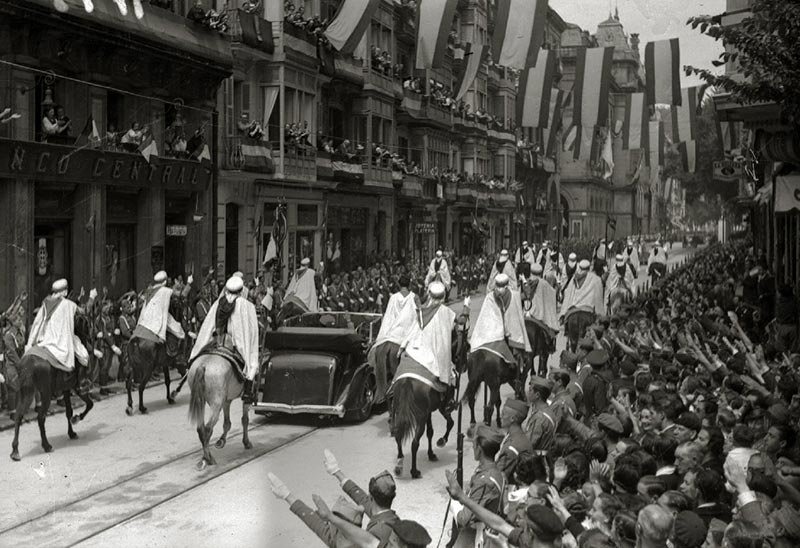
On April 1, 1939, the Spanish Civil War, which lasted for three years, concluded with the declaration of victory by the Nationalist forces led by General Francisco Franco. This war, which began in 1936, was the result of a struggle between the Republicans, who supported a democratic government, and the Nationalists who sought to establish an authoritarian regime. This war represented a turning point in the history of Spain and Europe, as it led to radical changes in the political and social landscape.
The Spanish Civil War was one of the bloodiest conflicts of the 20th century, resulting in the deaths of hundreds of thousands of people and widespread destruction across the country. It employed new methods of warfare, including aerial bombardment, making it one of the first modern wars.
Event Details
The Spanish Civil War began on July 17, 1936, when General Franco led a military rebellion against the Republican government. Although the Republicans were supported by the Soviet Union and some international volunteers, the Nationalists received significant backing from Nazi Germany and Fascist Italy. Violent battles continued until 1939, when the Nationalist forces managed to gain control over most of the country.
On April 1, 1939, Franco announced his victory, leading to the establishment of an authoritarian regime that lasted until his death in 1975. Spain experienced severe political repression during his rule, with many opponents being arrested and tortured.
Background & Context
The roots of the Spanish Civil War can be traced back to the political and social tensions that Spain faced during the 1930s. The country was suffering from deep divisions between the right and left, with conflicts over workers' rights, land reform, and the role of the church in society. These tensions ultimately led to the outbreak of conflict in 1936.
Furthermore, the Spanish Civil War was part of a broader struggle in Europe, representing a conflict between fascism and democracy. European countries closely monitored the situation in Spain, viewing the war as a test of different political systems.
Impact & Consequences
After the war, Franco established an authoritarian regime that lasted for decades, significantly impacting the political and social life in Spain. His rule continued to suppress political freedoms, leading to suffering for many Spaniards. The Spanish Civil War also left deep scars on the collective memory of the Spanish people, with wounds that remain open to this day.
Internationally, the Spanish Civil War served as a precursor to World War II, demonstrating how internal conflicts could have global repercussions. It also influenced leftist movements worldwide, being seen as a model for the struggle against fascism.
Regional Significance
Although the Spanish Civil War occurred far from the Arab world, it had indirect effects on the region. It inspired revolutionary movements in the Arab world, being viewed as a model for resistance against tyranny. The political and social conflicts experienced in Spain were similar to those faced by some Arab countries in later periods.
In conclusion, the Spanish Civil War remains a pivotal event in European history, marking a turning point in the trajectory of many nations. Understanding this conflict helps us grasp the political and social challenges that societies face even today.