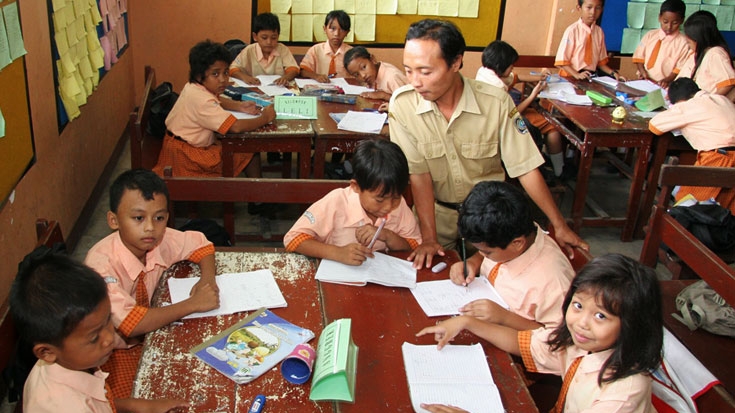
The World Bank has stressed the necessity of enhancing education quality and human resources as fundamental factors to support industry in Indonesia. In statements made by the bank's chief economist for the East Asia and Pacific region, Adiitya Mattoo, significant challenges facing basic education were highlighted, as many children struggle with reading and mathematics.
Mattoo added in an interview with Antara News Agency that the improvement of educational skills in the fields of science, technology, engineering, and mathematics (STEM) remains weak, negatively impacting Indonesia's ability to compete in the global market. He emphasized the importance of providing public infrastructure such as energy, ports, fiber-optic networks, and roads as essential factors to support this enhancement.
Details on Education Challenges
Mattoo explained that Indonesia has made notable progress in developing its infrastructure; however, there is an urgent need for further improvements. He pointed out that enhancing the human value chain must occur in parallel with infrastructure development, as quality education is the foundation upon which the economy relies.
He also called for the removal of policies that hinder economic activity, such as non-tariff barriers on goods and services. He affirmed that reforms in this area could lead to significant positive impacts on the business climate in the country.
Background & Context
Historically, Indonesia has suffered from weaknesses in its education system, which has affected its ability to develop a qualified workforce. Reports have shown that many students do not receive the quality education necessary to prepare them for the labor market. In recent years, the Indonesian government has sought to improve this situation through investments in education and curriculum development.
Indonesia is also facing multiple economic challenges, including the impacts of the COVID-19 pandemic on economic growth. The World Bank noted in its latest report that the Indonesian economy is expected to grow by 4.7% in 2026, which is lower than previous forecasts of 4.8%.
Impact & Consequences
Analyses indicate that improving education quality could lead to increased productivity and economic growth in Indonesia. If the government can address these issues, it may contribute to improving the business climate and attracting foreign investments. Furthermore, enhancing education can help reduce social and economic gaps within Indonesian society, thereby promoting social and political stability.
In conclusion, the World Bank's call to enhance education quality is not just about improving academic performance; it is about laying the groundwork for a more competitive economy and a more equitable society.
Regional Significance
The implications of these educational reforms extend beyond Indonesia, as a stronger workforce can enhance regional economic integration and cooperation. As Southeast Asia continues to evolve, the ability of its member states to adapt and innovate will be crucial for sustained growth and development.
Ultimately, the focus on education quality is a strategic move that could position Indonesia as a leader in the region, fostering a more resilient and dynamic economy.