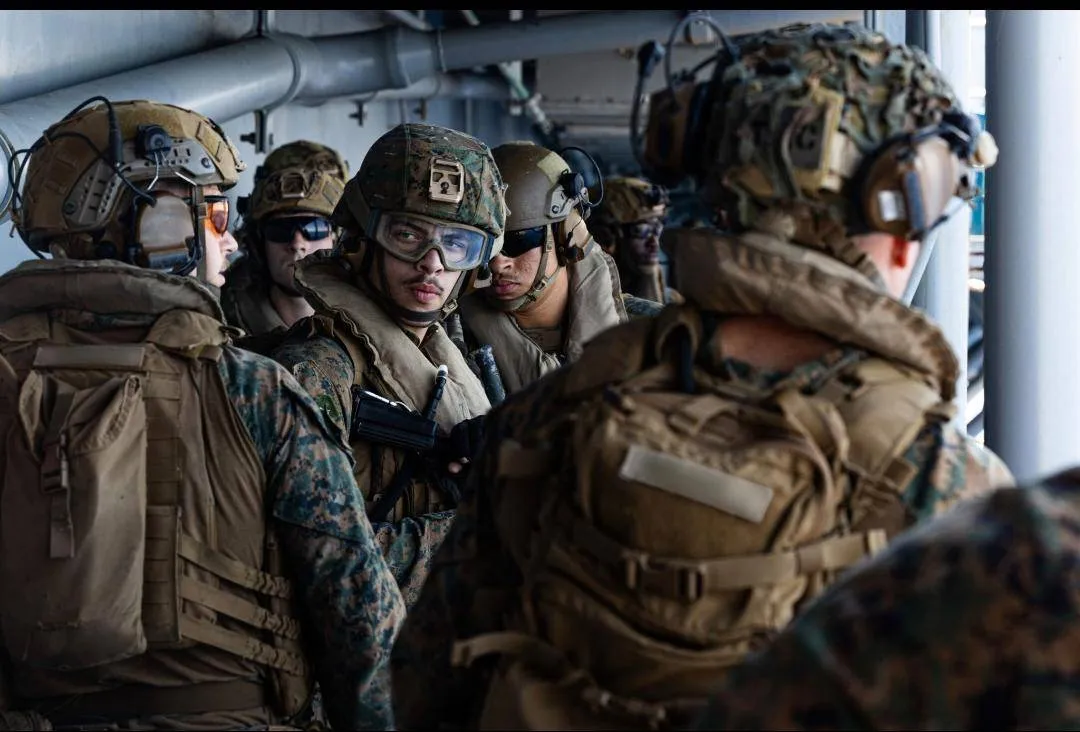
President Donald Trump has initiated a reinforcement of the US military presence in the Gulf region by sending additional naval vessels and troops. This decision comes at a time when the area is experiencing a notable escalation in tensions, especially with the ramping up of military operations by Iran and its allies.
The Wall Street Journal reported that US officials close to the White House stated that the Pentagon is considering sending an additional 10,000 troops to the Gulf, joining approximately 5,000 Marines, along with 2,000 paratroopers from the 82nd Airborne Division, who have already been ordered to deploy.
Details of the Military Reinforcement
The 31st Marine Expeditionary Unit has also arrived in the Middle East aboard the amphibious assault ship USS Tripoli, carrying around 3,500 sailors and soldiers, according to the US Central Command (CENTCOM). The military reinforcement is not limited to amphibious forces; a third US aircraft carrier, the USS George H.W. Bush, is heading to the Middle East after departing from Norfolk, Virginia, to join two other carriers already operating in the region.
Military analysts believe that this troop level is insufficient for a full-scale invasion of Iran, but it may allow for the execution of limited operations of strategic importance, such as targeting islands near the Strait of Hormuz. A month into the war, Iran has pushed its Houthi card into the ongoing conflict with the US and Israel; the group announced yesterday the launch of a batch of missiles towards Israel, while the latter reported intercepting a missile and a drone that came from Yemen, causing no damage.
Context and Background
These developments coincide with a meeting taking place today in the Pakistani capital, Islamabad, involving the foreign ministers of Saudi Arabia, Egypt, and Turkey, aimed at conducting in-depth discussions on a series of issues, including efforts to reduce tensions and escalation in the region. These talks come at a sensitive time, as the involved countries seek to find diplomatic solutions to the increasing crises.
On the ground, Saudi air defenses intercepted and destroyed 5 drones and a ballistic missile launched towards the Riyadh area, according to the official spokesman for the Ministry of Defense, Major General Turki al-Maliki. Additionally, Kuwait International Airport has faced several drone attacks, resulting in significant damage to the airport's radar system, without any reported human casualties.
Consequences and Threats
In light of these circumstances, the Iranian Revolutionary Guard threatened early this morning (Sunday) to target American universities in the Middle East, after reporting that US and Israeli strikes destroyed two universities in Iran. The Revolutionary Guard stated in a statement published by Iranian media: "If the US government wants these universities in the region to avoid retaliatory responses, it must condemn the bombing of the universities in an official statement before noon on Monday, March 30." The Revolutionary Guard also advised employees, professors, and students of American universities in the region to stay at least one kilometer away from universities that may be targeted.
Branches of several American universities exist in Gulf countries, such as Texas A&M University in Qatar and New York University in the United Arab Emirates. Reports indicated that explosions were heard in Tehran affecting the University of Science and Technology in the northeast of the city, causing damage to buildings without any injuries reported.
Regional Significance and Implications
In another development, Iran has agreed to allow an additional number of ships flying the Pakistani flag to transit through the Strait of Hormuz, according to the Pakistani Foreign Minister on Saturday. Ishaq Dar considered this step to be "a harbinger of peace" and that it "will contribute to enhancing stability in the region," as reported by the German News Agency. Pakistan shares a border of approximately 900 kilometers with Iran and has emerged as a mediator amid growing concerns over the widening conflict between the US and Israel on one side and Iran on the other.
In conclusion, these rapid developments in the Gulf reflect the increasing tensions between major powers in the region and highlight the importance of diplomacy and dialogue in addressing escalating crises.