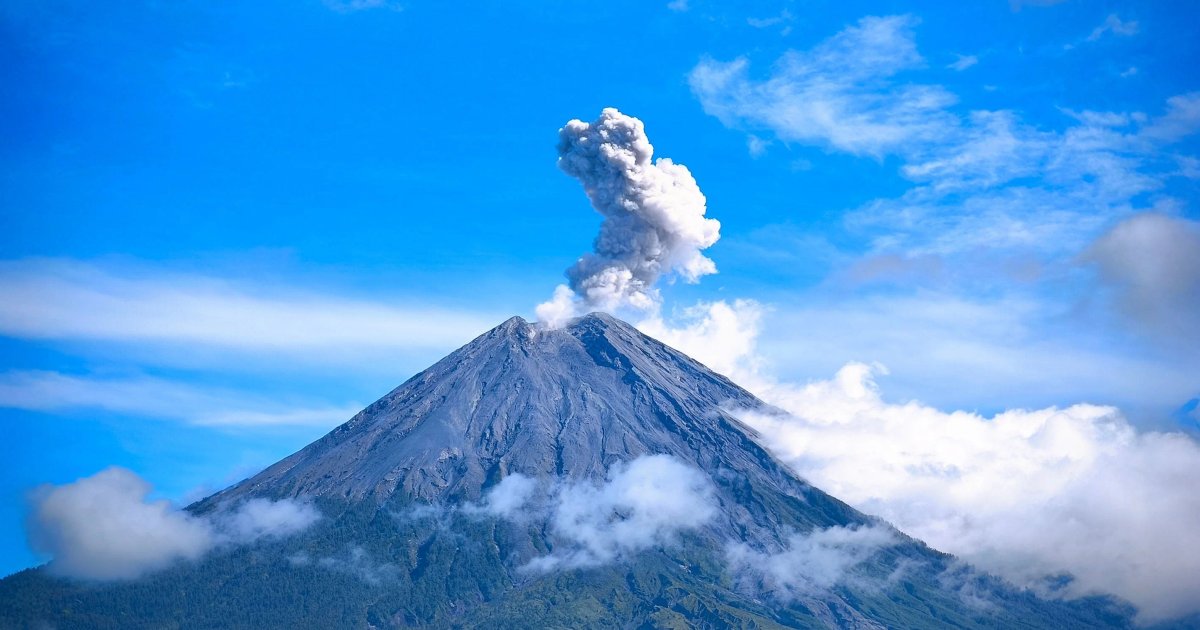
The eruption of Mount Semeru, located on the border between the districts of Lumajang and Malang in East Java, occurred on Sunday morning, releasing clouds of hot ash that extended 3.5 kilometers. This eruption was recorded at 02:02 local time, with the ash column reaching approximately 1,000 meters above the volcano's summit, equivalent to 4,676 meters above sea level.
According to statements from Yadi Yuliandi, the volcanic monitoring official, the ash column was notably dense and gray, drifting towards the west. The eruption was recorded on a seismograph, with vibration amplitudes reaching 22 mm and lasting for 3 minutes and 29 seconds.
Details of the Eruption Events
Following the initial eruption, the volcano experienced several other explosions, with a new eruption occurring at 06:55 local time, producing an ash column approximately 800 meters high. A white-gray ash column was also recorded, moving towards the southwest. At 07:02, another eruption took place, reaching 600 meters above the summit, followed by another eruption at 07:53 with a height of 800 meters. Observers were unable to see the eruption that occurred at 08:50 due to fog.
Currently, the volcanic activity of Mount Semeru is classified at alert level three, indicating a warning, which requires residents to avoid activities in the southeastern sector, 13 kilometers from the volcano's summit. Warnings have also been issued to stay at least 500 meters away from riverbanks in the area due to the potential for ash and lava flows.
Background & Context
Mount Semeru, the highest volcano on the island of Java, is one of the most active volcanoes in Indonesia. The country has a long history of volcanic activity, as the volcano is part of the Pacific Ring of Fire, a region known for seismic and volcanic activity. In recent years, Mount Semeru has experienced several eruptions, leading to the evacuation of local residents and destruction of some surrounding areas.
Historically, volcanic eruptions in Indonesia have had significant impacts on the environment and local communities, causing changes in local climate and destroying agricultural crops. Volcanic activity can also affect international air travel, as airspace is sometimes closed due to volcanic ash.
Impact & Consequences
Volcanic eruptions like those witnessed at Mount Semeru require swift responses from local authorities, as measures are taken to evacuate residents from threatened areas. These events raise concerns about the safety of local populations and impact the local economy, especially in sectors reliant on agriculture and tourism.
Furthermore, volcanic activity can have broader environmental impacts, potentially leading to water pollution and destruction of natural habitats. Volcanic ash can also affect air quality, posing risks to public health.
Regional Significance
Although Indonesia is far from the Arab world, natural events such as volcanic eruptions remind us of the importance of preparedness for natural disasters. These events highlight the need for international cooperation in research and studies related to volcanic activity and its effects.
Ultimately, Mount Semeru remains a symbol of nature's power, and the international community must be prepared to address the challenges posed by such natural phenomena.