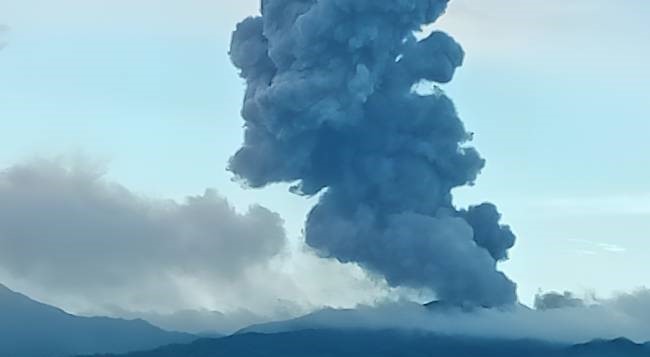
The Indonesian Volcanology Center reported that Gunung Dukono, located in North Halmahera, experienced a new eruption on Friday, releasing a cloud of volcanic ash that reached up to 4000 meters above the volcano's summit. The incident occurred at 17:28 West Indonesia Time, and volcanic activity continues.
According to statements from Bambang Sujiono, a staff member at the Volcanology Center, the ash cloud was a dense gray color and was blown northwest by prevailing winds in the area. The volcanic activity was recorded by seismograph instruments, which showed an increase in amplitude of 34 millimeters and an eruption duration of 95.41 seconds.
Details of the Eruption Event
This marks the second eruption of Gunung Dukono within a single day, as the volcano previously erupted at 11:06 AM, releasing an ash cloud that reached 1500 meters above the summit. Currently, the volcano's status is classified as Level II (Warning), indicating that volcanic activity remains unstable and may be accompanied by periodic ash eruptions.
Local authorities have urged residents and visitors to avoid approaching the Kawah Malupang Warirang area, which is considered the center of volcanic activity, with a danger zone established extending four kilometers around the volcano.
Background & Context
Gunung Dukono is one of Indonesia's active volcanoes, a country known for its many active volcanoes due to its geographical position on the Pacific Ring of Fire. Historically, Indonesia has experienced numerous significant volcanic eruptions, leading to substantial impacts on the environment and its population.
In recent years, volcanic activity in the region has increased, raising concerns among local residents and authorities. However, an effective monitoring system helps mitigate risks by providing essential information to the population.
Impact & Consequences
Volcanic eruptions can have negative effects on public health, particularly due to volcanic ash, which can affect the respiratory system. Therefore, officials have recommended that residents wear protective masks when necessary to shield themselves from inhaling ash.
Furthermore, volcanic activity may also impact air travel in the region, as ash clouds can lead to airport closures and flight disruptions. It is crucial to follow updates from local authorities regarding the situation.
Regional Significance
While this event may seem distant from the Arab region, the effects of natural disasters such as volcanic eruptions can extend beyond geographical borders. Climate changes and volcanic activity can influence weather patterns, potentially having indirect effects on Arab countries.
In conclusion, Gunung Dukono remains under observation as authorities continue to assess the situation and provide necessary guidance to residents. It is important for everyone to stay informed about developments to ensure public safety.