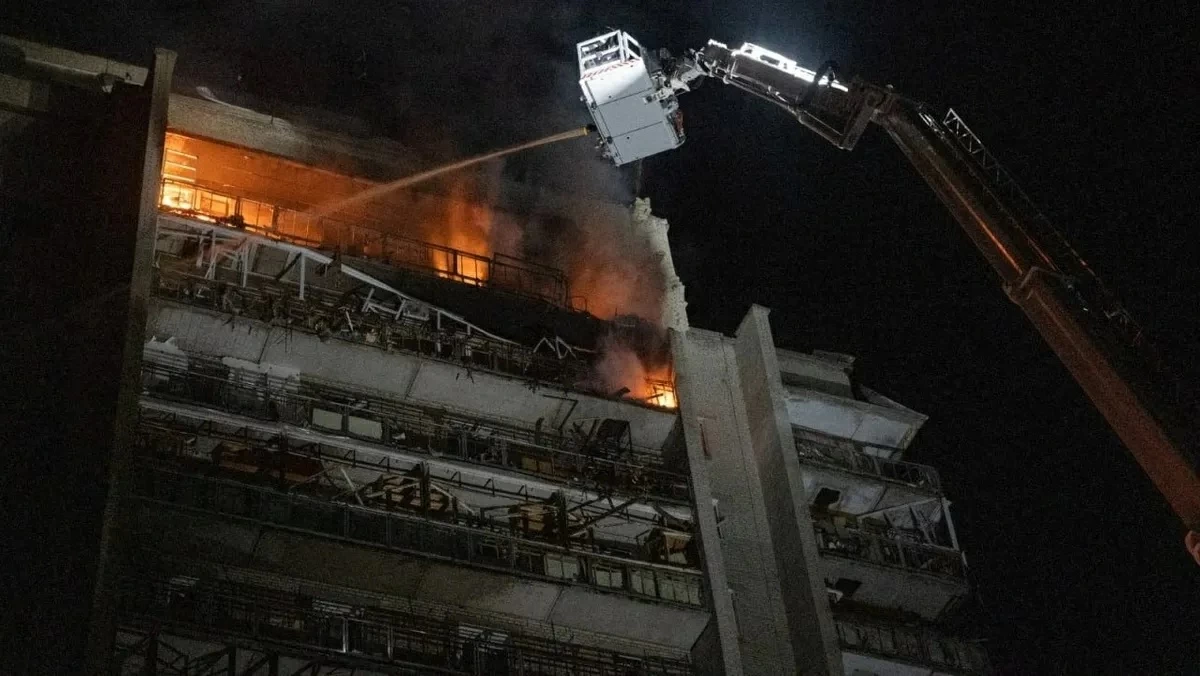
The war between Russia and Ukraine continues unabated, with military forces from both countries engaging in mutual shelling, reflecting an escalating conflict that has persisted since 2022. In the latest developments, the Russian Ministry of Defense announced that debris from a Ukrainian drone struck a foreign-flagged cargo ship in the Sea of Azov, near the city of Taganrog.
According to the governor of the Russian Rostov region, Yuri Slyusar, the ship sustained damage from the falling debris, resulting in a fire that was later brought under control. He also noted that the attack resulted in the death of one person and injuries to four others, in addition to damage caused by missile strikes targeting warehouses belonging to a logistics company.
Details of the Incident
In contrast, Ukrainian authorities reported that a Russian drone attack targeted a market in the city of Nikopol, located on the Dnieper River in the Dnipropetrovsk region, resulting in the deaths of five people and injuries to 19 others. These developments come at a time when hopes for a diplomatic resolution to the conflict are waning, especially with the U.S. administration preoccupied with other crises, such as the war in Iran.
In a related context, the Russian Ministry of Defense announced that its air defenses managed to shoot down 85 Ukrainian drones across approximately 12 regions during the night. Meanwhile, Ukrainian sources reported targeting launch and preparation sites for Shahed drones in the Bryansk and Kursk regions within Russia. The city of Tolyatti, located on the Volga River, also faced drone attacks, causing damage to industrial facilities and residential buildings.
Background & Context
Since the onset of the conflict in 2022, relations between Russia and Ukraine have deteriorated significantly, with the intensity of fighting markedly increasing. Several factors have contributed to the worsening situation, including Western military support for Ukraine, which has enhanced the Ukrainian forces' ability to counter Russian attacks. The diminishing hopes for diplomatic solutions reflect the complexities of the geopolitical situation in the region.
In recent weeks, mutual attacks have escalated, leading to numerous casualties. Observers note that this escalation could exacerbate humanitarian conditions in both countries, especially with rising numbers of displaced individuals and civilian casualties.
Impact & Consequences
The ramifications of the conflict extend beyond the borders of Russia and Ukraine, affecting security and stability across the entire region. The escalation of fighting could lead to increased tensions among major powers and heighten the likelihood of external military interventions. Furthermore, the ongoing mutual shelling may hinder humanitarian relief efforts and increase civilian suffering.
Moreover, the escalation of the conflict could impact global energy and food markets, as Russia and Ukraine are among the largest producers of wheat and gas. Any disruptions in these markets could lead to rising prices and increased economic pressures on other countries.
Regional Significance
Arab countries are directly affected by the consequences of the Russia-Ukraine conflict, particularly in the areas of food security and energy. The rise in wheat and gas prices due to the conflict may negatively impact the economies of Arab nations, which heavily rely on imports. Additionally, any military escalation could lead to increased tensions in the region, threatening stability.
In conclusion, the situation in Ukraine and Russia remains tense, with ongoing military operations and mutual escalation. The current situation requires urgent international efforts to achieve a peaceful resolution that ensures security and stability in the region.