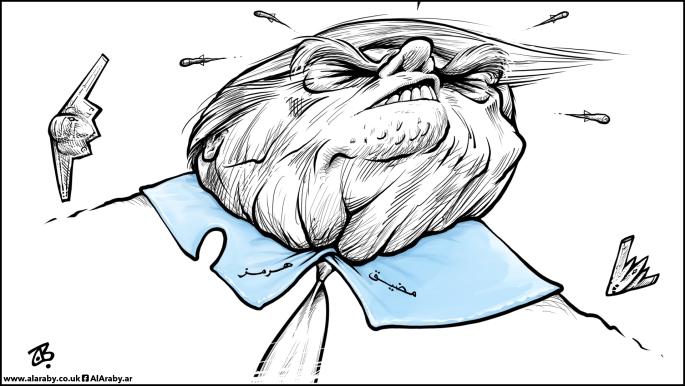
Concerns are rising over a potential military escalation in the Middle East as U.S. President Donald Trump collaborates with Israel to confront Iran. This situation echoes the Iraq War led by former President George W. Bush in 2003.
Amid increasing tensions, numerous questions arise regarding the political and military dimensions of this alliance and whether it will lead to outcomes similar to those witnessed in the early 21st century.
Details of the Situation
The U.S. administration has announced its increased support for Israel in the context of the escalation against Iran, accusing Tehran of supporting armed groups in the region, which threatens regional stability. This comes at a time when U.S.-Iran relations are at an unprecedented tension following Trump's withdrawal from the nuclear deal in 2018.
Israel, for its part, is seeking to bolster its military position in the region, having conducted several airstrikes on Iranian sites in Syria, further heightening tensions. Trump has repeatedly affirmed his commitment to protecting Israel, reflecting a new U.S. strategy in the region.
Background & Context
The roots of the U.S.-Iran conflict date back decades, with relations between the two countries deteriorating significantly since the Iranian Revolution in 1979. Since then, Iran has viewed the United States as a major adversary, leading to a series of conflicts and disputes in the region.
In 2003, former President George W. Bush led a war against Iraq, claiming that Saddam Hussein's regime possessed weapons of mass destruction and posed a threat to global security. Although that war had significant repercussions for Iraq and the region, many observers believe the outcomes were catastrophic, raising concerns about a repeat of the same scenario in the current escalation.
Impact & Consequences
If tensions continue to escalate, it could lead to serious repercussions for regional and international security. Oil prices may be significantly affected, impacting the global economy, especially given many countries' heavy reliance on Iranian oil.
Moreover, military escalation could exacerbate humanitarian crises in the region, where many countries are suffering from ongoing conflicts, increasing civilian suffering. This could lead to a further influx of refugees into neighboring countries, placing additional pressures on those nations.
Regional Significance
Arab countries are directly affected by any military escalation in the region, as many of them are experiencing internal conflicts. The escalation between the U.S. and Iran could increase sectarian and ethnic divisions in Arab nations, complicating peace and stability efforts.
Furthermore, Arab countries seeking to improve their relations with Iran may find themselves in a precarious position, having to balance their national interests with U.S. pressures. This situation could lead to changes in political alliances in the region, affecting the future of Arab-Iranian relations.
In conclusion, the situation in the Middle East remains complex and requires effective diplomacy to resolve existing conflicts. As Trump and Israel continue to confront Iran, history teaches us that escalation can lead to unforeseen outcomes, necessitating caution and deliberation in decision-making.