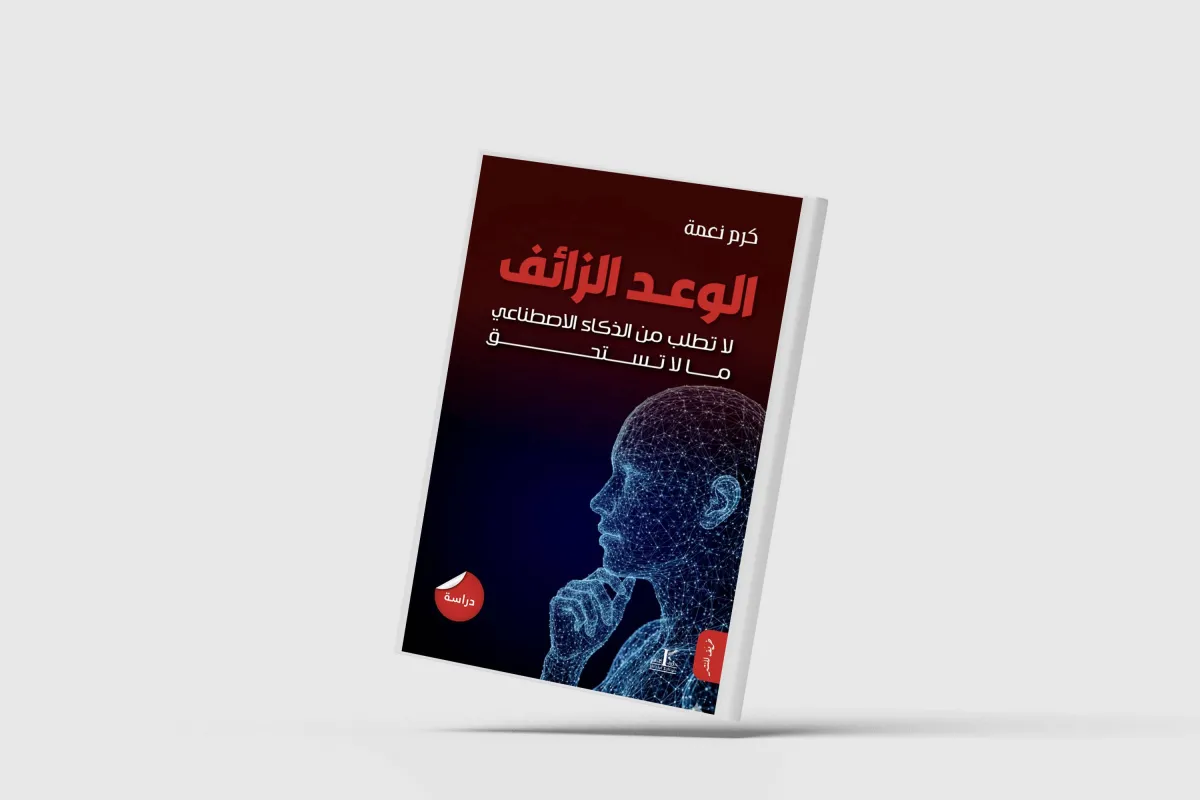
In his new book 'The False Promise: Don't Ask AI for What You Don't Deserve', published by Khareef Publishing in Tunisia at the beginning of 2026, Iraqi writer and journalist Karam Naama presents an intellectual work that straddles philosophy, literature, and cultural criticism. The book does not merely question artificial intelligence as a technological phenomenon; it reframes it as a symbolic story about humanity facing the illusion of perfection, in a time when the boundaries between imagination and programming, and between desire and knowledge, are diminishing.
From the very first pages, Naama confronts the reader with a central paradox: artificial intelligence, which began as a supportive tool for humans, now threatens their essence, namely their ability to think and express themselves. In the introduction, he recalls the experience of the British newspaper 'The Guardian' in 2020 when it assigned an automated program to write an editorial, marking the moment of the birth of the 'false promise' that offers ease and completeness while robbing us of meaning. This tension between temptation and danger forms the core of the book, where technology becomes a mirror revealing human fragility in the face of its own promises.
Event Details
In this view, artificial intelligence is not just a program; it is a re-narration of the world, where the algorithmic maze is replaced by a ready-made outcome. Naama states, 'The machine presents us with the end without a beginning, the result without struggle,' a phrase that encapsulates the entire ethical stance of the book. Under the title 'Usurpation of Our Intellectual Property', the author shifts to the cultural reality, detailing how language models have begun to feed on human texts to produce content without authorship. He cites experiences of Western novelists and journalists, such as Kate Moss and Andrew Hill, warning that 'digital abundance' could turn into a new form of literary plunder.
He then poses a deeper question: Can creativity continue in a world where human experience is reduced to training data? In 'Descartes' Intuition in Artificial Intelligence', the author revisits the age-old question 'Does AI think?' from a human, rather than a technical, perspective, reviewing the opinions of scientists like Yoshua Bengio on bridging the gap between human and artificial thinking. However, he concludes that the machine, no matter how advanced, remains incapable of grasping meaning because it knows neither doubt nor experience, which are the essence of human thought from Descartes to the present.
Background & Context
In this sense, the book becomes a defense of 'consciousness' rather than 'intelligence', and of 'spirit' rather than 'function'. The author believes that the real danger lies not in machines thinking, but in our ceasing to think. Naama connects 'One Thousand and One Nights' with algorithms, between Shahryar and 'ChatGPT', asserting that ancient myths preserved meaning through resistance, while modern algorithms kill meaning through speed. This comparison gives the book a profound literary dimension, as artificial intelligence transforms into a symbolic character in the narrative of contemporary humanity, rather than merely a scientific subject.
From a critical perspective, it can be said that 'The False Promise' offers a coherent intellectual reading in poetic language, yet it is not devoid of a cautionary tone that may seem pessimistic to technology advocates. Nevertheless, the strength of the book lies in its ability to transform fear into a philosophical question rather than an ethical stance. It does not condemn artificial intelligence but uses it as a mirror to examine humanity itself, revealing that the danger lies not in the machine, but in our desire for the machine to be our complete reflection.
Impact & Consequences
Ultimately, Karam Naama presents a work that can be read on multiple levels: as a cultural analysis of technology's impact on creativity, as a philosophical reflection on the meaning of desire and knowledge, and as a literary statement about human fragility in the face of its promises. It is a book that reminds the reader that artificial intelligence is not a promise of salvation, but a new test of consciousness, and that humanity, no matter how advanced, must still defend its right to remain incomplete, for incompleteness, as Naama implicitly suggests, is the first condition for meaning.
Regional Significance
The importance of this book is evident in the context of the rapid technological transformations occurring in the region, where Arab society faces new challenges related to identity and culture. The discussion about artificial intelligence and its impact on creativity and human consciousness opens new horizons for understanding the relationship between technology and humanity, necessitating a rethinking of how these technologies can be used to serve humanity.
In the conclusion of the book, Karam Naama calls for the preservation of human consciousness in the age of artificial intelligence, highlighting the importance of critical thinking and creativity as essential elements in facing future challenges.