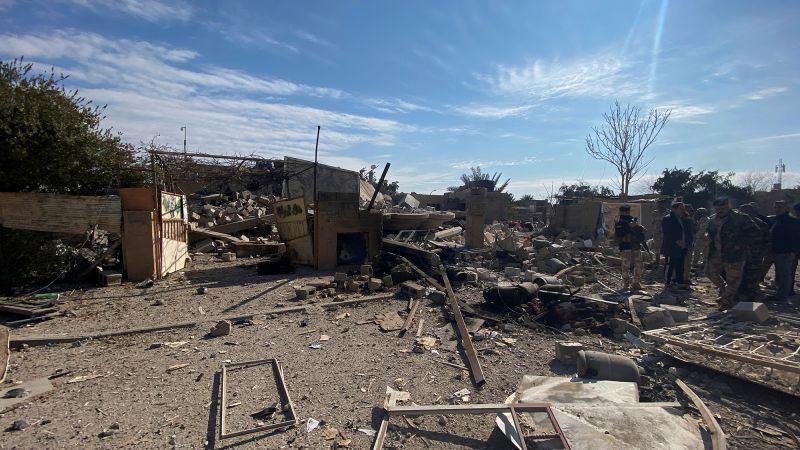
Five members of the Iraqi police and Popular Mobilization Forces were killed in airstrikes targeting various areas in Mosul and Kirkuk on Saturday, reflecting rising security tensions in Iraq. Meanwhile, the Kurdistan Region of Iraq faced several drone attacks, with one drone targeting the home of the region's president, Nechirvan Barzani, while air defenses shot down another drone near the residence of Kurdish leader Masoud Barzani.
In a statement, the Iraqi Ministry of Interior confirmed the deaths of two of its personnel due to what it described as "Zionist-American aggression" on the city of Mosul. The ministry reported that the attack targeted a point belonging to the First Emergency Police Regiment, resulting in the death of Colonel Omar Mahmoud Khalaf Ismail, the regiment commander, and officer Rafi Abdullah Ahmed, in addition to injuring five others while they attempted to rescue their wounded colleagues.
Details of the Incident
On another front, the Popular Mobilization Forces announced the death of three of their members in an airstrike targeting their headquarters in Kirkuk province. The Popular Mobilization Forces clarified in a statement that the Northern and Eastern Tigris Operations Command headquarters was subjected to an aerial assault with three strikes, leading to the martyrdom of three fighters and injuring four others as an initial toll.
Additionally, Iraqi security sources reported that air defenses shot down a drone near the residence of Kurdish leader Masoud Barzani in Erbil. Earlier in the day, the home of Kurdistan Region President Nechirvan Barzani in Duhok province was attacked by a drone, but no human casualties were reported.
Background & Context
These events come amid escalating tensions in the region, as the U.S.-Israeli war against Iran intensifies, leading to serious repercussions for Iraq. The U.S. State Department condemned the attacks, labeling them as "terrorist" actions by Iran-affiliated militias, noting that these attacks target the stability of Iraq and the Kurdistan Region.
In a related context, French President Emmanuel Macron emphasized the need to make efforts to avoid escalating situations in Iraq, underscoring the importance of Iraq's sovereignty, including that of the Kurdistan Region, for regional stability. Iraqi Prime Minister Mohammed Shia' al-Sudani also directed the summoning of the U.S. Chargé d'Affaires in Baghdad to deliver a note of protest regarding the killing of Iraqi military personnel in strikes in the western part of the country.
Impact & Consequences
Concerns are growing over the escalation of violence in Iraq, as these attacks affect the security and stability of the country. These events may provoke strong reactions from the Iraqi government, potentially leading to heightened tensions with both the United States and Iran.
Furthermore, these incidents could impact relations between the Kurdistan Region and Baghdad, as there is increasing worry that rising violence may deepen the divide between the two sides, negatively affecting dialogue and cooperation efforts.
Regional Significance
The recent events in Iraq are part of a series of escalating tensions in the region, where regional and international interests intersect in complex ways. These developments could lead to negative repercussions for regional security, threatening the stability of neighboring countries.
In conclusion, the situation in Iraq remains under close observation, as the current state of affairs requires a swift response from the international community to ensure that conditions do not worsen and to achieve stability in the region.