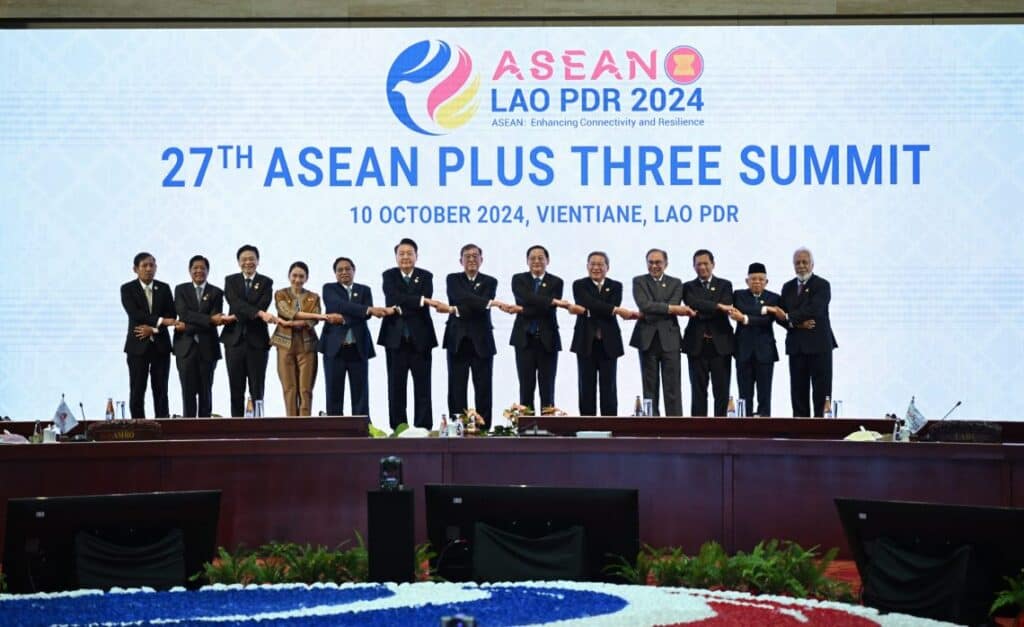
The ASEAN +3 Macroeconomic Research Office (AMRO) in Singapore has announced that economic growth in the ASEAN +3 region, which includes ASEAN countries along with China, Japan, and South Korea, is expected to decline to 4% in 2026 and 2027, down from 4.3% in 2025.
This forecast comes amid a decrease in external demand, as the United States has begun implementing new tariffs, negatively impacting regional exports and leading to a slowdown in global trade.
Details of the Situation
AMRO indicated that the widespread implementation of tariffs by the United States will reduce demand for American goods, which will directly affect exports from ASEAN +3 countries. Additionally, the slowdown in global trade is expected to persist due to stockpiling of goods resulting from tariffs in 2025.
Moreover, the adjustments that businesses are making in response to these tariffs, along with the restructuring of supply chains amid political uncertainty, may lead to decreased trade efficiency and increased production costs.
Background & Context
The ASEAN +3 region is considered one of the fastest-growing areas in the world, relying on trade as a primary driver of economic growth. However, global trade tensions, particularly between the United States and China, have significantly impacted market dynamics in this region.
Historically, ASEAN +3 countries have experienced sustainable growth due to the increasing global demand for electronic products and technology. However, changes in global trade policies may present these countries with new challenges.
Impact & Consequences
These forecasts are expected to have negative effects on investments in the region, as companies may hesitate to expand their operations amid uncertainty. Furthermore, the slowdown in growth could impact job opportunities and citizens' purchasing power.
Nevertheless, investments in technology sectors, such as artificial intelligence and data centers, may provide some hope for sustainable growth, as demand for electronic products is expected to continue.
Regional Significance
Trade relations between Arab countries and ASEAN +3 nations are significant, as changes in economic growth in this region can affect exports and imports between both sides. Additionally, the slowdown in growth may impact Arab investments in these countries.
In conclusion, the current situation requires Arab nations to closely monitor economic developments in the ASEAN +3 region, as there may be new opportunities in the fields of technology and trade.