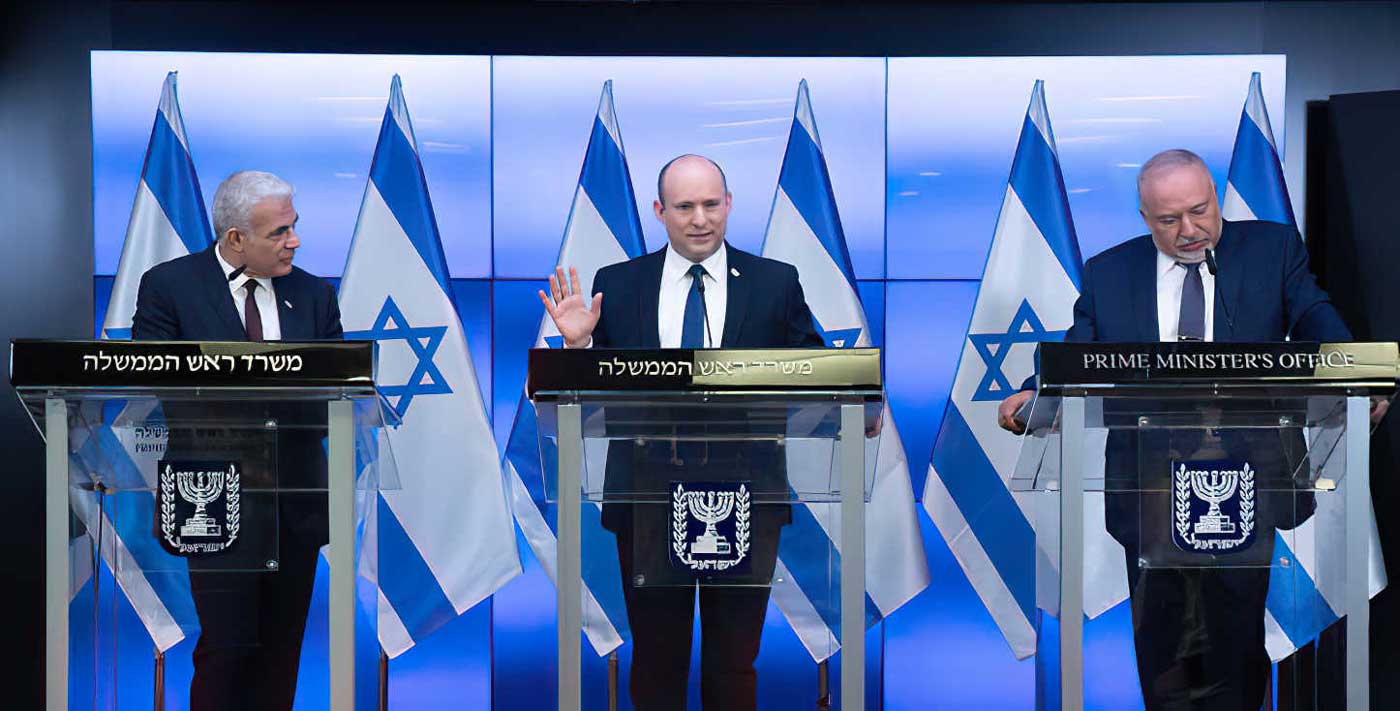
As the Israeli elections draw near, a new political landscape is forming with the coalition between former Prime Ministers Naftali Bennett and Yair Lapid, sparking debate about the stance of Arab parties regarding this alliance.
In light of the escalating political rhetoric, the United Arab List and some Arab figures have expressed their support for any coalition aiming to isolate Prime Minister Benjamin Netanyahu. In this context, the Likud Party has intensified its attacks on the Bennett-Lapid coalition, accusing it of relying on the support of Arab parties, in a discourse described as inflammatory towards Arab representation in the Knesset.
Details of the Event
Last Sunday, Bennett and Lapid, who formed a coalition government with Arab participation in 2021, announced their alliance for the upcoming elections, expected to take place later this year, with the goal of ousting Netanyahu.
In this context, the Likud Party published a digitally altered image using artificial intelligence techniques, depicting Arab Knesset member Mansour Abbas driving a vehicle carrying Bennett and Lapid, which sparked widespread reactions in political circles.
Background & Context
These developments come at a time when opinions vary regarding the nature of new alliances and their potential impact on the political conflict map in Israel. Some view them as reflecting fundamental changes, while others consider them merely a redistribution within closely aligned camps.
Political analyst Taha Ighbariya pointed out that the coalition between Bennett and Lapid, along with the support of certain Arab factions, is part of a reshaping of the political map that does not reflect substantial differences between Israeli camps, but rather competition within a closely aligned ideological framework.
Impact & Consequences
Ighbariya believes that the new coalition may be more likely to intersect with some Arab factions in the Knesset, given its focus on domestic issues and civil demands, compared to the rhetoric of the far-right led by Netanyahu.
He also noted that this coalition could provoke disparities within the Arab parties themselves, making their stance on any future government a matter of internal dispute. Polls indicate that the Bennett-Lapid coalition needs the support of at least one Arab list to secure a parliamentary majority.
Regional Significance
In light of these developments, researcher on Israeli affairs Amir Makhol believes that the political behavior of Arab parties should be understood through their internal balances, rather than holding them responsible for the outcomes of elections.
Makhol also warned against a simplistic reading that assumes any governmental change will automatically improve the conditions for Palestinians, emphasizing the need to analyze the implications of future Israeli alliances on settlement issues and regional relations.
In conclusion, Mansour Abbas, head of the United Arab List, confirmed that the Israeli campaign against Arab lists is part of a political escalation targeting this list, stressing the continued efforts to form a joint Arab list to enhance political representation.