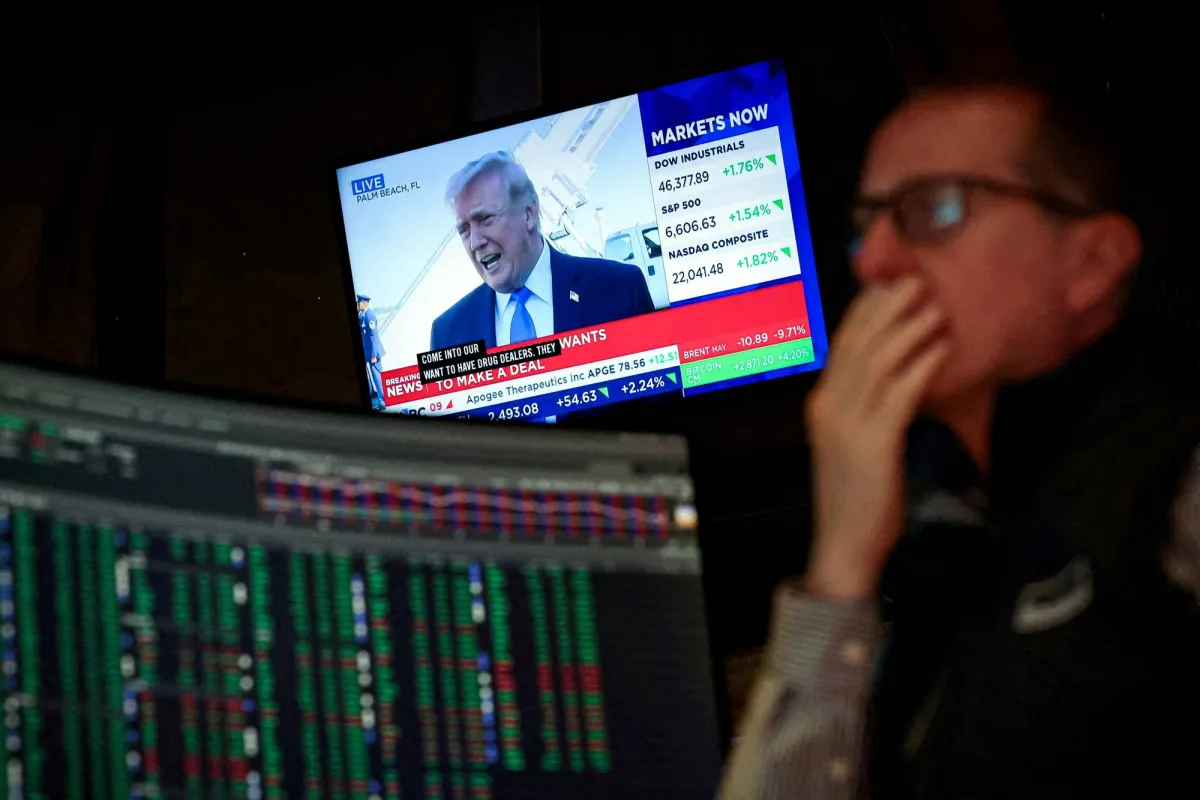
Futures tracking major Wall Street indices declined on Thursday, in the last session of a short week due to the holiday, after U.S. President Donald Trump indicated the possibility of more aggressive attacks on Iran. These statements lowered expectations for a quick end to the conflict in the Middle East, leading to a downturn in financial markets.
In a speech delivered on Wednesday, Trump confirmed that military operations would intensify over the next two to three weeks. This came a day after his remarks to Reuters that the United States would withdraw from Iran "very quickly." He also hinted at the possibility of targeting Iranian energy infrastructure, which pushed oil prices up by about 7%, bringing Brent crude to $108 a barrel. In contrast, shares of U.S. energy companies rose, with shares of Exxon Mobil and Chevron recording increases of 3% and 2.6% respectively in pre-market trading.
Event Details
Ross Mould, investment director at AJ Bell, stated: "Uncertainty represents a weakness in the markets, and between the conflicting messages from Trump, the disputed claims from both sides, and the lack of a clear plan to resolve the dispute, the markets are under significant pressure." However, the three Wall Street indices are expected to record their largest weekly gain in four months, marking this week as their first gains in six months, after markets previously welcomed signs of an impending end to the war.
As of 4:53 AM Eastern Time, futures for the Dow Jones fell by 443 points, or 0.95%, while futures for the S&P 500 dropped by 75.25 points, or 1.14%. The Nasdaq 100 index also declined by 357.75 points, or 1.48%. Meanwhile, the Russell 2000 index, sensitive to interest rates, fell by 1.5%, and the market volatility index rose by 1.86 points to 26.40.
Background & Context
The uncertainty surrounding the timeline and objectives of the conflict led to a decline in global markets in March, with the S&P 500 and Nasdaq recording their largest monthly losses of the year. At the same time, Brent crude prices achieved their strongest monthly performance ever. Concerns that rising energy costs could reignite inflationary pressures have increased uncertainty regarding the Federal Reserve's monetary policy outlook.
Market participants expect no easing from the Federal Reserve this year, after earlier expectations indicated the possibility of two rate cuts before the war began. Bets later reflected a 50% chance of a rate hike in December.
Impact & Consequences
Attention is now focused on developments related to SpaceX, Elon Musk's company, which filed a confidential initial public offering in the U.S. on Wednesday, aiming for a market valuation of $1.75 trillion. Shares of smaller competing companies, such as Rocket Lab, Planet Labs, and Intuitive Machines, also saw gains on Wednesday in anticipation of renewed investor interest in the sector.
On the data front, the release of the non-farm payrolls report on Friday will be preceded by a weekly reading of unemployment claims, while U.S. markets will remain closed in observance of Good Friday. Additionally, remarks from Dallas Fed President Lorie Logan will be monitored later in the day.
Regional Significance
Arab markets are significantly affected by geopolitical tensions, as any military escalation in the Middle East could impact oil price stability, and thus the economies of Arab countries reliant on oil exports. Furthermore, fears of escalating conflict could lead to increased inflationary pressures in the region, prompting Arab governments to take precautionary measures to protect their economies.
In conclusion, financial markets remain under continuous pressure due to political uncertainty and military tensions in the region, necessitating close monitoring of upcoming developments.